Why Choose Oman for Your Business?
Oman has steadily emerged as one of the most attractive destinations for entrepreneurs and investors in the Gulf region. With its strategic location connecting Asia, Africa, and Europe, a stable political environment, and progressive economic reforms under Vision 2040, the Sultanate offers a welcoming ecosystem for both local and foreign businesses.
The country now allows 100% foreign ownership in most sectors following reforms to the Foreign Capital Investment Law, competitive corporate tax rates, no personal income tax, and access to free zones with customs duty exemptions and full repatriation of profits. Oman's GCC membership broadens regional market access, while WTO membership ensures a transparent trading environment.
Choose Your Business Activity
The Ministry of Commerce, Industry and Investment Promotion (MOCIIP) maintains a comprehensive list of permitted activities, each classified under specific codes. Your chosen activity determines which authority you need approvals from, what license type you require, and whether your business falls under restricted or open sectors. Activities related to oil and gas, defense, or certain professional services may require additional approvals from specialized ministries. Consult a business setup expert at this stage to align your selection with Omani regulations.
Select the Right Legal Structure
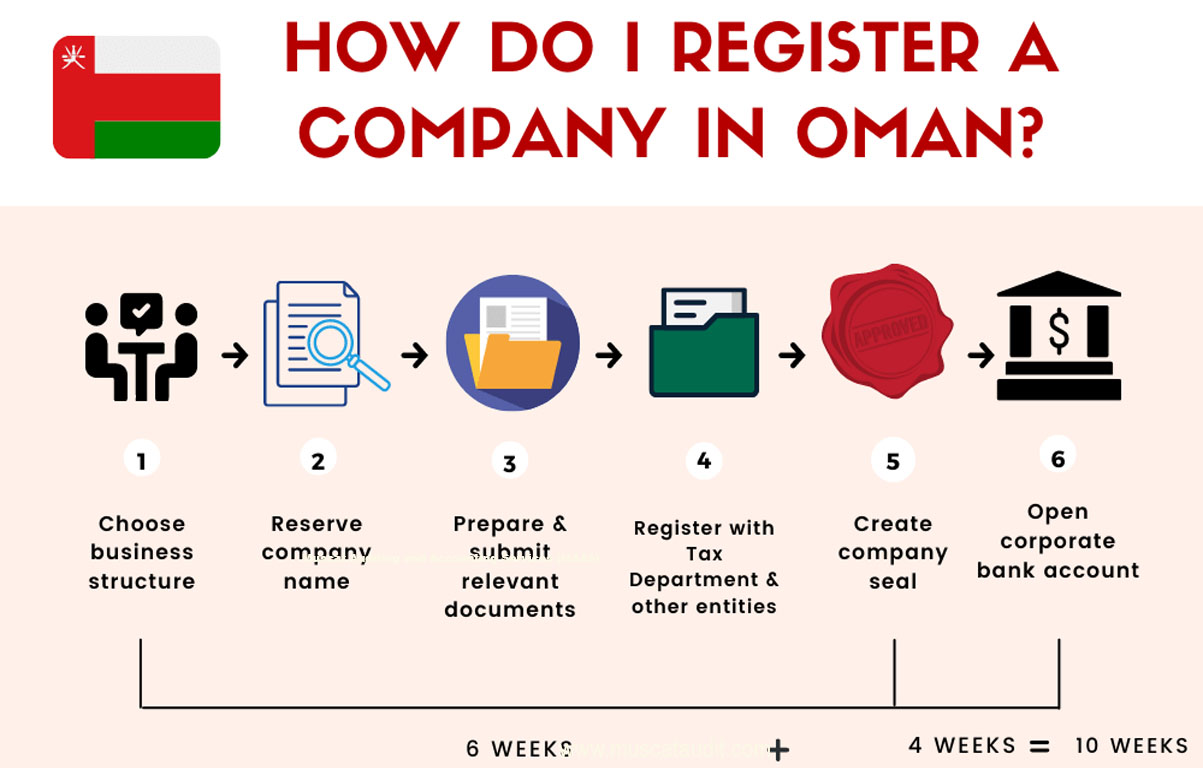
Selecting the appropriate structure depends on the number of shareholders, liability preferences, capital requirements, and the nature of your activities. The most common types are outlined below.
Ideal for foreign investors. Offers limited liability protection with a minimum of two shareholders (single-shareholder structures now permitted in many cases). No mandatory minimum capital for most activities.
Suited for individual Omani nationals or GCC citizens. Foreign nationals may establish these under certain conditions. Simple structure with full personal liability.
Allows a foreign company to operate in Oman without forming a separate legal entity. Commonly used by companies executing specific government contracts.
Permits market research and promotional activities only. Does not allow commercial transactions or revenue generation within Oman.
For larger enterprises raising capital. SAOG companies are publicly traded; SAOC companies are closed joint stock companies.
100% foreign ownership, customs duty exemptions, tax holidays, and streamlined import-export procedures within Oman's designated free zones.
Reserve Your Trade Name
Reserve a unique trade name through the Invest Easy portal, MOCIIP's online platform. The name must not conflict with existing registered names, violate public morals or religious sentiments, or misrepresent your business nature. The system checks availability and reserves the name for a specified period during which you must complete registration.
Draft the Memorandum of Association (MOA)
The MOA outlines your company's structure — shareholders, share capital distribution, business activities, management, and the rights of each partner. For LLCs, the MOA must be in Arabic and notarized by a licensed notary public. Work with a local legal consultant to ensure compliance with the Omani Commercial Companies Law. Any future changes to shareholding, capital, or activities require MOA amendments.
Register with MOCIIP
Submit your documents through the Invest Easy portal or in person at MOCIIP offices. Required documents include the notarized MOA, copies of shareholders' passports or Civil IDs, proof of registered office address, and details of authorized signatories. Upon review, MOCIIP issues your Commercial Registration (CR) certificate — your official proof of legal registration and the unique number required for all subsequent transactions.
Obtain Necessary Approvals and Licenses
Depending on your activity, additional approvals from relevant government bodies may be needed before commencing operations. For example, food and beverage businesses need Ministry of Health or municipal approval; financial services companies require Central Bank of Oman or Capital Market Authority licensing; healthcare facilities need Ministry of Health clearance; and educational institutions require Ministry of Education authorization. Identify these requirements early to avoid delays.
Register with the Tax Authority
All businesses must register with the Oman Tax Authority for corporate income tax purposes. If your supply of goods or services exceeds the mandatory registration threshold, VAT registration (introduced in Oman in 2021) is also required through the Tax Authority's online portal. Upon successful registration, you receive a Tax Identification Number (TIN).
Open a Corporate Bank Account
Banks typically require your CR certificate, MOA, shareholder identification, a board resolution authorizing account opening, and proof of registered address. Account opening can take a few days to a few weeks depending on the bank and your company structure. Some banks offer expedited services for free zone companies or businesses with established GCC banking relationships.
Register with PASI
If hiring employees, register with the Public Authority for Social Insurance (PASI) to ensure Omani employees receive social security benefits, including pensions and end-of-service entitlements. For expatriate employees, employers must still comply with Omani Labor Law provisions regarding end-of-service benefits and other entitlements.
Apply for Visas and Labor Clearances
For expatriate employees, obtain labor clearances and visa quotas from the Ministry of Labour. This involves determining your labor quota, applying for work permits, and processing residency visas through the Royal Oman Police. Each expatriate employee requires a valid employment visa, residency permit, and Civil ID card. The process typically involves medical fitness tests, document attestation, and biometric registration.
Obtain Municipality Approvals
Depending on your business location and activity, approvals from the local municipality may be needed. This includes ensuring premises comply with building codes and safety regulations, obtaining a municipality license for commercial activities, and securing approvals for signage or structural modifications.
Register for Industry-Specific Memberships
Most companies are required to register with the Oman Chamber of Commerce and Industry (OCCI), which represents the private sector and provides services including certificates of origin for export activities. Certain business activities may also require membership in other relevant industry bodies.
Special Considerations for Free Zone Companies
If you've chosen to establish your business within one of Oman's free zones, the registration process differs from mainland company registration. Each zone has its own authority and "one-stop-shop" registration process.
Oman's Major Free Zones & Special Economic Zones
These zones offer 100% foreign ownership, tax holidays of up to 30 years for certain activities, and full customs duty exemptions — making them ideal for manufacturing, logistics, and re-export businesses.
Common Challenges & How to Avoid Them
While Oman has made significant strides in simplifying business registration, foreign investors often encounter certain hurdles.
- Language Barriers Official documents must be in Arabic. Professional translation and legal services are essential for foreign investors navigating the process.
- Scope of Required Approvals Understanding the full scope of approvals required for your specific activity can be complex, as some sectors require layered approvals across multiple ministries.
- Cultural & Business Etiquette Building relationships with local partners and government officials is highly valued in Oman and can significantly impact business success. Invest time in relationship-building.
- Keeping Up with Regulatory Changes Oman's business laws are evolving rapidly as part of Vision 2040 reforms. Staying updated on regulatory changes is crucial for ongoing compliance.
Post-Registration Compliance Requirements
Once your company is registered and operational, ongoing compliance is essential for maintaining good standing with Omani authorities. This includes annual renewal of your CR certificate, maintaining accounting records in accordance with International Financial Reporting Standards (IFRS), filing annual tax returns with the Tax Authority, conducting statutory audits (mandatory for certain company types and sizes), and renewing various licenses and permits as required.
Companies should also stay informed about Economic Substance Regulations (ESR) requirements, which apply to certain types of businesses and require demonstrating that the company has substantial economic activity within Oman.
Conclusion
Registering a company in Oman involves multiple steps — from selecting your business activity and legal structure to obtaining various approvals and licenses from government authorities. While the process has been significantly streamlined through digital platforms like Invest Easy, the involvement of multiple government bodies and sector-specific requirements means that careful planning and professional guidance remain essential.
Oman's progressive economic policies, strategic location, and welcoming attitude toward foreign investment make it an increasingly attractive destination for businesses across various sectors. With the right approach and expert support, establishing a successful business in Oman can open doors to opportunities across the Gulf region and beyond.