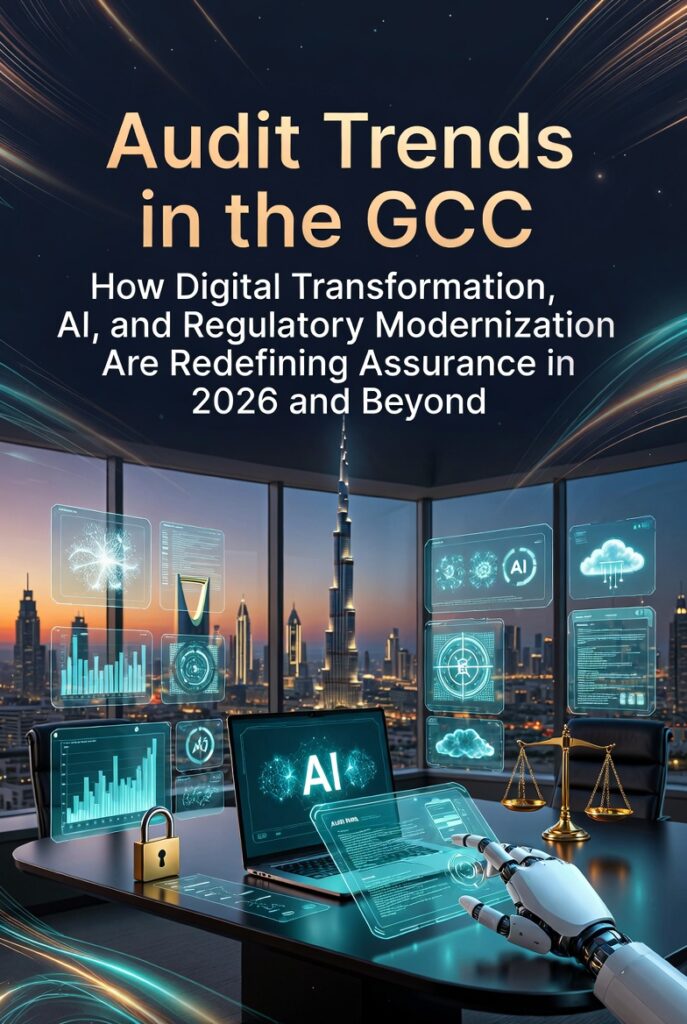
Audit Trends in the GCC
How Digital Transformation, AI, and Regulatory Modernization Are Redefining Assurance in 2026 and Beyond
.
Introduction
The Audit Profession at a Crossroads
There is a quiet revolution happening in boardrooms, finance departments, and audit firms across the Gulf Cooperation Council. It does not announce itself with headlines, but its impact is profound: the way businesses are examined, verified, and held accountable is changing at a pace that many organisations are still struggling to absorb.
For much of its modern history, auditing in the GCC was transactional and retrospective — a year-end ritual that confirmed what had already happened, based largely on sampling, professional judgment, and paper trails. That model served the region reasonably well during its oil-driven growth decades. But the GCC of 2025 is a fundamentally different economic landscape.
All six member states — Oman, the United Arab Emirates, Saudi Arabia, Qatar, Bahrain, and Kuwait — are executing national transformation visions that demand stronger governance, greater investor confidence, tax compliance infrastructure, and internationally credible financial reporting. Trillions of dollars in giga-projects, public-private partnerships, foreign direct investment, and capital market listings are riding on the quality of assurance behind the numbers.
At the same time, the instruments of auditing have changed beyond recognition. Artificial intelligence can now scan millions of journal entries in minutes. Blockchain can create immutable audit trails. Data analytics platforms reveal patterns across entire datasets rather than samples. Cloud-based ERP systems allow auditors to access live financial data from anywhere in the world. And regulators, from Muscat to Riyadh, are building digital compliance ecosystems that require auditors to be as fluent in technology as they are in accounting standards.
This article offers a deep, practical analysis of the audit trends reshaping the GCC — from digital auditing and AI-driven risk management to ESG assurance, cybersecurity audits, and the future of continuous monitoring. It is written for CFOs, internal audit leaders, business owners, and governance professionals who need not just a catalogue of buzzwords, but a genuine understanding of what these changes mean for how they operate.

- The New Stakes of Auditing in the GCC
- Digital Auditing
- Artificial Intelligence and Data Analytics
- The Regulatory Landscape
- Continuous Auditing and Continuous
- Cybersecurity Audit
- The Modernisation of Internal Audit
- ESG Audit & Sustainability Assurance
- Industry-Specific Audit Considerations
- Audit Quality, Independence
- Audit Automation Tools and Technology
- The Future of Auditing in the GCC
Why the GCC’s Transformation Agendas Make Audit More Critical Than Ever
The diversification plans animating GCC economies are not aspirational documents gathering dust on government shelves. They are active policy frameworks backed by sovereign wealth funds, regulatory mandates, and structural economic reforms.
Saudi Vision 2030 has unlocked new sectors — tourism, entertainment, logistics, manufacturing, technology — each bringing complex revenue models, novel accounting challenges, and previously untested regulatory environments. Oman Vision 2040 is driving privatisation of state-owned enterprises, foreign investment in special economic zones, and the professionalisation of the private sector. The UAE, already the GCC’s most diversified economy, has introduced Corporate Income Tax and is pushing toward mandatory e-invoicing. These are not peripheral changes. They are foundational shifts that put enormous pressure on financial reporting quality.
Consider what this means concretely. When a government sells a stake in a national airline, privatises a port, or lists a sovereign company on the stock exchange, the quality of the audit opinion attached to those financial statements is not merely a compliance formality — it is a signal to global capital. Institutions in London, Tokyo, New York, and Singapore decide whether to invest based in part on their confidence in GCC audit quality.
The same logic applies to the expanding GCC private sector. Family businesses seeking to bring in private equity, startups pursuing Series B funding, manufacturing companies applying for Oman Development Bank financing — all face heightened scrutiny over their financial governance. The audit is no longer just about tax and compliance. It is a measure of organisational credibility.
The Regulatory Architecture is Maturing Rapidly
GCC audit environments are converging toward international standards faster than many businesses realise.
Oman has embedded IFRS as the mandatory reporting framework for most entities, introduced VAT in 2021, strengthened anti-money laundering legislation, and aligned its audit quality oversight with International Standards on Auditing. The Capital Market Authority and the Central Bank of Oman have both tightened governance requirements for regulated entities. The Tax Authority of Oman has expanded its powers of examination and is increasingly data-driven in its risk selection.
The UAE’s introduction of Corporate Tax in 2023 was a watershed moment — transforming the tax audit landscape overnight for thousands of businesses that had never previously maintained tax-compliant financial records. The Ministry of Finance and Federal Tax Authority are now building the infrastructure for large-scale compliance monitoring. Economic Substance Regulations, Country-by-Country Reporting, and AML/CFT frameworks have added further layers of regulatory complexity.
Saudi Arabia has been among the most aggressive in regulatory modernisation. ZATCA’s (Zakat, Tax and Customs Authority) Phase 2 e-invoicing mandate requires businesses to integrate their invoicing systems directly with ZATCA’s Fatoorah platform, creating real-time transactional transparency for the government. The Saudi Organisation for Chartered and Professional Accountants (SOCPA) has raised audit quality standards and expanded mandatory audit requirements across more entity types.
For auditors and the businesses they serve, this regulatory maturation means one thing above all: the margin for error is shrinking. Weak internal controls, inconsistent documentation, and informal financial practices that were tolerated a decade ago now create serious compliance exposure.
Digital Auditing — Architecture, Adoption, and Competitive Advantage
What Digital Auditing Actually Means in Practice
“Digital auditing” is one of those phrases that gets used so frequently it risks losing precision. In the GCC context, digital auditing represents a genuine paradigm shift — not simply the use of computers in an audit, but the structural replacement of sample-based manual verification with automated, data-driven, full-population analysis.
In a traditional audit, an auditor might test 30 or 40 purchase transactions from a population of 50,000 to form a view about the completeness and accuracy of expenditure. In a digital audit, the entire population of 50,000 transactions is ingested into an analytics tool, analysed for anomalies, classified by risk level, and reviewed for patterns that manual sampling could never detect. The auditor shifts from reviewer to analyst — designing the analytical tests, interpreting the outputs, and applying judgment to what the data reveals.
The mechanics of digital auditing combine several interconnected capabilities: electronic data extraction from ERP and accounting systems (SAP, Oracle, Microsoft Dynamics, Zoho Books, Tally, and others); automated working papers that link audit steps to evidence in real time; cloud-based collaboration platforms that allow multi-location audit teams to work simultaneously; AI-powered anomaly detection that flags unusual transactions before human review begins; and digital communication with clients through secure portals that replace physical document collection.
Where GCC Businesses Stand on Digital Audit Adoption
Adoption is highly uneven across the GCC. Large listed companies, financial institutions, and subsidiaries of multinationals have generally embraced digital audit tools, driven by Big Four audit firms and the requirements of international capital markets. Mid-market companies in sectors like logistics, construction, retail, and manufacturing are in transition — many have moved to cloud ERP systems but have not yet fully leveraged the audit capabilities these systems make possible.
The largest gap is in the SME and family business segment, which represents the backbone of GCC private sector employment and GDP. Here, paper-based and spreadsheet-driven financial management remains common, and the concept of a digital audit often begins with a foundational step: helping the business establish the digital financial infrastructure from which a meaningful digital audit can be conducted.
This gap matters because regulatory pressure is increasingly flowing down the value chain. When a large GCC conglomerate implements digital audit and compliance processes, it frequently begins requiring digital documentation, e-invoicing compatibility, and structured data submission from its suppliers — many of which are SMEs. Digital audit readiness is therefore not just an internal compliance consideration; it is increasingly a supply chain requirement.
The Specific Benefits That GCC Business Leaders Report
Conversations with finance leaders across Oman, the UAE, and Saudi Arabia consistently highlight several practical benefits from digital audit adoption:
Speed and efficiency: Digital audit completion times in routine engagements have fallen by 20–40% for well-prepared entities, freeing finance teams from the disruption of extended fieldwork periods.
Detection breadth: Anomaly detection algorithms consistently identify issues — duplicate payments, rounded-number irregularities, post-period adjustments, dormant vendor activations — that traditional sampling would miss entirely. In one Oman-based manufacturing company’s experience, a digital audit first pass identified over 200 duplicate supplier invoices totalling nearly OMR 85,000 that had accumulated over three years.
Audit evidence quality: Digital audit trails are more robust, more retrievable, and more defensible to regulators than paper-based documentation. When the Tax Authority of Oman or ZATCA initiates an examination, organisations with digital audit files can respond with speed and precision.
Continuous improvement cycle: Because digital audits generate structured analytical output, businesses can use audit findings as a management intelligence tool — not just a compliance output. Patterns in audit findings drive process redesign and internal control improvement.
Artificial Intelligence and Data Analytics — The Engine of Modern Audit
How AI Is Genuinely Transforming Audit Work
The most overused phrase in professional services may be “AI-powered.” But in auditing, artificial intelligence represents a genuine and substantial transformation in what is possible, not a marketing veneer applied to existing services.
The core function of auditing — identifying material misstatement, whether from error or fraud — is fundamentally a pattern recognition challenge. Human auditors have always relied on their pattern recognition abilities: the experienced partner who notices something slightly off in the revenue recognition policy, the senior who spots that the depreciation rate has changed quietly mid-year. AI amplifies these abilities enormously, processing patterns across entire datasets at speeds and scales no human team can match.
Machine Learning for Risk Stratification
One of the most practically impactful AI applications in GCC auditing is risk stratification — the use of machine learning models to assess the relative risk level of individual transactions, vendor relationships, customer accounts, or business processes.
Rather than applying fixed sampling percentages across a transaction population, AI-driven risk stratification allows auditors to direct their work precisely where the risk is highest. A vendor who has recently changed their bank account details, received an unusual volume of payments just below approval thresholds, and operates in a jurisdiction with elevated corruption risk receives intense audit scrutiny. A well-established, long-tenured supplier with entirely consistent payment patterns and no behavioural anomalies receives lighter-touch testing.
In the GCC context, this is particularly valuable given the complexity of many organisations’ vendor ecosystems. Large construction projects, oil and gas operations, and government-linked entities routinely manage thousands of active vendor relationships across multiple jurisdictions. Manual risk assessment of such populations is practically impossible; AI-driven stratification makes it tractable.
Natural Language Processing in Contract and Document Review
One of the least publicised but most commercially significant AI audit applications is natural language processing (NLP) for contract analysis and document review.
GCC businesses operating in complex project environments — infrastructure development, oil field services, real estate development, hospitality construction — maintain enormous portfolios of contracts. These contracts contain financial obligations, contingent liabilities, performance guarantees, penalty clauses, and revenue recognition triggers that directly affect financial statement presentation. Reading and understanding the financial implications of thousands of pages of contracts has historically been one of the most time-consuming and error-prone aspects of audit work.
NLP tools can now scan contracts to extract key financial terms, flag clauses with accounting implications, identify inconsistencies between contract terms and how transactions have been recorded, and surface disclosure requirements that may have been missed. In large GCC audit engagements, this capability is already reducing contract review time by 60–70% while improving the thoroughness and consistency of findings.
AI-Powered Fraud Detection: The GCC’s Growing Priority
Fraud detection deserves particular emphasis in the GCC context, for reasons that are specific to the region’s economic structure.
The GCC’s combination of large expatriate workforces, complex supply chains, cash-intensive hospitality and retail sectors, high volumes of cross-border transactions, and rapid business growth creates an environment where fraud risk is structurally elevated. The Association of Certified Fraud Examiners (ACFE) consistently finds that the highest-risk fraud schemes — procurement fraud, payroll fraud, ghost suppliers, invoice manipulation — are prevalent across the MENA region.
AI fraud detection models trained on GCC transaction data can identify the specific behavioural signatures of these schemes with remarkable precision: split purchase orders designed to circumvent approval thresholds; payroll entries for employees whose IDs have lapsed; fictitious suppliers sharing bank account details with real employees; vendor invoice amounts that consistently arrive just below management approval limits.
When these models are deployed as part of continuous monitoring programmes — rather than as a one-time audit procedure — organisations gain near-real-time fraud detection capability that fundamentally changes the economics of fraud prevention.
The Regulatory Landscape — A Country-by-Country Analysis
Oman: Building a Comprehensive Compliance Architecture
Oman’s regulatory evolution over the past five years has been among the most substantive in the GCC, though it has received less international attention than UAE or Saudi Arabia’s developments.
The introduction of Value Added Tax in April 2021 was the most visible milestone, immediately requiring thousands of businesses to implement new accounting systems, compliance processes, and audit trails. But the VAT implementation was part of a broader pattern of regulatory strengthening that includes enhanced corporate governance requirements for listed companies, updated anti-money laundering regulations aligned with FATF recommendations, expanded audit requirements for entities accessing government financing, and the Tax Authority’s growing capability for data-driven compliance examination.
Muscat Auditing and Accounting Services (MAAS) has been at the forefront of helping Oman-based businesses navigate this regulatory transition, with particular expertise in VAT compliance audit, corporate governance advisory, and the documentation standards required for Tax Authority examinations. The firm’s accreditations with Invest Oman, the Oman Development Bank panel (Grade A), and the Ministry of Commerce reflect the seriousness with which MAAS approaches regulatory alignment.
Looking ahead, Oman is expected to follow the broader GCC trend toward mandatory e-invoicing, with phased implementation likely within the next three to five years. Businesses that have already invested in digital financial infrastructure will be well-positioned; those still operating on manual or spreadsheet-based systems face significant transition costs.
United Arab Emirates: Tax Transformation and ESG Leadership
The UAE’s 2023 Corporate Income Tax introduction was arguably the most significant structural change to the GCC’s financial reporting landscape in a generation. At a stroke, thousands of UAE businesses — many of which had never been subject to income taxation — were required to maintain financial records to a standard capable of supporting a corporate tax return.
This has created enormous demand for audit and accounting services, as businesses that previously prepared informal or minimal financial statements now require IFRS-compliant accounts, documented transfer pricing policies, and substantiated treatment of deductible expenses. For audit firms operating in the UAE, the CIT introduction has been transformative — expanding the market significantly and raising the floor of financial reporting quality across the economy.
The UAE is also the GCC’s most advanced market for ESG disclosure, driven by Abu Dhabi Global Market and Dubai Financial Market requirements for listed entities, UAE Central Bank sustainability guidelines for financial institutions, and the growing requirement from international investors and lenders for credible sustainability data. UAE-based companies seeking green financing, Sustainability-Linked Loans, or international capital market access increasingly require third-party assurance over their ESG metrics — creating a new and growing market for sustainability audit services.
Saudi Arabia: The Deepest Digital Compliance Ecosystem in the GCC
Saudi Arabia’s ZATCA e-invoicing programme, Fatoorah, represents the most advanced digital compliance ecosystem in the GCC and one of the most sophisticated in the world.
Phase 2 of Fatoorah, which has been rolling out since 2023, requires businesses above specified thresholds to integrate their internal ERP and accounting systems with ZATCA’s platform in real time. Every sales invoice is simultaneously transmitted to the tax authority at the moment of issuance. There are no end-of-period returns, no retrospective amendments, no opportunity to resolve discrepancies after the fact. The financial data is on the government’s servers the moment it is created.
The audit implications of this are profound. For external auditors, it means a portion of revenue verification can now be conducted with reference to tax authority data — providing an independent, real-time dataset against which reported revenues can be reconciled. For internal audit teams, the Fatoorah integration creates a continuous monitoring capability that would have required significant technology investment to build independently.
SOCPA’s enhanced audit quality standards are also raising the bar for audit firm quality in Saudi Arabia, with increased inspection frequency, stronger independence requirements, and mandatory continuing professional development aligned with international standards.
Qatar, Bahrain, and Kuwait: Converging on International Standards
Each of the smaller GCC economies is pursuing its own version of regulatory modernisation, with common themes: stronger AML/CFT frameworks, alignment with FATF recommendations, expanded corporate governance requirements for listed entities, and growing interest in sustainability reporting.
Qatar, buoyed by the economic momentum following the 2022 FIFA World Cup, is investing in financial sector governance and transparency as it seeks to deepen its capital markets. Bahrain, as a long-established regional financial centre, has consistently maintained relatively sophisticated regulatory standards and is now aligning more closely with international ESG expectations. Kuwait is modernising its tax and corporate governance frameworks as part of broader public finance reforms.
For businesses operating across multiple GCC jurisdictions — a common profile in the logistics, trading, construction, and professional services sectors — this convergence creates both opportunities and challenges. Opportunities, because a single coherent compliance strategy can increasingly serve the whole GCC. Challenges, because the pace and specifics of regulatory change vary by country, requiring active monitoring and adaptation.
Continuous Auditing and Continuous Monitoring — The Future Arriving Now
The Conceptual Shift: From Periodic Assurance to Perpetual Vigilance
The traditional annual audit cycle was designed for a world where financial data was produced slowly, stored in physical form, and analysed by human reviewers. It was a pragmatic response to the limitations of its era. In a world where ERP systems produce structured transactional data in real time, where anomalies can be detected algorithmically, and where financial risks can materialise and escalate within days rather than months, the annual audit cycle is increasingly insufficient as the primary assurance mechanism.
Continuous auditing (CA) and continuous monitoring (CM) represent the profession’s response to this inadequacy. While often discussed together, they are distinct functions: continuous auditing is conducted by external or internal auditors to provide ongoing assurance over financial and operational processes; continuous monitoring is conducted by management to supervise the organisation’s own compliance and risk position.
Together, they create a layered assurance ecosystem where exceptions are identified quickly, control failures are remediated before they become significant, and the year-end audit becomes a verification of a well-monitored process rather than a discovery exercise.
How Continuous Auditing Works in GCC Organisations
In practical GCC implementation, continuous auditing typically begins with the identification of high-risk process areas — procurement, payroll, revenue recognition, expense management, inventory management — and the definition of automated tests that can be applied to transactional data on a scheduled basis.
For a mid-size Omani trading company, this might mean: weekly automated testing of all new vendor setups against employee records, checking for shared bank account details or ID numbers; monthly reconciliation of purchase order approvals against system access logs; automated identification of invoices that have been processed twice; quarterly analysis of expense patterns by employee and department.
These tests run automatically, generate exception reports for review by the internal audit function, and create a documented control monitoring trail. When exceptions are identified, they are investigated promptly — days after occurrence rather than months. Remediation is faster, evidence is fresher, and the organisation learns continuously rather than once a year.
The CFO Perspective: Continuous Monitoring as Strategic Intelligence
The most progressive CFOs in the GCC are recognising that continuous monitoring platforms deliver value that extends far beyond audit and compliance. When properly designed, they provide real-time intelligence about business performance, operational efficiency, and emerging risks that informs management decision-making.
A construction company CFO using a continuous monitoring dashboard can see in real time whether subcontractor costs are tracking to budget, whether procurement is adhering to approved vendor lists, and whether project milestones are generating the expected revenue recognition events. An FMCG company CFO can monitor inventory write-offs, spot unusual sales returns patterns, and track whether promotional discounts are being applied within authorised parameters — all before month-end close.
This transformation of the audit and monitoring function from retrospective compliance mechanism to forward-looking management tool is one of the most significant shifts in GCC financial governance, and it is accelerating.
Cybersecurity Audit — The Non-Negotiable New Frontier
Why Cybersecurity Has Become Central to Financial Audit
The connection between cybersecurity and financial audit is no longer indirect. Cyber incidents are now among the primary drivers of material financial misstatement, operational disruption, and regulatory liability for GCC businesses.
A ransomware attack that encrypts a company’s accounting systems for two weeks does not just create an IT problem. It creates an audit problem: financial records may be corrupted or incomplete; backup restoration may introduce inconsistencies; the period during which systems were unavailable may contain unrecorded or mis-recorded transactions. The auditor must now assess not just whether the financial statements are accurately presented, but whether the IT environment that produced them was sufficiently reliable.
Beyond ransomware, cybersecurity vulnerabilities create audit exposure through unauthorised access to financial systems (enabling fraud), inadequate segregation of duties in ERP configurations (enabling manipulation), and insufficient data retention and backup processes (undermining audit evidence quality).
The Scope of IT General Controls in GCC Audit Engagements
IT General Controls (ITGC) assessment has become a standard component of audit engagements for GCC businesses above a certain complexity threshold, and is increasingly being extended to mid-market organisations as regulators raise expectations.
ITGC assessment evaluates the foundational security and reliability of the IT environment that produces financial information. Key control areas include:
Access Management: Does the organisation enforce the principle of least privilege? Are access rights reviewed regularly? Are terminated employees’ credentials revoked promptly? Are there adequate controls over privileged accounts? In many GCC businesses — particularly those with high staff turnover in their expatriate workforce — access management weaknesses are among the most commonly identified ITGC deficiencies.
Change Management: Are changes to financial systems subject to formal approval, testing, and documentation? Uncontrolled system changes represent one of the highest-risk sources of financial data integrity failure.
System Operations: Are systems monitored for performance and availability? Are backup procedures effective and regularly tested? Are system logs retained and reviewed for anomalous activity?
Data Integrity: Are there controls to prevent unauthorised modification of data after entry? Are audit trails enabled and protected from tampering?
Cybersecurity Frameworks Gaining Traction in the GCC
ISO 27001 certification, which provides internationally recognised independent assurance of information security management systems, is increasingly expected by international business partners, lenders, and regulators for GCC businesses in regulated or high-risk sectors. The UAE has issued its own National Cybersecurity Strategy, Oman’s ITA has published cybersecurity frameworks for critical infrastructure, and Saudi Arabia’s National Cybersecurity Authority has developed comprehensive national standards.
For internal audit functions, cybersecurity audit capability — either developed in-house or sourced through co-sourcing arrangements with specialist firms — is no longer optional for organisations with significant digital operations.
The Modernisation of Internal Audit
Internal Audit’s Expanding Mandate
The Institute of Internal Auditors’ updated Global Internal Audit Standards, released in 2024, formalise what leading GCC organisations have been practicing for several years: internal audit is not a compliance function with a mandate limited to verifying that controls operate as designed. It is a strategic assurance and advisory function with a responsibility to evaluate governance, risk management, and the reliability of information that leadership uses to make decisions.
This expanded mandate is reshaping internal audit departments across the GCC. Chief Audit Executives are increasingly members of the senior leadership team, reporting to audit committees with direct lines to the board. Internal audit plans are risk-based, forward-looking, and aligned with strategic objectives rather than driven by historical patterns and compliance calendars.
The practical implications are significant. Modern GCC internal audit functions are now expected to provide assurance over:
Digital transformation risk: When a company implements a new ERP system, migrates to cloud infrastructure, or launches a digital customer platform, internal audit should be involved in project risk assessment from the outset — not just reviewing what went wrong after implementation.
Third-party and supply chain risk: In a region where complex supply chains, outsourced services, and subcontracting are ubiquitous, the risk that arises through vendor and partner relationships requires structured assessment. Internal audit increasingly includes vendor qualification, contract compliance, and supply chain integrity within its scope.
Strategic initiative assurance: Major capital projects, market entry strategies, joint venture governance, and merger integration all carry risks that internal audit can help identify and mitigate if engaged early.
Culture and ethics: Leading internal audit functions in the GCC are beginning to assess organisational culture and ethics as a risk domain — recognising that cultural factors are often the root cause of fraud, compliance failures, and governance breakdowns.
Internal Audit for GCC Family Businesses: A Special Challenge
Family-owned enterprises represent the dominant form of business ownership across the GCC, and their governance needs are distinctive. The founder generation that built these businesses typically operated with informal governance, personalised control, and high concentrations of authority. As second and third generations take leadership, and as these businesses grow in complexity and seek external financing, the governance infrastructure that served the founder often becomes inadequate.
Internal audit plays a transformational role in family business professionalisation. Structuring appropriate segregation of duties, establishing formal procurement and expenditure approval frameworks, implementing related-party transaction governance, and creating the documentation infrastructure needed for bank financing or private equity investment — these are not just compliance improvements, they are the foundations of intergenerational business sustainability.
MAAS has particular experience in supporting GCC family businesses through this professionalisation journey, combining technical audit expertise with sensitivity to the cultural and relational dimensions of family enterprise governance.
ESG Audit and Sustainability Assurance
The ESG Imperative in the GCC
Environmental, Social, and Governance considerations have moved from a voluntary aspiration to a commercial necessity for GCC businesses operating in international markets or seeking international capital.
The mechanisms driving this shift are multiple and reinforcing. European Union sustainable finance regulations require EU financial institutions to assess the ESG profile of their investee companies globally — meaning GCC businesses seeking European investment must be able to demonstrate credible ESG performance. International banks increasingly incorporate ESG conditions into loan covenants and pricing. Sovereign wealth fund counterparties expect ESG alignment. And GCC governments themselves — driven by climate commitments, social development objectives, and governance reform agendas — are establishing ESG reporting requirements for listed companies and regulated entities.
Saudi Arabia’s Vision 2030 includes explicit sustainability targets, and the Capital Market Authority has issued ESG reporting guidance for listed companies. The UAE has committed to net-zero emissions by 2050 and is building mandatory sustainability disclosure frameworks for financial institutions and large corporates. Oman’s Vision 2040 includes environmental sustainability objectives aligned with national climate commitments.
What an ESG Audit Examines
ESG auditing is a distinct and technically demanding discipline that requires auditors to move beyond the financial statement domain into operational, environmental, and social data.
Environmental assurance involves verifying reported data on energy consumption, greenhouse gas emissions, water usage, waste generation, and environmental incident management. For GCC businesses in energy-intensive sectors — oil and gas, manufacturing, hospitality, aviation — environmental audit involves assessing measurement methodologies, data collection processes, and the reliability of emission calculations against reported figures.
Social assurance covers labour practices, worker health and safety, supply chain labour standards, community investment, and human rights due diligence. In the GCC context, with its large expatriate workforce, social audit frequently includes assessment of recruitment practices, accommodation standards, wage payment processes, and worker grievance mechanisms.
Governance assurance evaluates board structure and independence, executive compensation alignment with long-term performance, anti-corruption programmes, whistleblowing mechanisms, and the quality of internal controls over financial and non-financial reporting.
The Assurance Standard Question
ESG assurance lacks the well-established standardisation of financial audit, creating complexity for both preparers and assurance providers. The International Sustainability Standards Board (ISSB) standards — IFRS S1 and IFRS S2 — are gaining traction as the preferred framework for sustainability disclosures, and GCC regulators are expected to align with these standards progressively.
The International Auditing and Assurance Standards Board (IAASB) has released ISSA 5000, a comprehensive standard for sustainability assurance that provides a framework for audit firms providing ESG assurance engagements. MAAS is developing capability aligned with these emerging standards to support GCC clients as sustainability assurance requirements evolve from voluntary to mandatory.
Industry-Specific Audit Considerations Across the GCC
Oil and Gas: Complexity, Scale, and Geopolitical Risk
The GCC’s foundational industry presents audit challenges that are qualitatively different from other sectors. Production sharing agreements between national oil companies and international operators involve revenue recognition, cost recovery, and profit allocation mechanisms of extraordinary complexity. Joint venture audits — particularly in upstream exploration — require auditors to navigate multi-party governance structures, operated versus non-operated interests, and international fiscal regimes simultaneously.
Oil price volatility introduces asset impairment risk that requires careful assessment against IAS 36 requirements. Decommissioning liabilities — the obligation to restore oil fields and offshore installations at end of life — represent multi-decade estimates that are highly sensitive to discount rate assumptions and cost projections. Environmental liability assessment is increasingly important as GCC NOCs face pressure to account transparently for their environmental footprint.
Banking and Financial Services: IFRS 9 and the Credit Risk Imperative
Since the adoption of IFRS 9, GCC banks have been required to recognise expected credit losses forward-looking — provisioning for loan losses before they occur based on modelled probability of default and loss severity. The audit of Expected Credit Loss (ECL) models is one of the most technically demanding areas in GCC audit practice, requiring auditors to assess the robustness of statistical models, the quality of historical data, the appropriateness of macro-economic scenarios, and the adequacy of management overlays.
Liquidity risk reporting, capital adequacy assessment, and compliance with Central Bank macro-prudential requirements create additional audit complexity. The rapid growth of Islamic finance across the GCC adds further nuance — Sharia compliance audit is a distinct and specialised discipline that sits alongside conventional financial audit for many GCC banks and Islamic financial institutions.
Construction and Real Estate: Revenue Recognition and Project Governance
The construction and real estate sectors present some of the GCC’s most challenging revenue recognition audit scenarios. IFRS 15’s requirements for recognising revenue over time versus at a point in time require careful assessment of contract terms, progress measurement methodologies, and the allocation of contract consideration between distinct performance obligations.
Large infrastructure projects — Oman’s highway programme, Saudi Arabia’s NEOM, Qatar’s ongoing post-World Cup development — involve complex tendering processes, multi-party subcontracting, and cost management challenges that create significant audit risk. Budget overruns, contract modifications, claims and disputes, and related-party subcontracting are recurring themes in construction sector audit engagements across the region.
Retail and E-Commerce: The Digital Transaction Challenge
The growth of GCC e-commerce — already substantial before COVID-19 accelerated adoption — creates audit challenges centred on transaction volume, payment platform diversity, and revenue recognition completeness. When a GCC retailer processes transactions through fifteen different payment gateways, operates across six national markets, and integrates inventory across physical stores and fulfilment centres, the reconciliation complexity is formidable.
E-invoicing compliance in Saudi Arabia has added an additional dimension: revenue recognised in the financial statements must now reconcile precisely with invoices transmitted through the Fatoorah platform, creating a new data validation requirement in audit methodology.
Hospitality: Cash Intensity and Revenue Cycle Complexity
Oman’s growing tourism sector, the UAE’s world-class hospitality industry, and Saudi Arabia’s emerging tourism economy all generate audit engagements in a sector defined by cash intensity, complex revenue mix, and seasonal volatility.
Hotel revenue audits require point-of-sale system integrity testing, room revenue reconciliation, food and beverage controls assessment, and convention and event revenue recognition. The large expatriate workforce in hospitality creates payroll complexity and turnover-driven segregation of duties risks. Cash handling controls — in environments that still process significant cash despite the growth of digital payments — remain a critical audit focus.
Audit Quality, Independence, and Professional Ethics
The Audit Quality Imperative
Audit quality is the dimension of the profession that the public sees least and that matters most. An audit opinion that is technically correct but reflects the auditor’s genuine independence and professional scepticism is fundamentally different from one that reflects management pressure, commercial compromise, or superficial engagement.
GCC audit regulators are paying increasing attention to audit quality, and the direction of travel is clear: higher standards, more inspection, stronger enforcement, and greater accountability for audit failures.
In Oman, audit quality oversight for listed companies and public interest entities has been strengthened through enhanced inspection programmes and quality assurance requirements. In Saudi Arabia, SOCPA’s quality review process has been significantly upgraded. In the UAE, the audit regulatory landscape is evolving in response to high-profile corporate failures that highlighted the inadequacy of some audit work.
Independence: The Technical and Cultural Dimensions
Auditor independence is both a technical requirement and a cultural practice. The technical requirements — prohibitions on financial interests in audit clients, limitations on the provision of certain non-audit services, mandatory audit partner rotation, cooling-off periods — are well-defined in international standards and increasingly enforced in GCC jurisdictions.
The cultural dimension is more subtle and more challenging. In the GCC’s relationship-oriented business environment, where personal connections, long-standing professional relationships, and reputational considerations shape commercial interactions, maintaining genuine independence from audit clients requires conscious commitment and institutional discipline. The temptation to soften a difficult finding to preserve a commercial relationship, or to accept management’s preferred accounting treatment rather than challenge it, is a real and persistent threat to audit quality.
MAAS’s approach to independence is grounded in the conviction that genuine independence is the auditor’s most valuable professional asset — that the credibility of an audit opinion depends entirely on the confidence that it reflects honest, sceptical, independent professional judgment.
Professional Scepticism in the AI Age
One of the most important discussions in global audit circles concerns the relationship between AI tools and professional scepticism. AI can identify anomalies that human review misses. But it can also create a false sense of comprehensive coverage — the belief that because the algorithm has processed all the data, nothing has been missed.
Professional scepticism requires auditors to challenge not just the transactions and controls they are auditing, but the adequacy of their own procedures. In the AI age, this means questioning whether the algorithms are testing the right things, whether management might have structured transactions to evade automated detection, and whether the absence of exceptions in AI output reflects genuine control strength or clever circumvention.
The auditors most effective in the digital environment are those who combine strong data analytics capability with deep professional scepticism — who use AI as a powerful tool rather than an infallible oracle.
Audit Automation Tools and Technology Ecosystems
The Technology Stack of the Modern GCC Audit
Leading audit firms and internal audit functions operating in the GCC deploy layered technology ecosystems that combine specialised audit tools with broader data analytics and business intelligence platforms.
Data Extraction and Analytics: IDEA by CaseWare and ACL by Galvanize (now Diligent) remain the most widely used dedicated audit analytics platforms, enabling auditors to extract, cleanse, and analyse data from a wide range of ERP and accounting systems. These tools provide pre-built audit test libraries alongside the flexibility to design custom analytical tests for specific client environments.
Visualisation and Reporting: Microsoft Power BI and Tableau are increasingly integrated into audit workflows, enabling the presentation of analytical findings through interactive dashboards that communicate insights to boards, audit committees, and management in formats they can readily understand. A well-designed Power BI dashboard showing control exception trends across a twelve-month period is far more impactful than a table of findings in a Word document.
ERP-Embedded Controls: SAP’s Audit Management and GRC (Governance, Risk and Compliance) modules, Oracle Risk Management Cloud, and similar ERP-native tools provide continuous control monitoring within the financial systems that produce transaction data. These tools are most powerful in large GCC organisations with complex ERP landscapes.
AI Anomaly Detection: A new generation of purpose-built AI audit tools — including platforms from vendors such as MindBridge, Appzen, and emerging regional solutions — apply machine learning to financial data to identify transactions that warrant human review. These tools are increasingly being adopted by mid-tier GCC audit firms as well as the Big Four.
Accounting Software for SMEs: Zoho Books, QuickBooks, and local solutions including Hampers and Pact are widely used by Oman’s SME sector, and each provides varying levels of data export capability that supports digital audit processes. The ability to extract clean, structured data from the client’s accounting system is the enabling step for any digital audit, and working with the full range of GCC SME accounting platforms is a practical capability requirement for audit firms serving this market.
The Future of Auditing in the GCC — A Ten-Year Outlook
The Convergence of Real-Time Finance and Real-Time Audit
The most profound near-term development in GCC auditing will be the convergence of real-time financial reporting with real-time audit and monitoring capability. As e-invoicing mandates extend across all six GCC states, as ERP systems become more sophisticated and interconnected, and as regulatory data-sharing frameworks mature, the distinction between “preparing financial information” and “auditing financial information” will progressively blur.
Regulators will have direct access to structured financial data as it is produced. Continuous monitoring systems will flag exceptions immediately. Audit procedures will be conducted on a rolling basis throughout the year. The year-end audit will become a focused exercise in verifying judgmental estimates, evaluating the appropriateness of accounting policies, and providing the independent professional opinion that automated monitoring systems cannot replace.
This is not a future that eliminates the need for skilled auditors — it is a future that demands auditors with a qualitatively different skill set: deep data analytics capability, sophisticated AI literacy, strong risk management judgment, and the professional scepticism to challenge what technology tells them.
Blockchain and the Immutable Audit Trail
Blockchain’s potential contribution to auditing lies in its most fundamental characteristic: the immutability of recorded data. When transactions are recorded on a blockchain, they cannot be altered or deleted — creating an audit trail that is permanently verifiable without access to the original source systems.
For GCC applications — intercompany transactions within complex conglomerates, trade finance documentation, supply chain provenance tracking, land and property registry — blockchain provides audit trail integrity that eliminates entire categories of documentation risk. As blockchain infrastructure matures in the region, auditors will develop methodologies for auditing blockchain-recorded transactions that are fundamentally different from traditional source document testing.
Mandatory ESG Assurance: Sooner Than Most Expect
Market signals and regulatory trajectory across the GCC suggest that mandatory sustainability assurance — independent third-party verification of ESG disclosures — will extend to a wider range of GCC companies within the next three to five years, beginning with listed companies and large regulated entities.
Organisations that prepare now — by building robust ESG data collection processes, establishing baseline metrics, and engaging with the ISSB reporting frameworks — will be well ahead of those who wait for the regulatory mandate. Those who wait are likely to face the same compressed, expensive scramble that characterised VAT implementation for many GCC businesses in 2020–21.
The Rise of Forensic Audit as a Strategic Capability
As GCC business environments become more complex and digital fraud more sophisticated, demand for forensic audit and investigation capability is growing rapidly. Forensic auditors combine financial analysis skills with investigative methodology to uncover fraud, corruption, and financial irregularities — providing evidence quality suitable for legal proceedings and regulatory submissions.
Procurement fraud, embezzlement, financial statement manipulation, and bribery are the most common triggers for forensic audit engagements in the GCC. As whistleblower protections improve and corporate governance standards rise, more organisations are proactively commissioning forensic audits when internal controls flag suspicious activity — rather than waiting for the matter to reach a crisis point.
Talent and the Audit Profession
Underlying all these technological and regulatory trends is a human reality: the auditing profession in the GCC faces a talent challenge. The skills required of a modern GCC auditor — IFRS expertise, data analytics capability, AI literacy, cybersecurity understanding, ESG knowledge, tax compliance experience — represent a breadth that no single educational curriculum yet fully prepares graduates for.
Progressive audit firms and internal audit functions are responding by investing heavily in continuous professional development, building data analytics centres of excellence, developing specialised ESG audit practices, and creating career pathways that allow professionals to develop depth in specific domains. Partnerships between audit firms and technology training providers are accelerating skills development.
For businesses seeking audit quality, this talent landscape makes firm selection increasingly consequential. The technical competence, professional development investment, and technology capability of audit firms vary significantly — and the gap between the best and the adequate is widening.
Conclusion: Embracing the Audit of Tomorrow, Today
The GCC audit landscape is not gently evolving — it is being reshaped by forces of regulatory reform, technological disruption, and economic transformation that are accelerating simultaneously. For organisations that have been slow to adapt, the pressure points are accumulating: regulatory examinations are becoming more sophisticated, investor expectations are rising, fraud risks are intensifying, and the quality gap between digital-ready and paper-based organisations is widening to a point where it cannot be ignored.
The path forward is clear, even if the journey is demanding. Invest in digital financial infrastructure — not just because it makes audits easier, but because it makes the business smarter and more resilient. Engage with audit partners who bring genuine technology capability alongside deep professional expertise. Build internal audit functions that operate as strategic partners to management, not just compliance checkers. Take ESG reporting seriously before it becomes mandatory and reactive rather than strategic. And cultivate the governance disciplines — independence, transparency, professional scepticism — that make financial information genuinely trustworthy rather than technically compliant.
At MAAS, we work with businesses across Oman and the wider GCC through this transition. Our services span external audit and assurance, internal audit co-sourcing, VAT and corporate tax compliance, ESG advisory, ERP implementation support, and regulatory compliance guidance. We bring not just technical expertise but genuine partnership — understanding that the organisations we serve are navigating real business challenges in a fast-changing environment, and that our role is to help them navigate with confidence.
The next decade of GCC auditing will be defined by the organisations that seized the moment of transformation — and the audit partners who helped them do it well.
Book Your Free Consultation →
Muscat Auditing and Accounting Services (MAAS) is a leading consulting firm in Oman, accredited by Invest Oman, the Oman Development Bank (Grade A panel), and the Tax Authority of Oman. Our team of experienced professionals provides audit, assurance, taxation, and advisory services to businesses across Oman and the GCC.