
Business Process & Finance Department Outsourcing (BPO / FAO) in Oman: Cost-Benefit Analysis, SLA Governance & Omanisation Compliance
For decades, the standard operating model for small and mid-sized enterprises in the Sultanate of Oman was to hire one or two full-time accountants to manage everything from daily supplier vouchers and bank transfers to quarterly Value Added Tax (VAT) returns, Ministry of Labour Wage Protection System (WPS) files, and year-end audit schedules. In 2026, that single-accountant model has become one of the highest operational risk points for Omani LLCs, foreign branch offices, and high-growth SMEs.
Why? Because no single bookkeeper—however diligent—simultaneously possesses deep technical expertise in IFRS 9, 15, 16, and 18, Oman Tax Authority (OTA) e-invoicing (Fawtara) and withholding tax rules, Social Protection Fund (SPF) contribution calculations under Royal Decree 52/2023, and internal control segregation of duties. Moreover, when an in-house accountant goes on 30-day annual leave or resigns unexpectedly mid-year, reconciliations stall and statutory filing penalties accumulate rapidly. Partnering with a premier provider of Auditing and Accounting Services in Oman for managed Business Process and Accounts Outsourcing (BPO / FAO) replaces key-person fragility with an institutional multi-specialist finance department at a lower Total Cost of Ownership.
1. Why Omani Enterprises Are Shifting from Single-Accountant Bookkeeping to Managed BPO/FAO
Across Muscat, Sohar, Duqm, and Salalah, three structural shifts are accelerating the adoption of outsourced finance departments:
- Escalating Regulatory Complexity: Between OTA cross-matching of quarterly VAT returns against annual Corporate Income Tax declarations, MoCIIP mandatory audited financial statement uploads via the Oman Business Platform, and strict CBO banking KYC renewals, bookkeeping errors now trigger immediate administrative fines or frozen bank facilities.
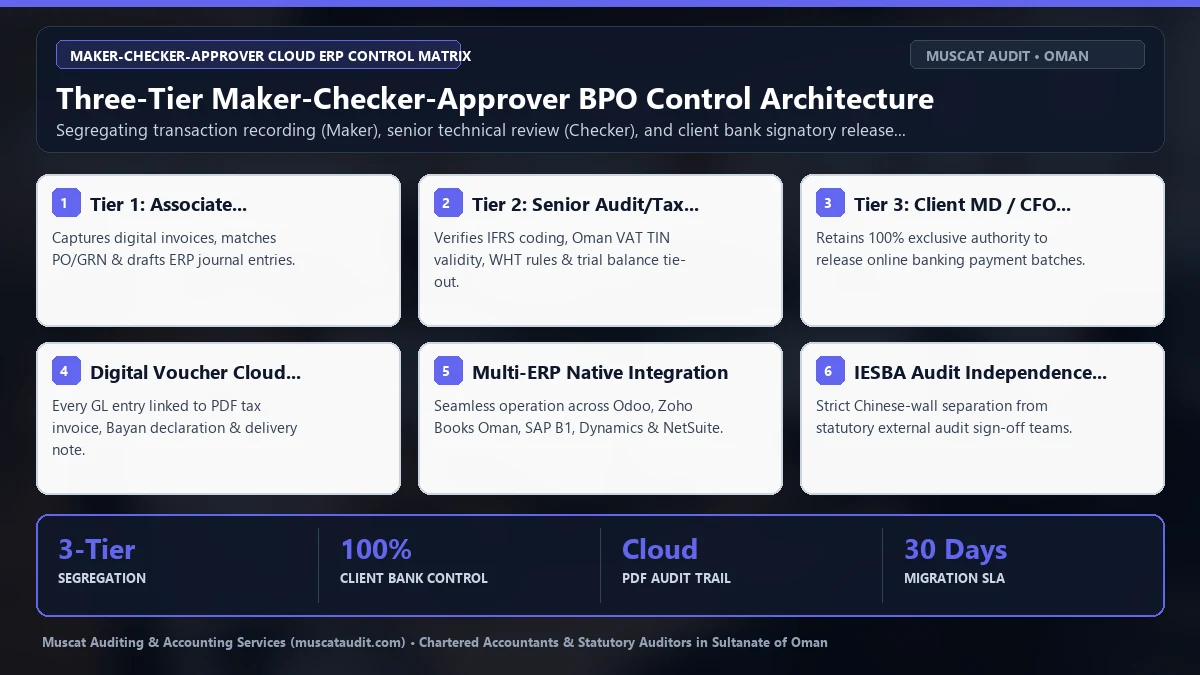
- Segregation of Duties (Maker-Checker-Approver): In a 1-person or 2-person in-house accounts office, the same individual who creates a vendor master record often enters the purchase invoice, prepares the online banking payment batch, and reconciles the bank statement. An outsourced Accounting & Bookkeeping Outsourcing model enforces a three-tier workflow: Associate Bookkeeper (Maker) → Senior Review Manager (Checker) → Client Managing Director/CFO (Bank Signatory Approver).
- Workforce & Omanisation Agility: Foreign investors establishing new LLCs under the Foreign Capital Investment Law (RD 50/2019) or EPC contractors mobilizing for 24-month project contracts in Oman need an immediate, battle-tested finance back office from Day 1 without waiting 90 days to recruit, visa-process, and onboard an internal finance team.
2. Total Cost of Ownership (TCO) Analysis: In-House Finance Team vs. Managed BPO in Muscat
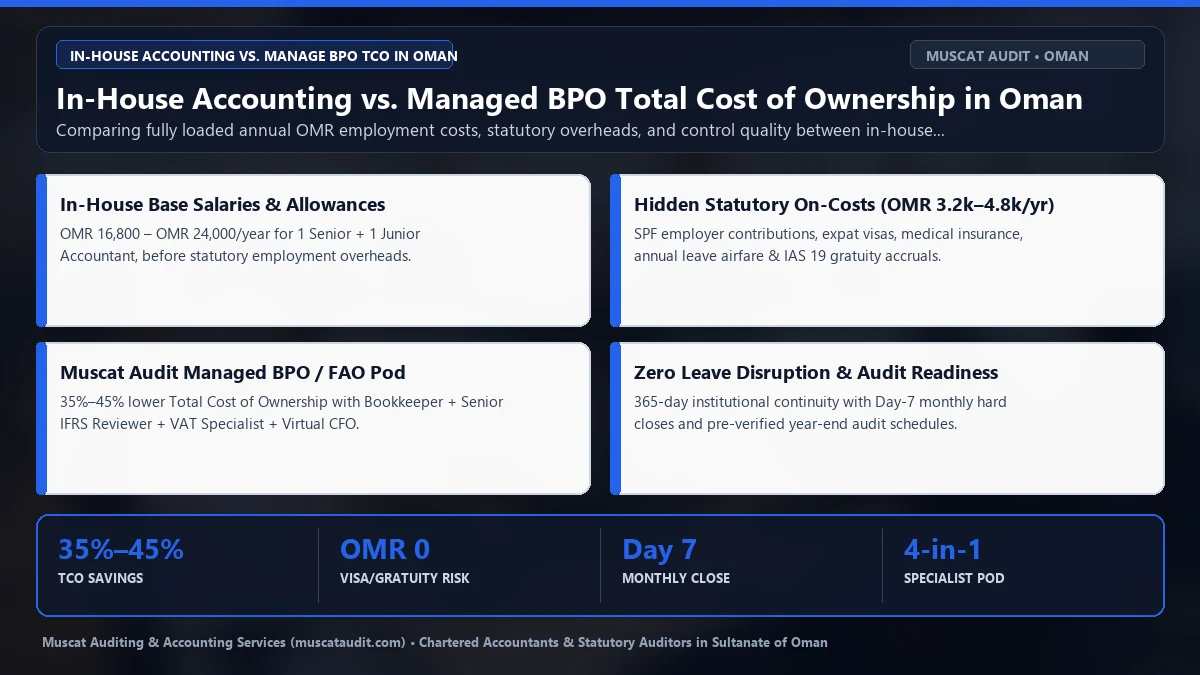
When evaluating whether to build an internal accounting department or transition to a managed FAO model, business owners often compare only the base monthly salary of a junior accountant against an outsourcing retainer. A realistic CFO analysis must capture the full fully-loaded annual cost in Omani Rials (OMR):
| Cost & Capability Dimension | In-House Finance Setup (1 Senior + 1 Junior Accountant) | Muscat Audit Managed BPO / FAO Pod |
|---|---|---|
| Base Salaries & Allowances (Annual) | OMR 16,800 – OMR 24,000 per year (OMR 1,400–2,000/month combined) | Predictable fixed monthly SLA retainer (typically 35%–45% lower TCO) |
| Statutory On-Costs (SPF / Visa / Medical / Leave / Gratuity) | OMR 3,200 – OMR 4,800 per year (SPF employer share or expat visa, medical insurance, annual leave tickets & IAS 19 gratuity) | OMR 0 (Zero visa, zero leave replacement, zero gratuity liability) |
| Technical Depth Included | Limited to the individual experience of the 2 hired staff | Bookkeeper + Senior IFRS Reviewer + OTA VAT/Tax Specialist + Virtual CFO |
| Continuity During Leave / Sick Days | 30-day annual leave creates reconciliation and VAT filing backlogs | 365-day institutional continuity with backup pod shadow coverage |
| Year-End Statutory Audit Readiness | Often requires weeks of external audit adjustments and cleanup fees | Monthly audit-grade schedules (fixed asset register, IFRS 16, ECL, tax pack) |
3. Core Pillars of Finance & Business Process Outsourcing in the Sultanate
Rather than offering generic data entry, our Business Process Redesign & Accounts Outsourcing practice operates as a modular, end-to-end finance operations center tailored to Omani enterprises:
- Procure-to-Pay (P2P) & Accounts Payable Management: Three-way matching of Purchase Orders, Goods Received Notes (GRNs), and vendor tax invoices; verification of supplier Oman VAT TIN validity and mandatory 11-point Tax Invoice compliance before scheduling weekly bank payment batches.
- Order-to-Cash (O2C) & Credit Control: Automated e-invoicing (Fawtara-ready XML/PDF generation), customer aging analysis, automated collection reminders at 30/45/60/90 days, and quarterly IFRS 9 Expected Credit Loss (ECL) provisioning.
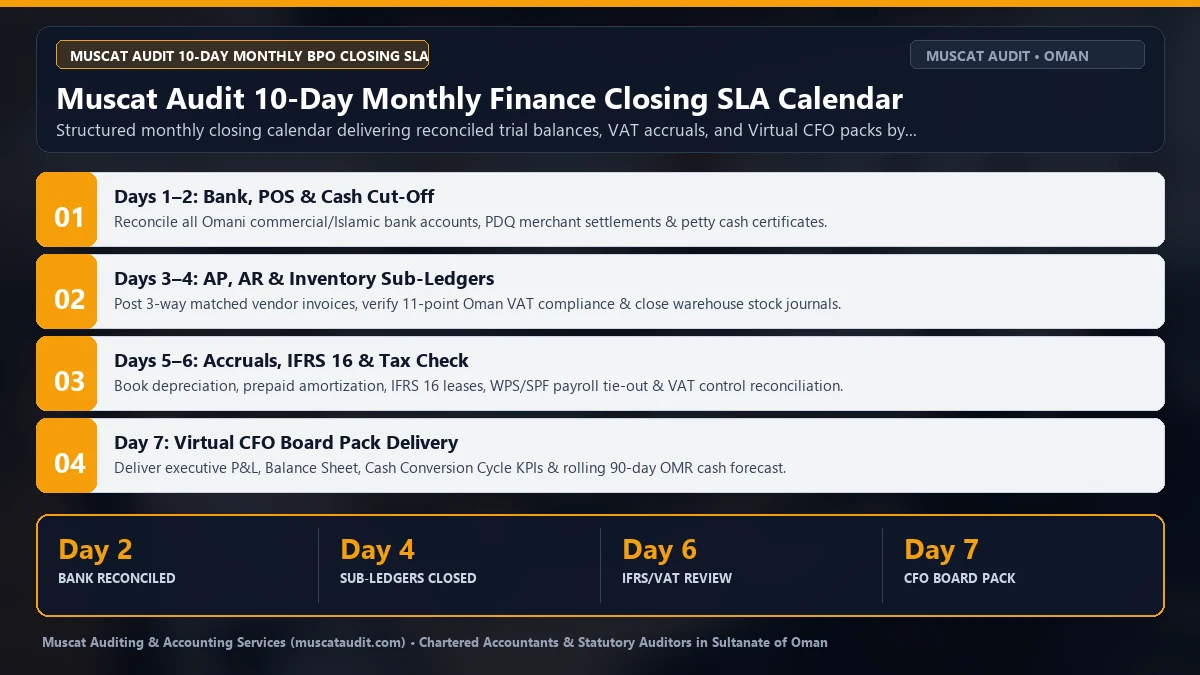
- Record-to-Report (R2R) & Virtual CFO Reporting: Monthly hard-close by Day 7, including accrual journals, prepayment amortization, fixed asset depreciation, IFRS 16 lease schedules, intercompany reconciliations, and a board-ready CFO dashboard comparing actuals against budget.
- OTA Tax & VAT Compliance Management: Preparation and reconciliation of quarterly VAT returns and annual Corporate Income Tax returns in collaboration with our Tax & VAT Advisory specialists.
4. Payroll BPO: Navigating Royal Decree 53/2023 (WPS) & Royal Decree 52/2023 (SPF)
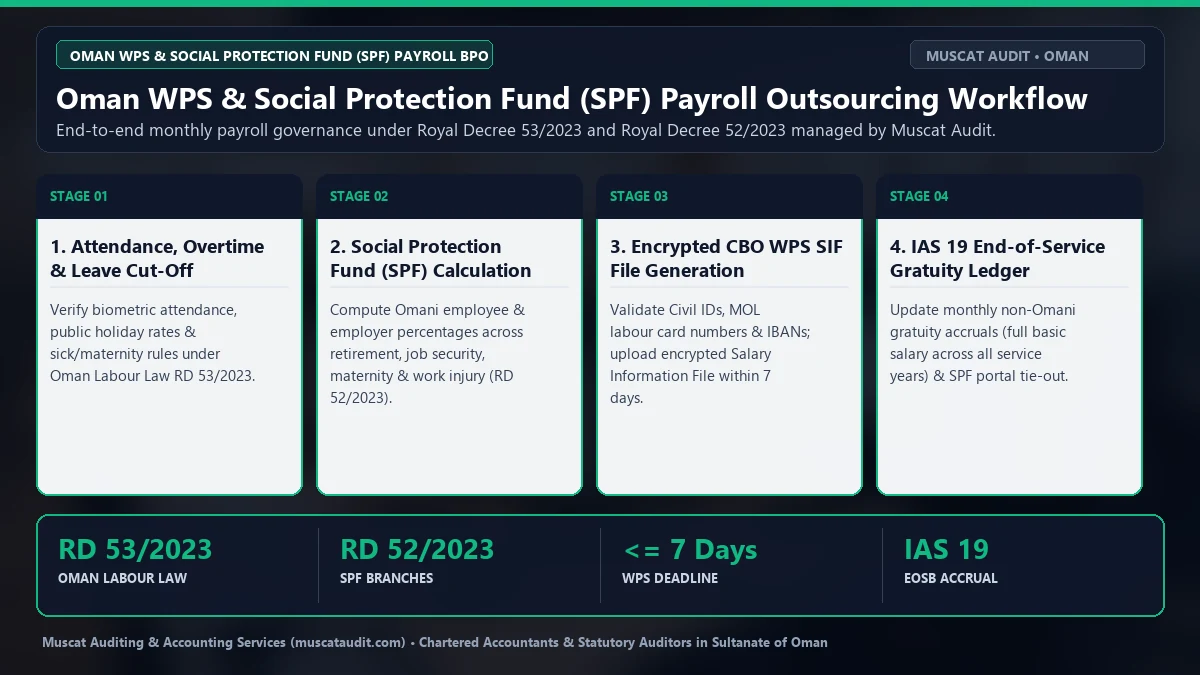
Payroll administration in Oman has undergone its biggest transformation in twenty years following the enactment of the Oman Labour Law (Royal Decree No. 53/2023) and the unified Social Protection Law (Royal Decree No. 52/2023). Mistakes in payroll calculation or late WPS file uploads directly impact a company’s Ministry of Labour electronic clearance status—blocking work permit renewals and government tender eligibility.

Our HR & Payroll Outsourcing Services protect executive confidentiality while ensuring 100% statutory precision:
- CBO Wage Protection System (WPS) SIF File Generation: Validating employee Civil IDs, labour card numbers, IBANs, basic salary vs. allowances, and legally permissible deduction caps before generating encrypted bank upload files.
- Social Protection Fund (SPF) Multi-Branch Reconciliation: Accurately calculating employee and employer contribution percentages across old-age/disability/death, job security, maternity leave insurance, sickness leave insurance, and work injury branches, alongside preparing for the transition toward the unified Provident/Savings System for non-Omani workers.
- End-of-Service Gratuity (EOSB) Actuarial & Accounting Accruals: Under Royal Decree 53/2023, statutory end-of-service indemnity for non-Omani employees is calculated on basic salary across all years of service (eliminating the legacy 15-day cap on the first three years for updated contracts). We maintain employee-by-employee EOSB schedules reconciled directly to the general ledger.
5. Designing Bulletproof SLAs, Maker-Checker Controls & Cloud ERP Architecture
Whether your enterprise runs Odoo Enterprise, Zoho Books Oman Edition, SAP Business One, Microsoft Dynamics 365 Business Central, Oracle NetSuite, or TallyPrime, an outsourced finance department is only as strong as its Service Level Agreement (SLA) and approval matrix. We configure cloud-based document capture and role-based access permissions so that your management team retains 100% visibility and bank release authority via smartphone or desktop, while Muscat Audit handles 100% of the coding, reconciliation, and compliance heavy lifting (read our related analysis on How Proper Bookkeeping Transforms SME Growth and Bank Loan Approvals in Oman).
Worked Transition Case: 30-Day Migration of a Muscat Trading & Contracting LLC to Managed FAO
How does an Omani company transition from an overburdened in-house bookkeeper to a managed BPO pod without disrupting daily vendor payments or customer billing? We follow a structured 30-day onboarding protocol: during Week 1 (Diagnostic & Cut-Off), our onboarding team audits the opening trial balance, reconciles all Omani bank accounts and petty cash floats, and verifies historical OTA VAT and Social Protection Fund (SPF) portal filings; during Week 2 (Cloud ERP & Approval Matrix Setup), we configure digital invoice capture, cost-center tags, and Maker-Checker-Approver workflows in Odoo, Zoho Books, or SAP Business One; during Week 3 (Parallel Run & WPS Dry Run), we process live payables, receivables, and the monthly WPS SIF payroll file alongside management sign-off; and by Week 4 (First Day-7 Hard Close), the Board receives its first reconciled Virtual CFO management pack—complete with customer aging, SKU margin analysis, and a rolling 90-day OMR cash forecast.
6. Mandatory Omani Statutory Record Rules vs. Outsourced Finance Best Practices
Mandatory Statutory Requirements in Oman
- 10-Year Statutory Accounting & Tax Record Retention: Under Oman Income Tax Law and VAT Law (Article 72 of RD 121/2020), businesses must preserve organized accounting books, general ledgers, and tax invoices for 10 years (15 years for real estate records).
- Timely WPS Salary Disbursement (RD 53/2023): Employers in Oman must transfer monthly wages via the Wage Protection System within 7 days of the end of the wage period to avoid Ministry of Labour administrative blocks.
- Monthly SPF Remittance (RD 52/2023): Social Protection Fund contributions must be reconciled and paid monthly within the statutory window to prevent automatic late-payment surcharges.
- Accrual Basis Accounting in Omani Rials (OMR): Corporate tax returns and MoCIIP statutory financial statements must be maintained on the accrual basis under IFRS in OMR (unless foreign-currency functional permission is granted).
Professional Best-Practice Recommendations
- Enforce Strict Maker-Checker Segregation: Never allow the same person who maintains vendor bank details or records purchase invoices to authorize online bank transfers.
- Adopt a 7-Business-Day Monthly Hard Close: Close sub-ledgers (AP, AR, Inventory, Bank, Payroll) by the 7th business day of each month rather than waiting until year-end.
- Maintain Digital Cloud Voucher Attachments: Attach a PDF/image scan of every supplier tax invoice, customs Bayan, and delivery note directly to its ERP journal entry for instant audit retrieval.
- Conduct Quarterly Virtual CFO Reviews: Pair outsourced bookkeeping with a quarterly Virtual CFO review of gross margin by product line, working capital days, and tax exposure.
7. Frequently Asked Questions on Business Process & Accounts Outsourcing in Oman
Is it more cost-effective for an Omani LLC or SME to hire an in-house accounting team or outsource to a BPO/FAO firm in Muscat?
For Omani SMEs and mid-market enterprises with annual turnover between OMR 150,000 and OMR 5,000,000, full or hybrid Finance and Accounting Outsourcing (FAO) typically reduces Total Cost of Ownership (TCO) by 32% to 48%. In-house costs include not only base salaries and housing/transport allowances, but also Ministry of Labour visa/licensing fees, mandatory health insurance, Social Protection Fund (SPF) employer contributions, annual leave/airfare accruals, and the operational risk of single-accountant turnover during quarterly VAT or year-end audit cycles.
How does outsourcing accounting and back-office functions interact with Omanisation requirements under the Ministry of Labour?
Under Ministry of Labour regulations in Oman, specified job codes across finance, administration, and human resources are subject to sectoral Omanisation targets or reserved occupation rules. Partnering with an Oman-based professional firm for Business Process and Accounts Outsourcing allows growing companies to access a dedicated team of Omani and Chartered accountants under a corporate service level agreement (SLA) while focusing their direct in-house recruitment quotas on core revenue-generating and operational roles.
How do outsourced payroll teams in Oman handle Wage Protection System (WPS) and Social Protection Fund (SPF) filings?
Under Oman’s Labour Law (Royal Decree 53/2023) and Social Protection Law (Royal Decree 52/2023), employers must disburse salaries in Omani Rials through Central Bank of Oman (CBO) Wage Protection System (WPS) bank files within seven days of the due date and remit monthly Social Protection Fund (SPF) contributions for Omani staff (plus maternity, work injury, and sickness branches). An outsourced BPO payroll team prepares the encrypted WPS SIF file, reconciles SPF portal deductions, and tracks expatriate end-of-service gratuity liabilities under IAS 19.
Can a company outsource its bookkeeping and internal accounting to the same firm that performs its statutory external audit in Oman?
Under the International Code of Ethics for Professional Accountants (IESBA) and Omani statutory audit independence rules enforced by MoCIIP and the FSA, an audit firm cannot audit financial statements that it has itself prepared for a Public Interest Entity, and strict self-review safeguards apply. Where a client engages Muscat Audit for outsourced accounting/BPO, we either maintain strict Chinese-wall team separation where permissible or coordinate seamlessly with an independent statutory sign-off structure so independence is 100% preserved.
What Service Level Agreements (SLAs) should an Omani company demand in a Finance & Accounts Outsourcing contract?
A robust FAO contract in Oman should stipulate quantifiable KPIs: daily bank and POS reconciliation within 24–48 business hours, monthly trial balance and management pack closing by Day 7 of the following month, WPS payroll file delivery by the 25th of each month, draft OTA VAT return submission 10 days before the statutory deadline, and 100% audit PBC schedule readiness within 20 days of fiscal year-end.
Upgrade Your Finance Function with Muscat Audit’s Managed BPO & FAO Team
Eliminate accounting backlogs, key-person turnover risk, and tax filing anxiety. Speak with our Business Process & Accounts Outsourcing directors in Muscat to receive a tailored TCO comparison and 30-day transition roadmap for your Omani company.