
Corporate Finance, Debt Restructuring, Islamic Sukuk & Oman Development Bank (ODB) Funding Advisory in Oman
Access to competitively priced capital is the decisive catalyst that separates Omani companies that scale across the GCC from those that stall under working-capital strain. Following Oman’s sovereign credit rating upgrades to investment grade and the promulgation of the New Banking Law (Royal Decree No. 2/2025) alongside the establishment of the Financial Services Authority (FSA), corporate borrowers in Muscat, Sohar, Duqm, and Salalah have more financing instruments available than ever before—spanning conventional commercial credit, Sharia-compliant Islamic banking, sovereign developmental loans through the Oman Development Bank (ODB), and capital-market Sukuk issuances.
At the same time, credit underwriting standards enforced by the Central Bank of Oman (CBO) under Basel III and IFRS 9 have grown significantly more analytical. Commercial lenders no longer extend credit solely against personal guarantees or unverified management projections. Engaging a premier firm for Financial Advisory Services in Oman ensures your Information Memorandum, three-statement financial model, and audited balance sheet are structured to pass rigorous credit committee scrutiny.
1. Navigating Oman’s Evolving Corporate Credit & Capital Markets Landscape
Across the Sultanate, mid-market LLCs, family conglomerates, and industrial SAOCs frequently encounter a structural mismatch in their balance sheets: funding long-term capital expenditure (factory expansions, fleet acquisitions, or project mobilization) using short-term working capital lines such as bank overdrafts, 90-day Loan Against Trust Receipts (LTRs), or bill discounting facilities. When a major contract payment is delayed by 60 days, the company’s short-term revolving limits freeze, triggering a liquidity crunch even though the underlying business is profitable.
Our Corporate Finance & Business Advisory practice helps Omani CFOs and business owners realign their debt maturity profile with the economic life of their assets—matching trade working capital with revolving Murabaha/LTR lines, equipment and warehouse builds with 5-to-10-year term debt or ODB concessional financing, and large infrastructure or real estate expansions with syndicated facilities or Sukuk.
2. Comparing Corporate Funding Channels in Oman: Commercial Debt, Islamic Finance, ODB & Sukuk
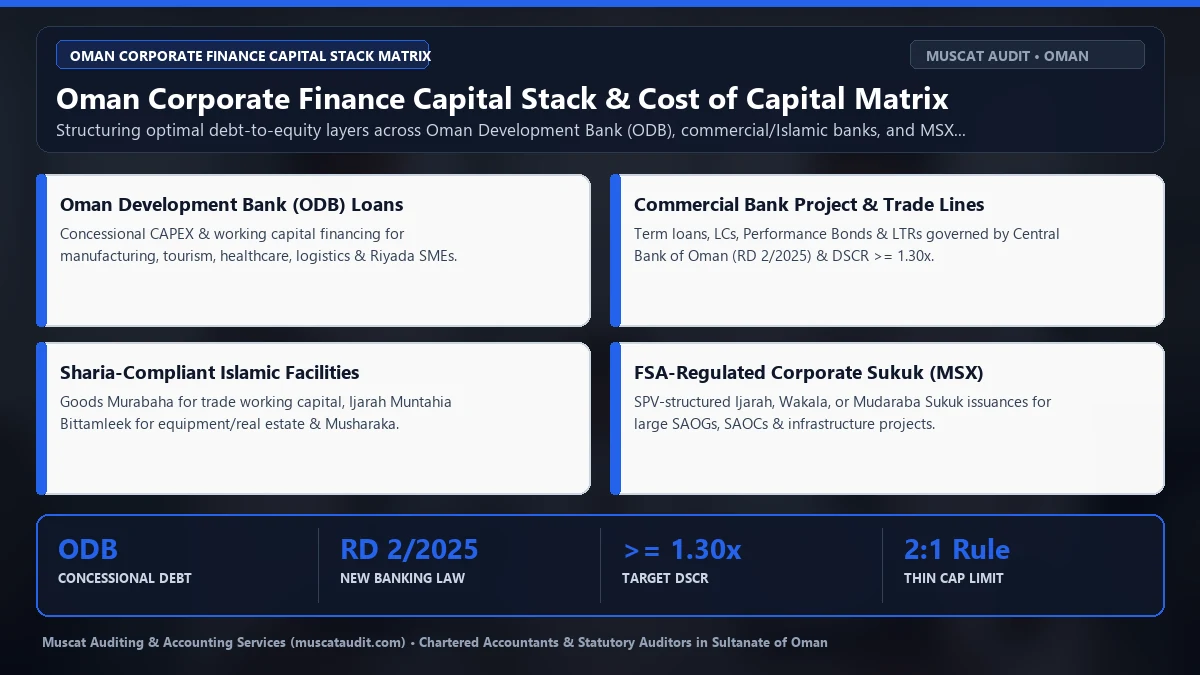
| Financing Channel | Typical Instrument Structures | Best Suited For | Key Audit & Advisory Prerequisites |
|---|---|---|---|
| Oman Development Bank (ODB) & SME Funds | Subsidized / Concessional Term Loans, CAPEX & Working Capital Facilities | Manufacturing, Tourism, Agriculture, Fisheries, Healthcare, Logistics & Riyada SMEs | Bankable Feasibility Study, 5-to-10-year cash flow model, verified CR/municipal permits & audited accounts. |
| Commercial Bank Corporate Facilities | Overdrafts, LTRs, LCs, Performance Bonds, Project Finance & Term Loans | Established LLCs, EPC contractors (PDO/OQ/Gov tenders), Importers & Trading Groups | 3 years of unqualified IFRS audited financials, clean Mala’a credit report, DSCR ≥ 1.30x & contract assignment. |
| Islamic Banking Facilities | Commodity/Goods Murabaha, Ijarah Muntahia Bittamleek, Diminishing Musharaka, Wakala | Asset-backed real estate, industrial machinery, fleet expansion & Sharia-compliant corporates | Identifiable tangible underlying assets, sequence-of-contracts compliance & Sharia audit verification. |
| Corporate Sukuk & Debt Capital Markets (MSX/FSA) | Public or Private Placement Ijarah / Wakala / Mudaraba Sukuk & Corporate Bonds | SAOGs, large SAOCs, Energy/Infrastructure SPVs & Real Estate Investment Vehicles | FSA prospectus approval, SPV incorporation, Sharia Supervisory Board fatwa & credit rating. |
3. Securing Oman Development Bank (ODB) & SME Development Financing
For Omani industrialists and entrepreneurs building factories in Rusayl, Sohar, Nizwa, or Raysut, or launching healthcare, educational, or tourism projects, the Oman Development Bank (ODB)—working alongside the Small and Medium Enterprises Development Authority (Riyada)—offers highly attractive financing terms, extended grace periods during construction, and competitive profit/interest rates aligned with national economic diversification priorities.
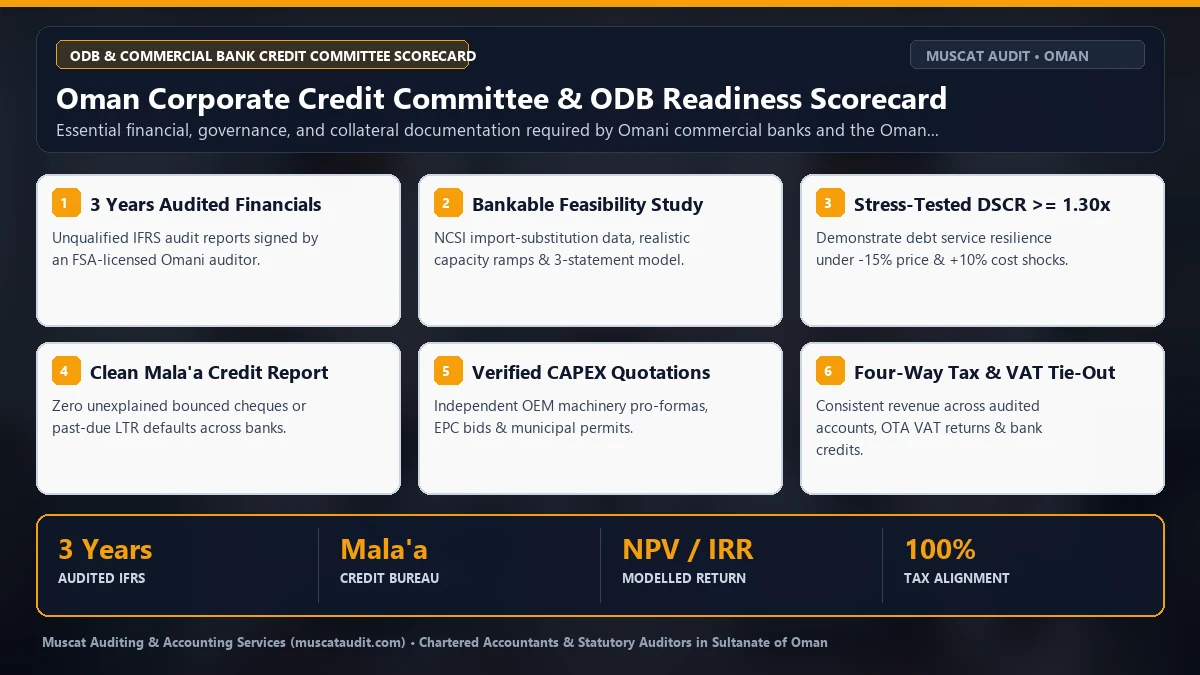
Why do some ODB and commercial project-finance applications get approved in weeks while others stall in credit review? Credit analysts look for a cohesive, stress-tested package prepared by qualified Feasibility Study & Financial Modelling advisors:
- Independent Market & Technical Feasibility: Verified import-substitution data (utilizing National Centre for Statistics and Information [NCSI] and Royal Oman Police customs trade statistics), realistic capacity utilization ramps (e.g., 45% in Year 1, 65% in Year 2, 80% in Year 3), and documented supplier EPC/machinery quotes.
- Dynamic Sensitivity & Breakeven Analysis: Demonstrating that the project maintains a Debt Service Coverage Ratio (DSCR) above 1.30x even under a 15% drop in selling prices or a 10% increase in raw material input costs.
4. Structuring Sharia-Compliant Facilities (Murabaha, Ijarah) & FSA-Regulated Sukuk
Islamic banking assets in Oman have grown steadily across standalone Islamic banks (Bank Nizwa, Alizz Islamic Bank) and dedicated Islamic windows (Meethaq, Muzn, Sohar Islamic, Maisarah, Al Yusr, Ahli Islamic), now operating under the modernized framework of Royal Decree 2/2025. For corporate treasurers, Sharia-compliant structures require strict accounting and operational discipline:
- Sequence of Contracts in Murabaha Trade Finance: Unlike a conventional overdraft that reimburses past invoices, an Islamic Goods Murabaha facility requires the bank (or the company acting as disclosed Wakeel/agent prior to supplier payment) to purchase the inventory or raw materials first and sell them to the corporate at a disclosed cost-plus-profit markup. Submitting already-paid supplier invoices to a Murabaha desk invalidates the transaction under Sharia audit rules.
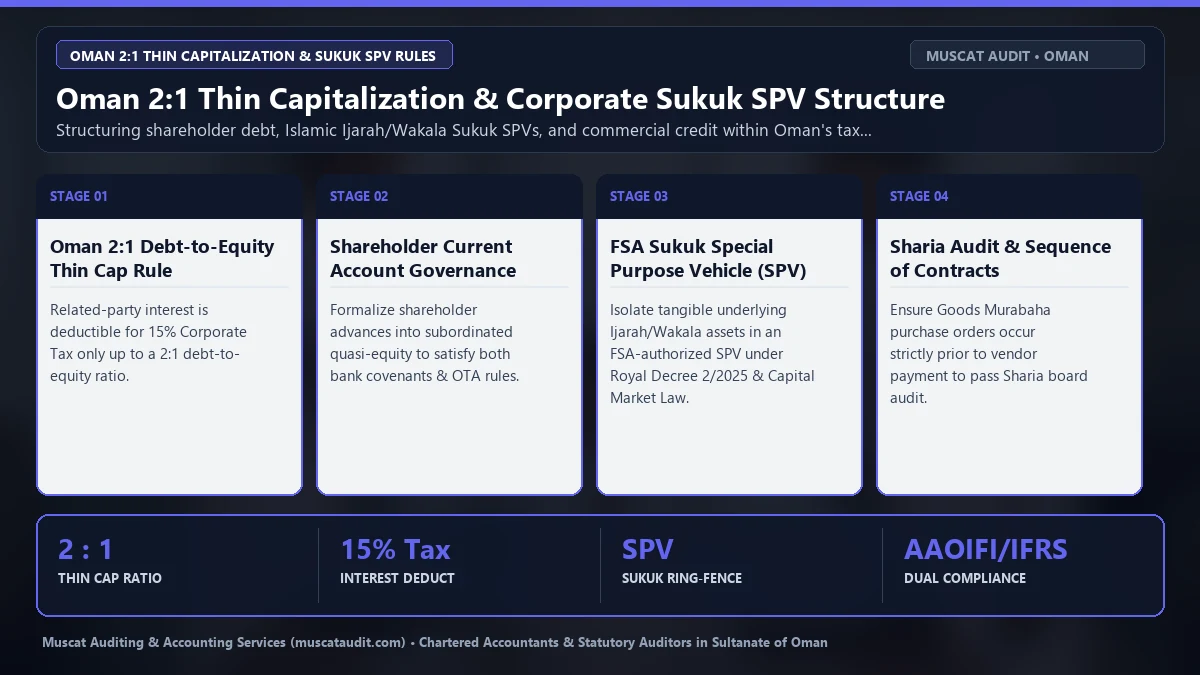
- Sale-and-Leaseback Ijarah & Sukuk SPVs: Corporates with unencumbered industrial land, warehouses, or commercial buildings can unlock liquidity without diluting equity by executing an Ijarah Muntahia Bittamleek or issuing FSA-regulated Sukuk through a Special Purpose Vehicle (SPV). Our Business Valuations & Corporate Finance team prepares the independent asset valuation, cash-flow coverage model, and IFRS 16 / IFRS 9 accounting treatment assessment.
5. Debt Restructuring, Independent Business Reviews (IBR) & DSCR Covenant Rescue
When an Omani contracting, trading, or manufacturing company faces delayed receivable collections, rising finance costs, or approaching maturity walls, waiting until a bank facility falls into past-due default is a costly mistake. Under CBO IFRS 9 staging guidelines, once a corporate borrower exhibits significant increase in credit risk (Stage 2) or 90+ days past due (Stage 3), banks face higher regulatory provisioning charges and tighten credit lines.
Muscat Audit acts as lead financial restructuring advisor to bridge the confidence gap between Omani borrowers and bank credit/special-assets committees:
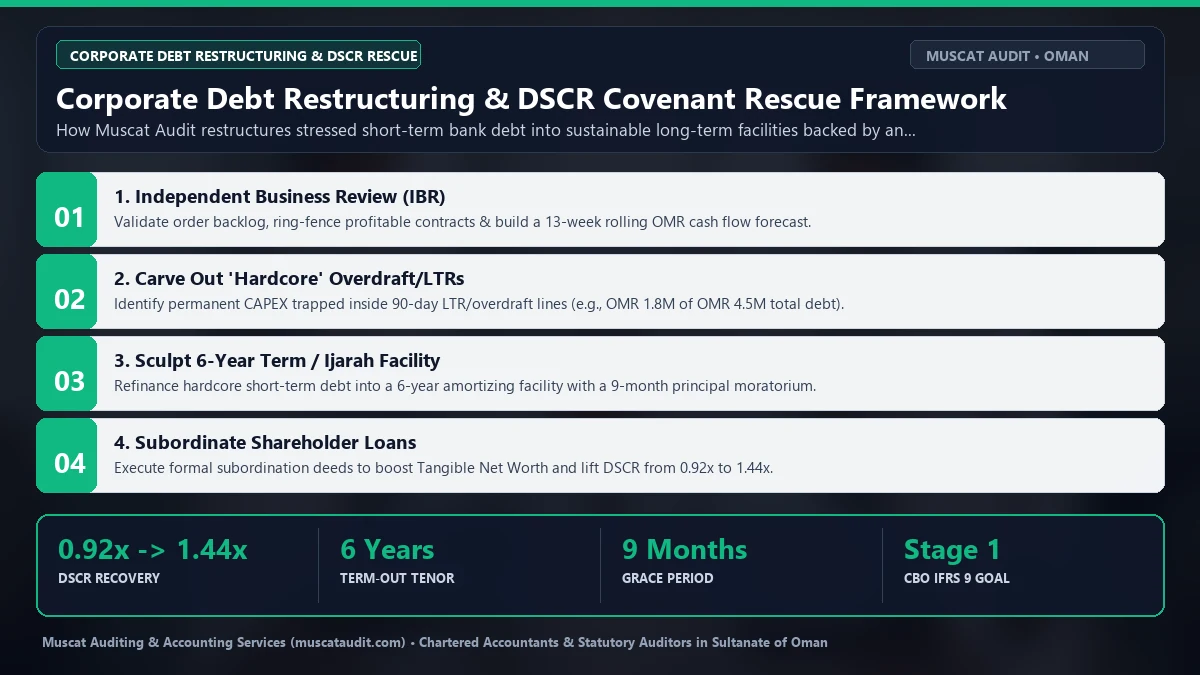
- Independent Business Review (IBR) & 13-Week Rolling Cash Flow: We validate the company’s order backlog, ring-fence core profitable contracts from loss-making divisions, and build a granular 13-week cash flow forecast showing exact debt-service capacity.
- Hardcore Working Capital Term-Out: Where a company’s overdraft or revolving LTR line has become permanently fully drawn (“hardcore debt”), we structure a reprofiling proposal that carves out the hardcore portion into a 5-to-7-year amortizing term loan with a 6-to-12-month principal moratorium, restoring active LC/LTR limits so the business can fulfill new orders (see also our guide on Bank Loan Facility & Project Finance Audits in Oman).
Worked OMR Case Study: Restructuring a Stressed OMR 4.5 Million Working Capital Facility
Consider a mid-sized Omani electromechanical and industrial trading LLC in Muscat carrying OMR 4,500,000 in total bank debt across two commercial banks: OMR 1,500,000 in a high-cost bank overdraft and OMR 3,000,000 in 90-day Loan Against Trust Receipts (LTRs). After investing OMR 1,400,000 of short-term cash into a new fabrication workshop in Sohar and experiencing 120-day receivable delays on major project retentions, the company’s LTR lines hit 98% utilization, dropping its Debt Service Coverage Ratio (DSCR) to 0.92x and threatening an imminent CBO IFRS 9 Stage 2 downgrade.
Engaged as lead corporate finance advisor, Muscat Audit prepared an Independent Business Review (IBR) and a 13-week rolling cash flow model demonstrating that OMR 1,800,000 of the short-term overdraft/LTR balance represented permanent “hardcore” CAPEX and long-cycle retention funding. By presenting a unified restructuring package to both lenders, we carved out OMR 1,800,000 into a 6-year sculpted Islamic Ijarah / Term Facility with a 9-month principal grace period, converted OMR 600,000 of Shareholder Current Account balances into formally subordinated quasi-equity (boosting Tangible Net Worth and satisfying Oman’s 2:1 thin capitalization rules), and restored OMR 2,700,000 in clean revolving LC/LTR trade lines—lifting projected Year-1 DSCR to a bankable 1.44x.
6. Mandatory Banking/FSA Rules vs. Corporate Treasury Best Practices
Mandatory Statutory Requirements in Oman
- Audited IFRS Financial Statements for Credit Renewal: Omani banks and ODB require annual audited financial statements signed by a licensed external auditor in Oman to renew funded and non-funded credit limits.
- Subordination of Shareholder Loans: When commercial banks require Shareholder Current Accounts to be subordinated as quasi-equity to meet leverage covenants, formal subordination agreements and board resolutions must be executed and disclosed in the audit notes.
- FSA Approval for Sukuk & Debt Issuances: Any public or private placement Sukuk or corporate bond issuance in Oman must comply with Financial Services Authority (FSA) prospectus and SPV regulations.
- Withholding Tax & Thin Capitalization (Debt-to-Equity 2:1) Rules: Under Oman Income Tax Law, interest paid to related parties is subject to strict 2:1 debt-to-equity thin capitalization limits for corporate tax deductibility.
Professional Best-Practice Recommendations
- Match Asset Life to Debt Tenor: Never finance multi-year CAPEX (machinery, fleet, warehouse construction) out of 90-day LTR or overdraft lines.
- Monitor Quarterly Covenant Headroom 6 Months Ahead: Run quarterly rolling DSCR, Current Ratio, and Leverage checks so covenant waivers or resets are negotiated before year-end.
- Maintain Dual-Bank Relationships: Avoid 100% single-lender concentration by splitting working capital and project lines across at least two Omani conventional or Islamic banks.
- Prepare an Institutional Information Memorandum (IM): Present banks with a board-grade IM and dynamic Excel financial model rather than raw trial balances.
7. Frequently Asked Questions on Corporate Finance in Oman
What financing options are available through the Oman Development Bank (ODB) for Omani SMEs and industrial projects?
The Oman Development Bank (ODB) provides developmental and concessional financing for startups, Riyada-certified SMEs, and larger strategic projects across priority Oman Vision 2040 sectors—including manufacturing, agriculture, fisheries, tourism, healthcare, education, and logistics. To secure ODB approval, applicants must submit a bankable Feasibility Study, valid Commercial Registration (CR) licences, quotation pro-formas for machinery/CAPEX, and—for existing companies—IFRS audited financial statements.
How did Oman’s New Banking Law (Royal Decree 2/2025) impact corporate and Islamic finance in the Sultanate?
Royal Decree No. 2/2025 modernized Oman’s banking framework (replacing the 2000 Banking Law), strengthening Central Bank of Oman (CBO) governance over commercial and investment banking, digital banking licensing, Special Purpose Vehicles (SPVs) for Islamic finance, and the structural governance of Islamic banking operations.
How do Omani companies raise capital through Islamic Finance or Sukuk?
Corporates in Oman can access Sharia-compliant financing either through bilateral/syndicated Islamic bank facilities (using Murabaha for working capital/trade finance, Ijarah Muntahia Bittamleek for equipment and real estate leasing, or Diminishing Musharaka for project finance) or by issuing corporate Sukuk regulated by the Financial Services Authority (FSA) and listed on the Muscat Stock Exchange (MSX).
What financial ratios do Omani commercial banks scrutinize most closely before approving a corporate credit facility?
Credit committees at Omani commercial and Islamic banks focus primarily on four audited metrics: Debt Service Coverage Ratio (DSCR, typically requiring at least 1.25x to 1.50x), Net Debt-to-EBITDA leverage, Tangible Net Worth (properly excluding unsubstantiated shareholder current account withdrawals), and the Cash Conversion Cycle (receivable days vs. payable days).
When should an Omani company initiate formal debt restructuring with its lenders?
Companies should engage corporate finance advisors at least two quarters before a projected DSCR covenant breach or working-capital liquidity squeeze—allowing management to present an independent Business Review (IBR), 13-week rolling cash flow forecast, and debt reprofiling proposal (such as converting short-term LTR/overdraft debt into a sculpted 5-to-7-year term facility) before accounts are classified under CBO IFRS 9 Stage 2 or Stage 3.
Structure Bankable Capital & Debt Advisory for Your Omani Enterprise
Whether you are applying for Oman Development Bank (ODB) project financing, raising commercial or Islamic working capital facilities, or restructuring existing bank covenants, Muscat Audit’s Corporate Finance and Chartered Accountancy team in Muscat is ready to lead your transaction.