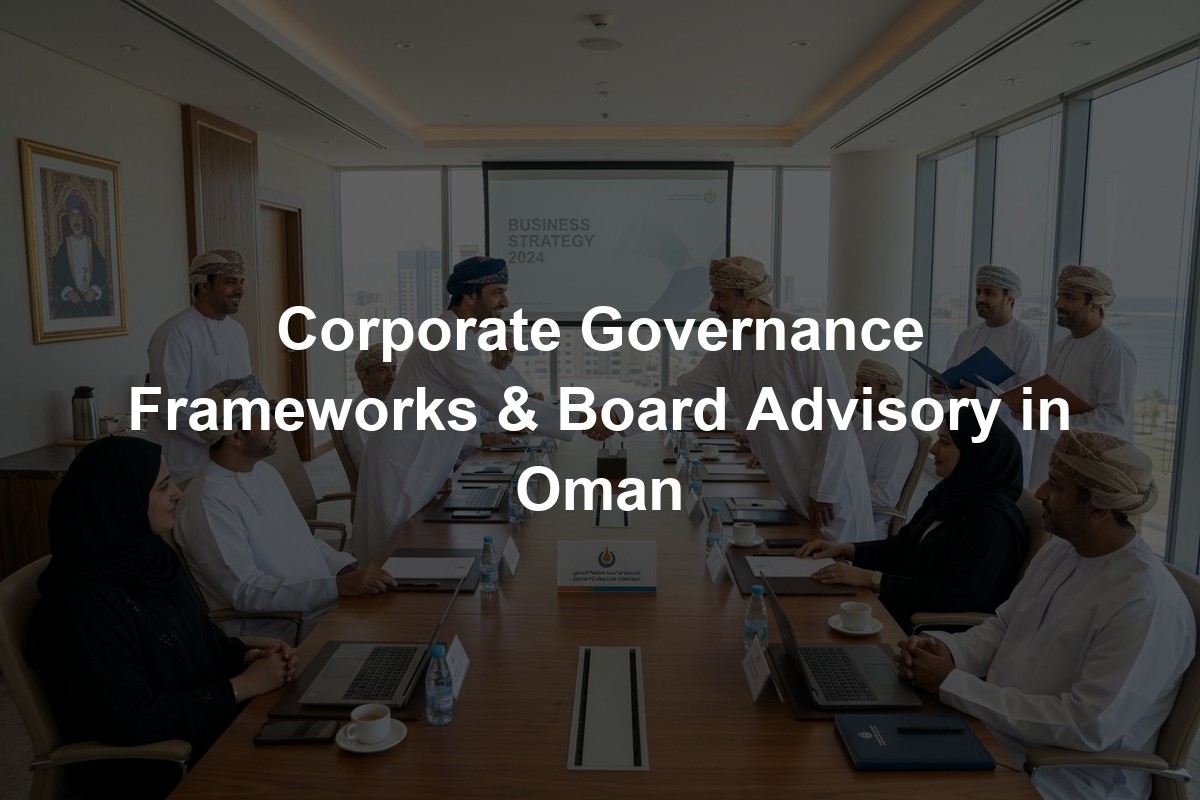
The Strategic Importance of Corporate Governance Frameworks & Board Advisory in Oman in Oman’s Evolving Economy
To truly appreciate the value of Corporate Governance Frameworks & Board Advisory in Oman, one must first understand the broader macroeconomic context of Oman. The Sultanate is actively transitioning away from a hydrocarbon-dependent economy towards a diversified, knowledge-based ecosystem. This monumental shift necessitates a corresponding evolution in corporate governance, financial transparency, and operational efficiency. The government has implemented sweeping reforms designed to modernize the business environment, attract foreign direct investment (FDI), and stimulate the growth of small and medium-sized enterprises (SMEs). Within this paradigm, Corporate Governance Frameworks & Board Advisory in Oman acts as a foundational pillar.
When an organization commits to excellence in Corporate Governance Frameworks & Board Advisory in Oman, it sends a powerful signal to the market. It demonstrates to investors, regulatory bodies, banking institutions, and business partners that the company is managed with integrity, precision, and a forward-looking perspective. This level of transparency is invaluable. It facilitates easier access to capital, lowers borrowing costs, and enhances the overall valuation of the enterprise. Furthermore, in an increasingly competitive marketplace, operational inefficiencies can quickly erode profit margins. By implementing the rigorous controls and strategic frameworks associated with Corporate Governance Frameworks & Board Advisory in Oman, companies can identify hidden costs, streamline their workflows, and optimize resource allocation.
Moreover, the strategic importance extends to risk management. The modern business landscape is fraught with risks—ranging from cybersecurity threats and supply chain disruptions to sudden regulatory shifts and economic downturns. A robust approach to Corporate Governance Frameworks & Board Advisory in Oman provides the necessary early warning systems and mitigation strategies to protect the company’s assets and ensure business continuity. It shifts the organizational mindset from reactive firefighting to proactive risk management. As a leading Audit firm in Oman, we have consistently observed that our clients who prioritize this strategic approach are significantly more resilient and adaptable in the face of unforeseen challenges.
Furthermore, the integration of advanced technologies is reshaping how Corporate Governance Frameworks & Board Advisory in Oman is executed. The adoption of artificial intelligence, machine learning algorithms, and blockchain technology is providing unprecedented levels of analytical depth and accuracy. These tools allow financial professionals to move beyond basic reporting and delve into predictive analytics, forecasting future trends with remarkable precision. This technological integration is not merely a trend; it is a fundamental shift in how financial data is leveraged for strategic decision-making. In Oman, businesses that are early adopters of these technologies are gaining a significant competitive advantage.
Navigating the Complex Regulatory Landscape in the Sultanate
Operating a business in Oman requires a deep and nuanced understanding of a complex, multi-layered regulatory environment. The government has established several key authorities to oversee various aspects of commercial activity, and adherence to their mandates is non-negotiable. A comprehensive strategy for Corporate Governance Frameworks & Board Advisory in Oman must be intrinsically linked to this regulatory framework.
The Ministry of Commerce, Industry and Investment Promotion (MOCIIP) is the primary gateway for business operations. They oversee company registration, commercial licensing, and the enforcement of the Commercial Companies Law. This law dictates the structural requirements, governance protocols, and reporting obligations for different types of corporate entities, such as Limited Liability Companies (LLCs) and Joint Stock Companies (SAOCs/SAOGs). Failure to comply with MOCIIP regulations can result in severe penalties, including fines and the suspension of commercial activities.
Equally critical is the Capital Market Authority (CMA), which regulates the financial services sector, insurance companies, and publicly listed entities. The CMA is instrumental in setting standards for corporate governance, disclosure requirements, and the protection of minority shareholders. For companies aiming for public listing or seeking significant institutional investment, adhering to CMA guidelines is a prerequisite. Our role as a premier Audit firm in Oman involves guiding our clients through these rigorous compliance audits.
Furthermore, the Oman Tax Authority (OTA) plays a central role in the financial life of every business. The introduction of Value Added Tax (VAT) and the ongoing refinement of Corporate Income Tax regulations have significantly increased the compliance burden. A fundamental component of Corporate Governance Frameworks & Board Advisory in Oman involves ensuring meticulous record-keeping, accurate tax calculations, and the timely filing of returns. The OTA is increasingly utilizing sophisticated data analytics to identify discrepancies, making it imperative for businesses to maintain impeccable financial hygiene. Additionally, the recent implementation of Economic Substance Regulations (ESR) requires companies engaged in specific relevant activities to demonstrate adequate economic presence in the Sultanate, adding another layer of complexity to the compliance landscape.

Deep Dive: Core Methodologies and Implementation Strategies
Understanding the theory of Corporate Governance Frameworks & Board Advisory in Oman is one thing; implementing it effectively across a complex organization is another entirely. A successful implementation requires a structured, phased approach that integrates people, processes, and technology. As an experienced Audit firm in Oman, we advocate for a holistic methodology that begins with a comprehensive diagnostic phase and culminates in continuous optimization.
Comprehensive Diagnostic and Gap Analysis
The journey begins with a meticulous assessment of the current state. This involves a deep dive into existing financial processes, internal control mechanisms, IT infrastructure, and organizational culture. The objective is to identify vulnerabilities, inefficiencies, and compliance gaps. We conduct extensive interviews with key stakeholders, review historical financial data, and map out the entire lifecycle of financial transactions. This diagnostic phase serves as the foundation upon which the entire strategy is built. It ensures that the subsequent solutions are tailored to the specific needs and challenges of the organization, rather than applying a generic, one-size-fits-all approach.
Strategic Design and Process Re-engineering
Based on the findings of the gap analysis, the next phase involves designing the target operating model. This often necessitates the re-engineering of legacy processes to eliminate redundancies, enhance data accuracy, and strengthen internal controls. We work closely with our clients to establish clear policies and procedures, define roles and responsibilities, and design robust reporting frameworks. A critical aspect of this phase is the selection and integration of appropriate technological solutions. Whether it’s upgrading an ERP system, implementing automated reconciliation software, or deploying advanced analytics tools, the technology must align seamlessly with the newly designed processes.
Execution, Change Management, and Training
Implementation is often where organizations encounter the most significant resistance. A robust change management strategy is essential to ensure user adoption and minimize disruption to daily operations. This involves clear communication, active stakeholder engagement, and comprehensive training programs. Employees must not only understand the new processes but also appreciate the rationale behind them. Training should cover not only the technical aspects of new software but also the broader principles of financial governance and compliance. As a leading Audit firm in Oman, we provide extensive support during this critical transition period.
Continuous Monitoring, Auditing, and Optimization
The implementation of Corporate Governance Frameworks & Board Advisory in Oman is not a destination; it is an ongoing journey. The business environment is constantly changing, and internal controls must adapt accordingly. This requires a formalized program of continuous monitoring and internal auditing. Key Performance Indicators (KPIs) must be tracked, and regular reviews should be conducted to assess the effectiveness of the implemented processes. This iterative approach allows organizations to identify emerging risks, capitalize on new technological advancements, and continuously refine their financial operations for maximum efficiency and compliance.
Sector-Specific Nuances and Tailored Approaches
The application of Corporate Governance Frameworks & Board Advisory in Oman is highly dependent on the specific industry in which a company operates. While the fundamental principles of financial governance remain consistent, the operational realities, risk profiles, and regulatory requirements vary significantly across different sectors. A generic approach is invariably insufficient.
The Construction and Real Estate Sector: In this sector, project-based accounting is paramount. The ability to accurately track costs, manage subcontractor payments, and forecast cash flow on a project-by-project basis is critical to profitability. Furthermore, the complexities of revenue recognition for long-term contracts require specialized expertise. A robust Corporate Governance Frameworks & Board Advisory in Oman strategy must incorporate stringent cost control mechanisms and rigorous financial modeling to mitigate the risks associated with project delays and cost overruns.
The Energy and Manufacturing Sector: These industries are characterized by capital-intensive operations, complex supply chains, and significant exposure to volatile commodity prices. Effective inventory management, depreciation strategies for heavy machinery, and sophisticated hedging programs are essential components of financial management. Additionally, compliance with environmental regulations and the reporting of ESG (Environmental, Social, and Governance) metrics are becoming increasingly critical in these sectors.
The Retail and Trading Sector: In retail, the focus shifts to high-volume transaction processing, inventory optimization, and point-of-sale (POS) reconciliation. The ability to track margins at a granular level, manage multi-channel sales data, and quickly identify instances of shrinkage or fraud is vital. A tailored approach to Corporate Governance Frameworks & Board Advisory in Oman in this sector must leverage technology to automate the reconciliation process and provide real-time visibility into inventory levels and sales performance.
The Technology and Services Sector: For service-oriented and technology firms, human capital is often the most significant expense. Accurately tracking billable hours, managing project profitability, and navigating the complexities of intellectual property valuation are key priorities. The rapid scalability of these businesses also requires flexible financial systems capable of supporting rapid growth and international expansion. Our experience as a top Audit firm in Oman allows us to provide customized solutions that address these unique industry challenges.

Advanced Technology Integration for Financial Excellence
We are currently witnessing a paradigm shift in how financial data is managed and analyzed. The integration of advanced technologies is no longer an optional upgrade; it is a fundamental requirement for maintaining a competitive edge. The modern approach to Corporate Governance Frameworks & Board Advisory in Oman is inextricably linked to digital transformation.
Enterprise Resource Planning (ERP) systems represent the foundational layer of this digital architecture. A properly implemented ERP system integrates all core business processes—including finance, HR, manufacturing, and supply chain—into a single, unified database. This eliminates data silos, ensures data consistency, and provides management with a holistic, real-time view of organizational performance. However, implementing an ERP system is a complex undertaking that requires careful planning and expert guidance to ensure a successful return on investment.
Beyond ERP, the application of Artificial Intelligence (AI) and Machine Learning (ML) is revolutionizing financial analysis. These technologies are capable of analyzing vast datasets at unprecedented speeds, identifying patterns and anomalies that would be impossible for a human auditor to detect. AI-driven algorithms can automate complex reconciliations, categorize expenses with high accuracy, and predict future cash flow constraints. This frees up financial professionals to focus on high-value strategic advisory roles rather than mundane administrative tasks.
Furthermore, the emergence of Robotic Process Automation (RPA) is streamlining repetitive, rule-based processes. RPA bots can be programmed to extract data from invoices, process payroll, and generate standard financial reports, operating 24/7 with zero error rates. While these technologies offer immense benefits, they also introduce new cybersecurity and data privacy risks. A comprehensive strategy must incorporate rigorous IT general controls, data encryption protocols, and regular penetration testing to safeguard sensitive financial information.
The Intrinsic Link Between Compliance and Business Growth
There is a common misconception that regulatory compliance is merely a cost of doing business—an administrative burden that distracts from core commercial activities. In reality, a robust framework for Corporate Governance Frameworks & Board Advisory in Oman is a powerful catalyst for sustainable business growth. When compliance is integrated seamlessly into daily operations, it transforms from a defensive mechanism into an offensive strategy.
Consider the process of securing external funding. Whether seeking a bank loan, attracting private equity investment, or preparing for an Initial Public Offering (IPO), potential investors and lenders will scrutinize the company’s financial health and governance structures. A history of clean audit reports, transparent financial disclosures, and adherence to all regulatory mandates significantly lowers the perceived risk profile of the organization. This translates directly into more favorable borrowing terms and higher enterprise valuations.
Furthermore, robust internal controls are essential for identifying and eliminating operational inefficiencies. By analyzing financial data with precision, companies can identify unprofitable product lines, optimize their pricing strategies, and negotiate better terms with suppliers. The insights generated through a rigorous approach to Corporate Governance Frameworks & Board Advisory in Oman empower management to make data-driven decisions that directly enhance the bottom line. As your dedicated Audit firm in Oman, we view compliance not as a restriction, but as a framework for building a stronger, more profitable enterprise.
Future Outlook and Emerging Trends in Oman
The business landscape in Oman is dynamic, and the principles governing Corporate Governance Frameworks & Board Advisory in Oman will continue to evolve. We anticipate several key trends that will shape the future of financial governance in the Sultanate. The regulatory environment will likely become even more stringent, with a continued focus on transparency, anti-money laundering (AML) protocols, and the combatting of terrorist financing (CFT). The OTA is expected to further refine its tax regulations, potentially introducing new indirect taxes or adjusting existing frameworks.
Digitalization will accelerate, with the widespread adoption of e-invoicing and real-time reporting mechanisms. Companies that fail to modernize their financial systems will find it increasingly difficult to meet these evolving reporting requirements. Furthermore, Environmental, Social, and Governance (ESG) criteria will become a central component of corporate reporting. Investors and stakeholders are increasingly demanding transparency regarding a company’s environmental impact, social responsibility initiatives, and governance structures. Integrating ESG metrics into the core financial reporting framework will be essential for maintaining corporate reputation and attracting investment.
Navigating these future trends requires a proactive and adaptable approach. Partnering with a forward-thinking Audit firm in Oman ensures that your organization remains ahead of the curve, prepared to capitalize on emerging opportunities while mitigating novel risks.
Comprehensive FAQ on Corporate Governance Frameworks & Board Advisory in Oman
Q1: What are the immediate benefits of upgrading our approach to Corporate Governance Frameworks & Board Advisory in Oman?
A1: The immediate benefits include significantly enhanced data accuracy, a reduction in processing errors, streamlined workflows that save valuable time, and the immediate identification of cost-saving opportunities. Furthermore, it provides management with the reliable, real-time data necessary for agile decision-making.
Q2: How do we manage the transition to new financial technologies without disrupting our daily operations?
A2: A successful transition requires a phased implementation approach. This involves conducting thorough testing in a sandbox environment, providing extensive training to all users before going live, and maintaining parallel systems during the initial rollout phase to ensure uninterrupted operations. Comprehensive change management is critical.
Q3: What are the specific penalties for non-compliance with Oman Tax Authority regulations?
A3: Penalties vary depending on the nature of the infraction but can include substantial financial fines, late payment interest charges, the suspension of commercial licenses, and in severe cases of tax evasion, criminal prosecution. Maintaining strict compliance is essential for business continuity.
Q4: How does Corporate Governance Frameworks & Board Advisory in Oman apply to a small or medium-sized enterprise (SME) compared to a large corporation?
A4: While the fundamental principles are the same, the scale and complexity differ. SMEs must focus on establishing foundational internal controls, accurate record-keeping, and ensuring tax compliance using cost-effective technological solutions. Large corporations require more sophisticated ERP systems, complex consolidation procedures, and dedicated internal audit functions.
Q5: Why is it necessary to engage an external Audit firm in Oman if we have an internal finance team?
A5: An external firm provides an objective, independent perspective that is invaluable for identifying hidden risks and inefficiencies. Furthermore, reputable advisory firms possess specialized expertise in complex regulatory matters, tax optimization, and advanced technologies that may not exist within an internal team. They act as a strategic partner, supplementing your internal capabilities.
Explore Our Comprehensive Suite of Services
To further support your business objectives, we invite you to explore our specialized services tailored for the Omani market. Discover how our holistic approach to financial management can drive your success:
- ERP System Implementation & Accounting Software Advisory in Oman
- Asset & Enterprise Valuation Services in Muscat, Oman
- Virtual CFO Services & Strategic Financial Consulting in Oman
- IFRS Compliance & Financial Statement Preparation Services in Oman
- Internal Audit & Risk Advisory Services in Oman: Corporate Governance Frameworks
Conclusion: Partnering for Sustainable Success
In conclusion, mastering Corporate Governance Frameworks & Board Advisory in Oman is an indispensable requirement for any business aspiring to achieve sustainable success in the Sultanate of Oman. The complexities of the regulatory environment, the rapid pace of technological advancement, and the demands of a competitive marketplace require a strategic, proactive, and highly disciplined approach to financial governance.
As the premier Audit firm in Oman in Oman, Muscat Audit possesses the deep industry expertise, regulatory knowledge, and technological capabilities to guide your organization through this complex landscape. We are committed to delivering tailored solutions that not only ensure strict compliance but also unlock new avenues for operational efficiency and strategic growth. Do not leave your financial future to chance.
Ready to elevate your financial governance? Contact Muscat Audit today to schedule a comprehensive consultation with our team of leading experts.
Need Expert Professional Guidance in Oman?
Consult with our senior chartered accountants, licensed tax agents, and corporate setup specialists for tailored advisory, statutory audit, and tax compliance.