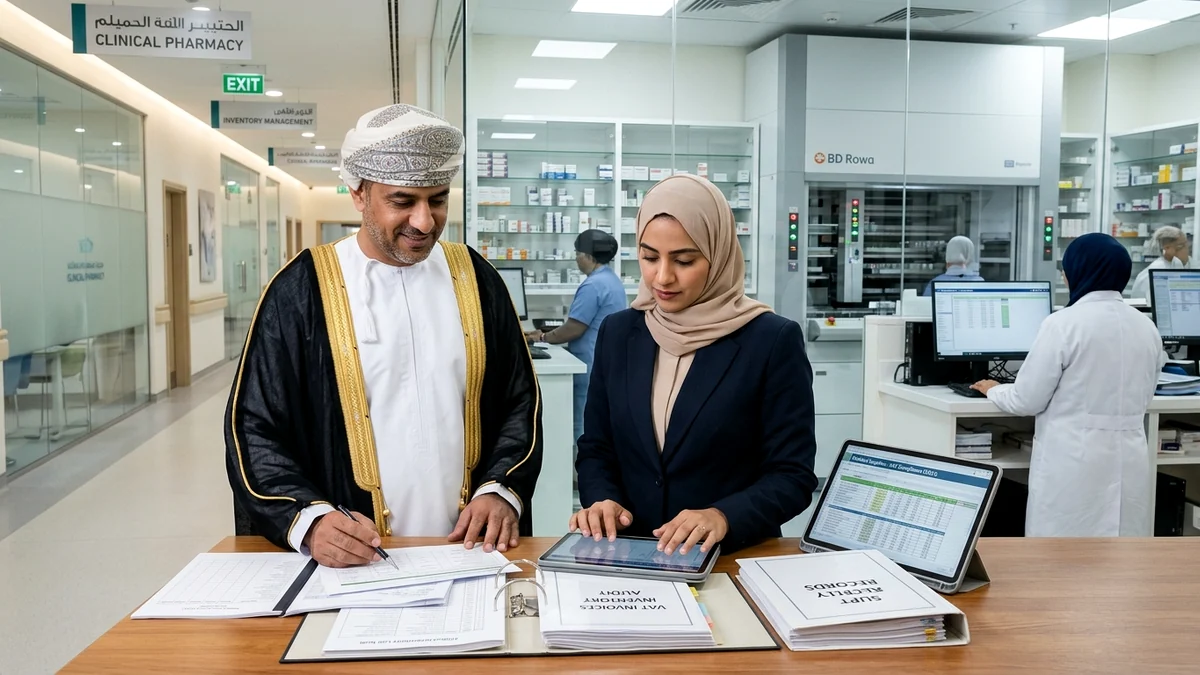
Healthcare, Private Hospital & Pharmacy Accounting and VAT Audit in Oman: Exempt Medical Care vs. Zero-Rated Medicines & Insurance Claims
Private healthcare is expanding rapidly across the Sultanate of Oman—from multi-specialty hospitals in Al Khuwair, Bausher, and Seeb to dental and aesthetic polyclinics in Sohar and Salalah, and nationwide retail pharmacy chains. Yet beneath strong patient volumes lies a financial reporting trap that catches many healthcare operators off guard during Oman Tax Authority (OTA) field inspections: confusing “VAT Exempt” medical services with “Zero-Rated (0%)” pharmaceutical and medical device supplies.
On a patient’s receipt, both Exempt and Zero-Rated items show OMR 0.000 in VAT charged. On the hospital’s general ledger and quarterly VAT return, however, the difference can be worth tens of thousands of Omani Rials in recoverable Input VAT—or severe administrative penalties if residual overhead Input VAT is claimed without a compliant Partial Exemption calculation. Working with the Best Audit Firm in Oman ensures your Hospital Information System (HIS), pharmacy ERP, and TPA insurance receivables align seamlessly with both OTA tax legislation and International Financial Reporting Standards (IFRS).
1. Why Healthcare & Pharmacy Is Oman’s Most Complex VAT Sector
When a commercial trading or manufacturing company in Oman registers for 5% VAT, nearly 100% of its sales are taxable (either at 5% domestically or 0% on exports), allowing it to recover virtually all Input VAT paid on rent, equipment, and professional fees. A private hospital or medical center in Muscat operates under a fundamentally different tax structure: its core clinical revenue—doctor consultations, inpatient ward beds, diagnostic radiology, pathology labs, and surgical theatre fees provided by Ministry of Health (MOH)-licensed practitioners—is Exempt from VAT under Royal Decree 121/2020.
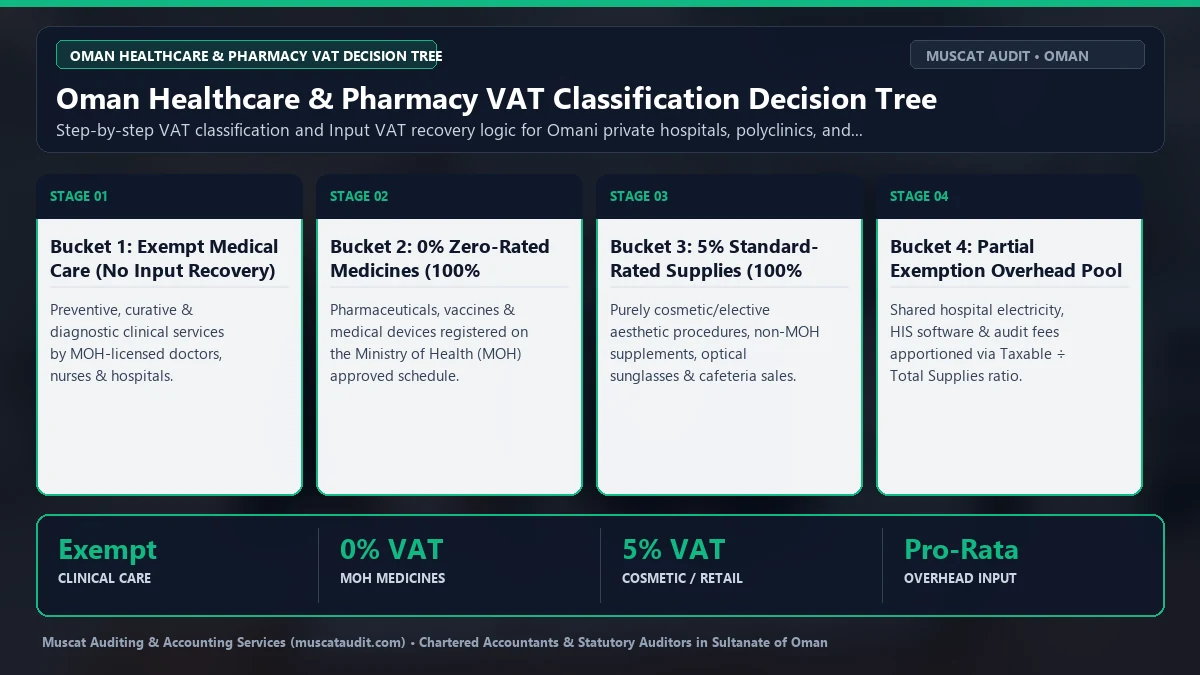
Because Input VAT incurred directly to generate Exempt supplies is non-recoverable, a hospital that only provides exempt clinical care must absorb 5% VAT on its medical consumables, facility maintenance, and outsourced services as an unrecoverable cost. However, virtually every private hospital and polyclinic in Oman operates a mixed-supply business model:
- Exempt Supplies: Licensed medical, surgical, dental, and diagnostic healthcare services for therapeutic purposes;
- Zero-Rated (0%) Taxable Supplies: Sales of qualifying human medicines, vaccines, biological products, and MOH-classified medical equipment; and
- Standard-Rated (5%) Taxable Supplies: Elective cosmetic/aesthetic procedures (Botox, fillers, non-therapeutic plastic surgery), retail pharmacy sales of vitamins/cosmetics/personal care items, hospital cafeteria sales, doctor CME conference fees, and commercial space rentals.
2. Tax Classification Matrix: Exempt Clinical Care vs. 0% Medicines vs. 5% Commercial Supplies
Our Tax & VAT Advisory team uses the following classification matrix when auditing Hospital Information Systems (HIS) and retail pharmacy Item Masters in Oman:
| Healthcare Revenue Stream | Oman VAT Rate | Direct Input VAT Recovery | Key Audit Evidence Required |
|---|---|---|---|
| Therapeutic Consultations, Surgery, Lab & Inpatient Stay | Exempt | 0% (Blocked / Cost to Hospital) | Active MOH facility & clinician licenses; clinical diagnosis code (ICD-10) on patient file. |
| MOH-Registered Human Medicines & Approved Medical Devices | 0% (Zero-Rated) | 100% Recoverable | MOH Drug Registration Certificate, HS customs tariff code, and separate line item on inpatient/pharmacy invoice. |
| Elective Cosmetic / Aesthetic Dermatology & Laser Procedures | 5% (Standard) | 100% Recoverable | Cosmetic consent form; separate 5% tax code in HIS; valid VAT tax invoice. |
| Retail Pharmacy Cosmetics, Supplements, Baby Care & Cafeteria | 5% (Standard) | 100% Recoverable | Barcode SKU segregation in pharmacy POS between MOH drugs (0%) and general retail (5%). |
3. Worked OMR Example: Partial Exemption Input VAT Apportionment for a Muscat Hospital
How should a private hospital in Muscat calculate its recoverable Input VAT each quarter? Under the Oman VAT Executive Regulations, Input VAT must first be directly attributed wherever possible, and only unattributable Residual (Overhead) Input VAT is apportioned using the Partial Exemption recovery ratio:
Suppose Al Noor Specialist Hospital LLC in Bausher records the following quarterly figures:
- Zero-Rated (0%) Pharmacy & Medical Device Sales: OMR 420,000
- Standard-Rated (5%) Aesthetic Clinic & Cafeteria Sales: OMR 180,000 (Output VAT = OMR 9,000)
- Total Taxable Supplies (0% + 5%): OMR 600,000
- Exempt Medical & Surgical Inpatient/Outpatient Supplies: OMR 1,400,000
- Total Quarterly Revenue (Taxable + Exempt): OMR 2,000,000
Now examine the hospital’s Input VAT incurred during the quarter:
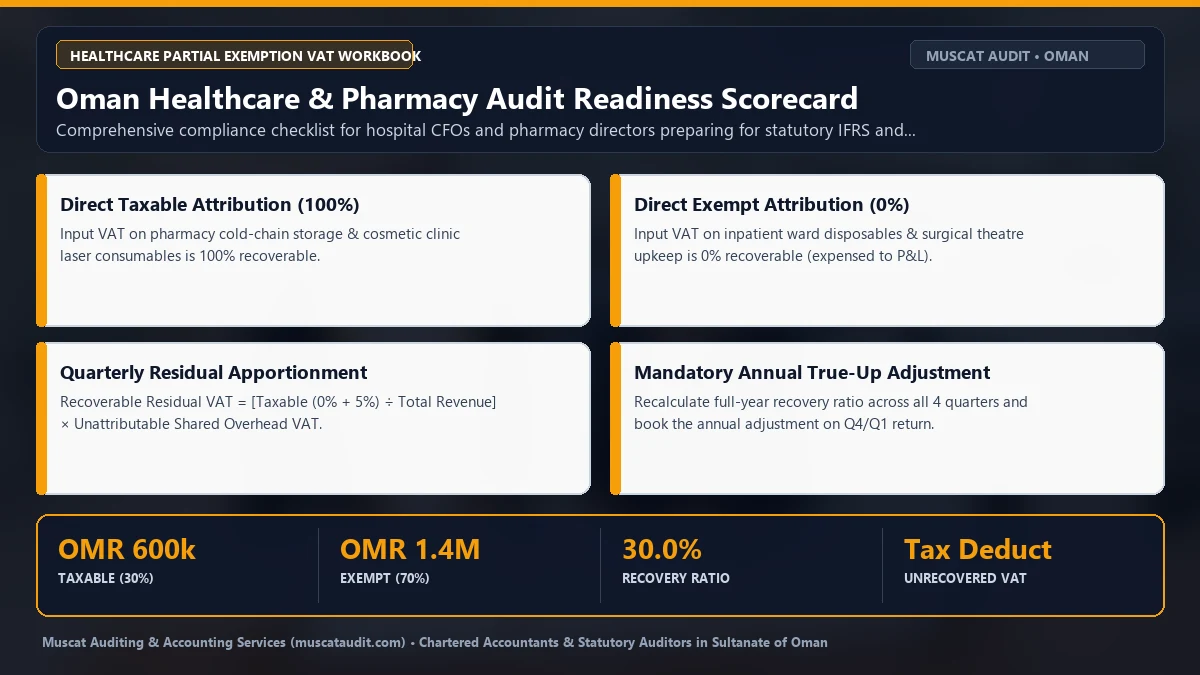
- Directly Attributable to Taxable (0% & 5%) Supplies (e.g., cold-chain storage for pharmacy drugs, laser consumables for the cosmetic wing): OMR 6,500 → 100% Recoverable (OMR 6,500).
- Directly Attributable to Exempt Medical Supplies (e.g., surgical theatre maintenance, inpatient ward disposables billed inside exempt packages): OMR 14,000 → 0% Recoverable (OMR 0).
- Residual Shared Overhead Input VAT (hospital electricity/water, HIS cloud ERP license, security, statutory audit fees): OMR 10,000.
Proportional Recovery Percentage = Taxable Supplies (OMR 600,000) ÷ Total Supplies (OMR 2,000,000) = 30.0%.
Recoverable Residual Input VAT = 30.0% × OMR 10,000 = OMR 3,000 (while the remaining OMR 7,000 is expensed to the P&L and deducted for 15% Corporate Tax purposes!).
4. TPA & Medical Insurance Receivables, Claim Rejections & Dhamani Readiness
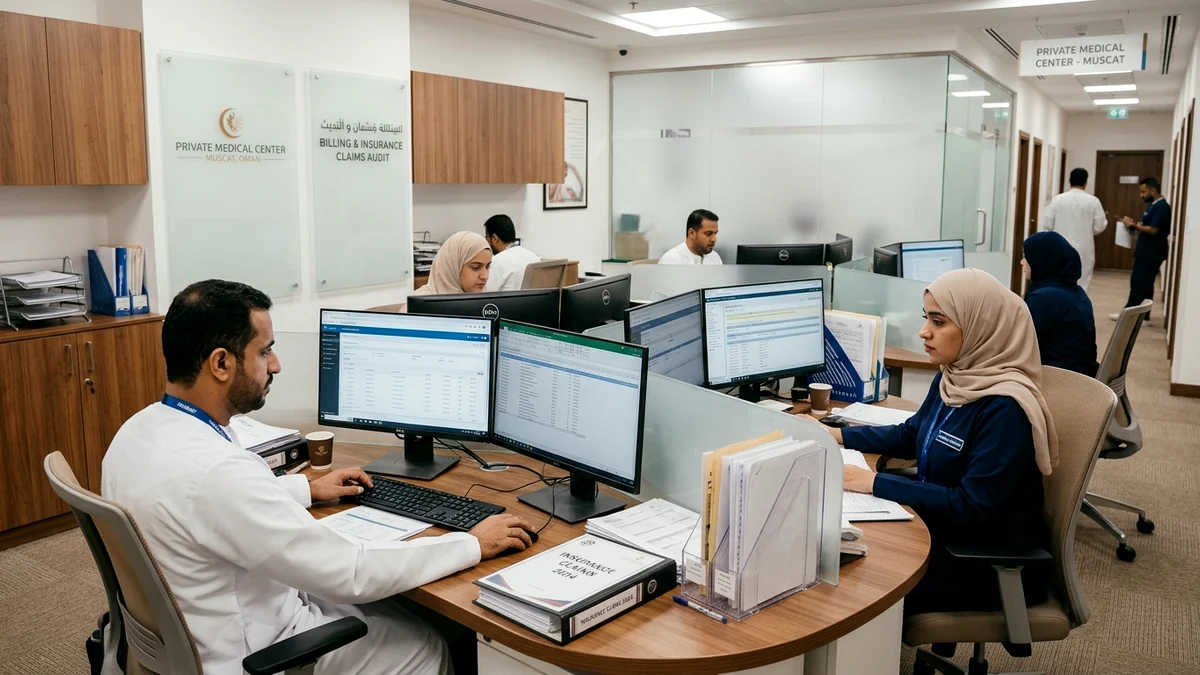
With the rollout of Oman’s unified electronic health insurance platform (Dhamani) overseen by the Financial Services Authority (FSA), private hospitals and polyclinics generate the majority of their revenue through Third-Party Administrators (TPAs such as Nextcare, MedNet, GlobeMed, and FMC) and domestic insurers (Dhofar Insurance, Liva Insurance, Oman Qatar Insurance, Arabia Falcon). During statutory audits conducted by our Audit & Assurance team, TPA receivables are consistently the highest-risk balance sheet area:
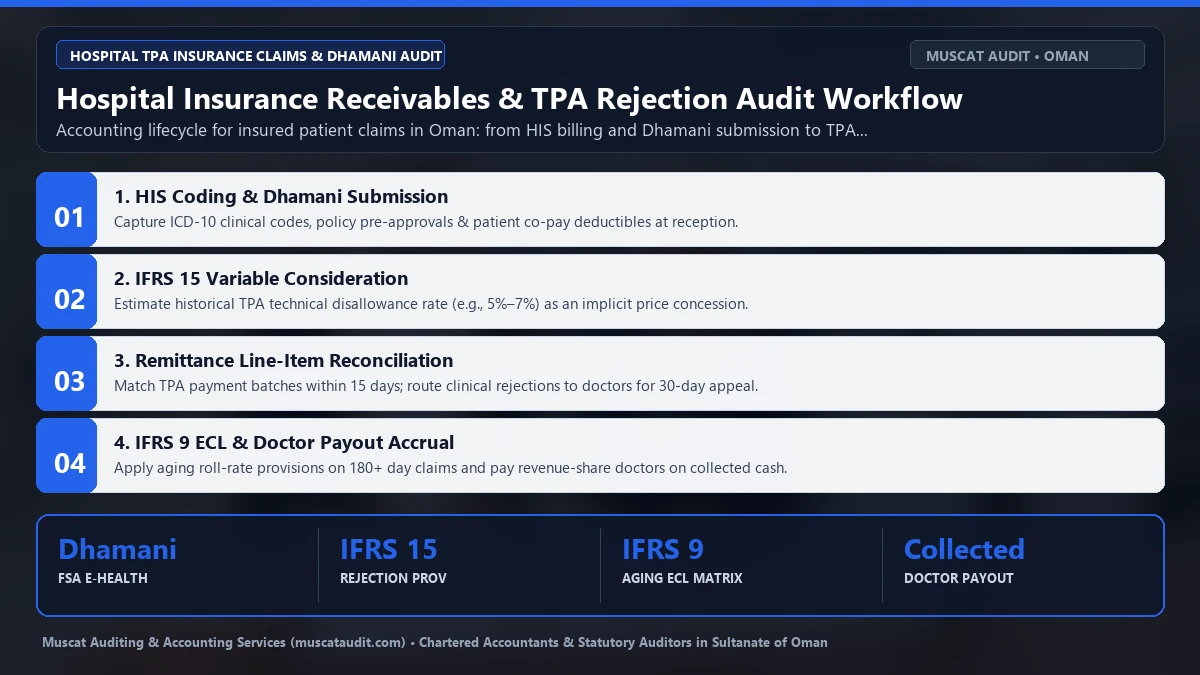
- IFRS 15 Variable Consideration (Implicit Price Concessions): When a hospital submits OMR 500,000 in monthly insurance claims knowing from historical data that TPAs will disallow 6% due to coding mismatches, policy exclusions, or unapproved diagnostic tests, recognizing the full OMR 500,000 as revenue overstates profit and inflates 15% Corporate Tax! Under IFRS 15, expected technical disallowances must be estimated and deducted as variable consideration at the end of each reporting period.
- IFRS 9 Expected Credit Loss (ECL) Aging Matrix: Claims remaining unpaid beyond 180 or 360 days after final resubmission require a structured IFRS 9 provision matrix—and for Oman Tax Authority purposes, actual bad-debt write-offs must be supported by formal settlement agreements or legal recovery evidence under OTA deductibility rules.
5. Pharmacy Batch Expiry Controls, FEFO Inventory Audits & Controlled Drug Ledgers
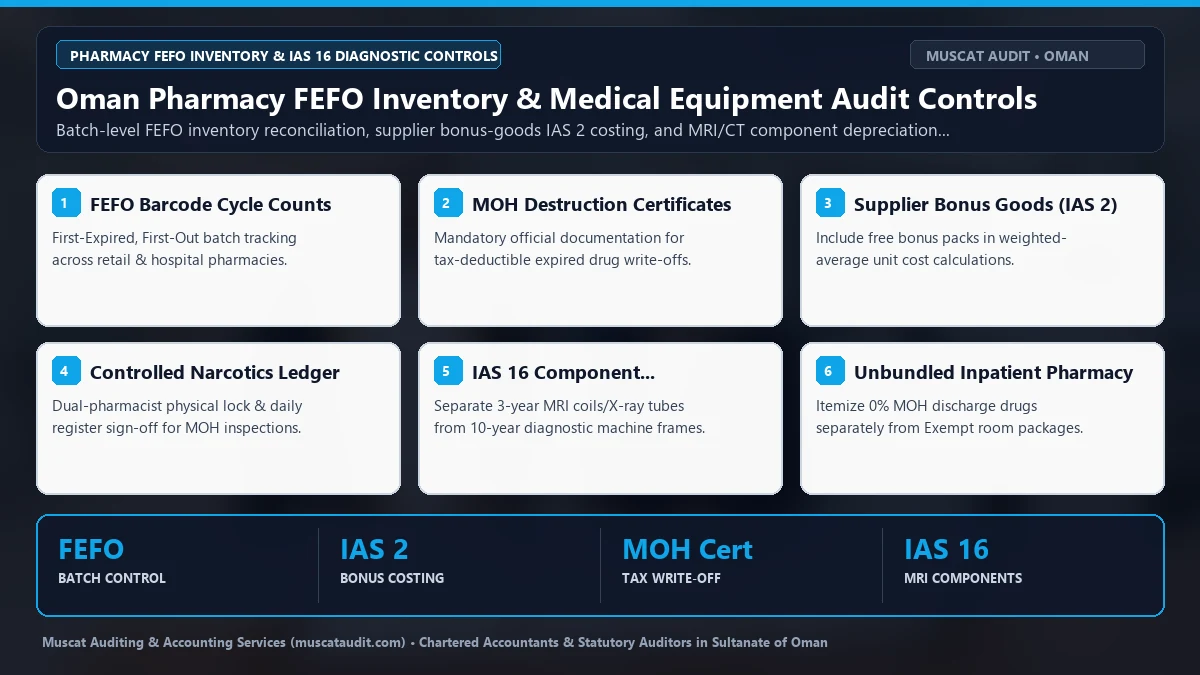
For pharmaceutical importers, scientific offices, and retail pharmacy chains across Muscat, Sohar, and Nizwa, inventory represents both a major working-capital investment and a strict regulatory obligation under Ministry of Health (Directorate General of Pharmaceutical Affairs and Drug Control) rules. Our Internal Audit & Risk Advisory specialists implement First-Expired, First-Out (FEFO) batch audits, verify supplier bonus-goods accounting (ensuring free bonus packs reduce weighted-average unit cost under IAS 2 rather than sitting off-ledger), and document formal MOH destruction certificates for expired pharmaceuticals so inventory write-offs are accepted as tax-deductible losses by the Oman Tax Authority.
Componentized Depreciation of Diagnostic Equipment (IAS 16) & Consultant Fee Models
Beyond pharmacy stock, private hospitals in Muscat, Sohar, and Salalah carry high-value diagnostic equipment—including MRI scanners, CT machines, catheterization labs, and robotic surgical systems. Under IAS 16 (Property, Plant and Equipment), high-cost components that require periodic replacement (such as X-ray tubes, MRI cryogens/coils, and specialized laser heads with 3-to-4-year useful lives) must be depreciated separately from the 10-year main diagnostic frame, while annual OEM preventive maintenance contracts must be expensed ratably over the service period rather than capitalized. Similarly, where visiting or resident medical consultants operate under revenue-sharing contracts (e.g., 35% of net collected outpatient consultation and procedure fees), hospital controllers must accrue doctor fee payables based strictly on net realizable post-TPA-disallowance revenue and verify whether visiting international specialists trigger 10% Oman Withholding Tax (WHT) or Reverse Charge VAT obligations.
6. Mandatory Healthcare Tax/Audit Rules vs. Hospital CFO Best Practices
Mandatory Statutory Requirements in Oman
- Strict Separation of Exempt vs. 0% vs. 5% SKUs: Hospitals and pharmacies must maintain distinct tax codes in their HIS/POS for Exempt clinical services, 0% MOH-approved medicines/devices, and 5% cosmetic/retail supplies.
- Partial Exemption Apportionment & Annual Adjustment: Mixed-supply healthcare entities must apportion residual overhead Input VAT each quarter and perform a mandatory annual Partial Exemption true-up calculation.
- MOH Destruction Certificates for Expired Drugs: Pharmaceutical inventory write-offs claimed as deductible expenses on the 15% Corporate Tax return must be substantiated by official MOH/municipality destruction protocols.
- Doctor & Nurse Licensing & Payroll Compliance: All clinical staff salaries and end-of-service benefits must comply with WPS, Social Protection Fund (SPF), and MOH licensing rules.
Professional Best-Practice Recommendations
- Unbundle Zero-Rated Drugs from Inpatient Bills: Itemize 0% MOH-registered discharge and inpatient medications separately on patient folios rather than bundling them inside an all-inclusive Exempt ward package, preserving your right to recover direct Input VAT.
- Monthly TPA Claim Rejection Reconciliation: Reconcile TPA remittance advice files line-by-line within 15 days of receipt so medical coders can appeal clinical rejections inside the 30-day insurer window.
- Automate Doctor Revenue-Share Accruals: Where visiting or full-time consultants earn a percentage of net collected revenue, calculate doctor payouts on collected TPA cash rather than gross billed invoices.
- Conduct Semi-Annual Surprise Pharmacy Cycle Counts: Perform barcode-verified batch and expiry counts across high-value biologics and controlled medications.
7. Frequently Asked Questions on Hospital & Pharmacy Auditing in Oman
What is the difference between Exempt medical services and Zero-Rated (0%) medicines under Oman VAT Law?
Under the Oman Value Added Tax Law (Royal Decree 121/2020) and its Executive Regulations, core preventive and curative medical services rendered to patients by Ministry of Health (MOH)-licensed hospitals and clinics are VAT Exempt—meaning no VAT is charged to the patient, and the hospital cannot recover Input VAT on expenses directly tied to those exempt services. By contrast, qualifying human medicines and medical equipment approved on MOH/OTA schedules are Zero-Rated (0% VAT)—allowing pharmacies and hospital dispensaries to recover 100% of the Input VAT incurred on purchasing, importing, and storing those zero-rated items.
Are elective cosmetic procedures and non-therapeutic aesthetic treatments exempt from 5% VAT in Oman?
No. Elective cosmetic surgeries, aesthetic dermatology treatments, laser procedures, and wellness therapies that are not performed to treat a diagnosed medical condition, trauma, or congenital abnormality do not qualify for the medical VAT exemption and are subject to the standard 5% VAT rate.
How do Omani hospitals calculate recoverable Input VAT on shared overhead expenses (Partial Exemption)?
Because a multi-specialty private hospital generates Exempt revenue (inpatient/outpatient consultations), Zero-Rated revenue (dispensary pharmaceuticals), and 5% Standard-Rated revenue (cosmetic clinics, cafeteria sales, VIP companion rooms, and commercial pharmacy OTC items), it must apply the Partial Exemption Proportional Recovery formula prescribed by the Oman Tax Authority on residual overhead Input VAT (utilities, HIS software, audit fees, and facility maintenance), followed by an annual true-up adjustment.
How does a patient’s medical insurance policy affect hospital VAT invoicing in Oman?
While the underwriting of medical insurance policies by insurance companies is generally subject to 5% VAT, the underlying medical treatment provided by the hospital to an insured patient retains its statutory VAT classification (Exempt for medical care, 0% for registered medicines). Hospitals must ensure their Hospital Information System (HIS) issues accurate split-folios to Third-Party Administrators (TPAs) and insurers without charging 5% VAT on exempt clinical procedures.
How should private hospitals account for rejected or disputed insurance claims under IFRS 15 and IFRS 9?
Hospitals in Oman routinely experience a 4% to 12% technical or clinical rejection rate from TPAs and insurance carriers. Under IFRS 15 (Variable Consideration / Price Concessions) and IFRS 9 (Expected Credit Loss), healthcare CFOs must maintain historical insurer-by-insurer rejection matrices and recognize an audited provision for claim rejections and credit losses rather than carrying uncollectible gross receivables on the balance sheet.
Protect Your Hospital, Polyclinic, or Pharmacy Group from VAT & TPA Leakage
Speak with Muscat Audit’s healthcare accounting, Partial Exemption VAT, and statutory audit specialists in Muscat to review your HIS tax codes, optimize your Input VAT recovery, and audit your TPA insurance receivables.