
Hospitality, Hotel & Tourism Accounting and Audit in Oman: 5% VAT, 5% Municipality Tax, 4% Tourism Levy & USALI Guide
Under Oman Vision 2040, hospitality and heritage tourism represent one of the fastest-expanding non-oil economic pillars in the Sultanate—spanning beachfront luxury resorts in Muscat and Integrated Tourism Complexes (ITCs) like Al Mouj, Muscat Bay, and Jebel Sifawy, mountain retreats on Jabal Akhdar, Khareef-season resorts in Salalah, and desert camps in Sharqiyah Sands. Yet from a financial controller’s perspective, hospitality is also one of the most transaction-dense and heavily regulated industries in Oman.
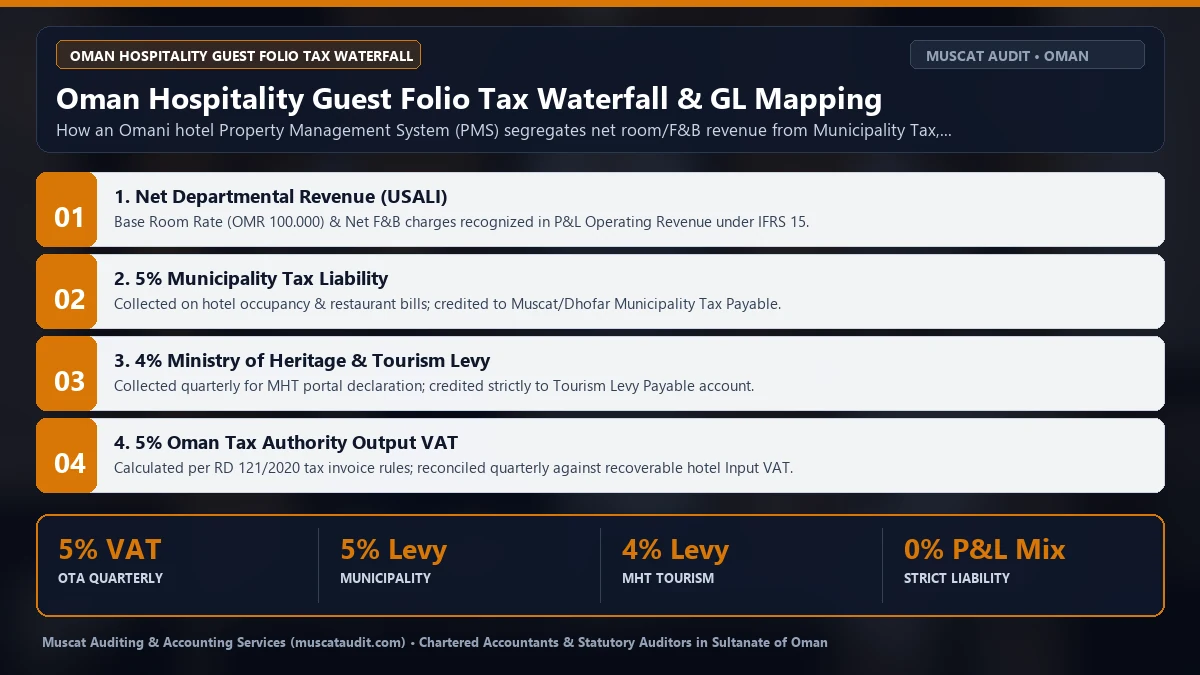
A single guest folio at a Muscat hotel can simultaneously trigger 5% Value Added Tax (VAT) for the Oman Tax Authority (OTA), 5% Municipality Tax for Muscat Municipality (or regional municipalities), a 4% Tourism Tax / Levy for the Ministry of Heritage and Tourism (MHT), and contractual service charges—all while settling across multi-currency credit cards, corporate city-ledger accounts, and foreign Online Travel Agencies (OTAs). Partnering with experienced Chartered Accountants in Oman who understand both the Uniform System of Accounts for the Lodging Industry (USALI) and Omani statutory tax law is essential to prevent costly assessment penalties.
1. Why Hospitality Finance in Oman Demands Specialized Accounting & Audit Controls
Unlike a standard commercial trading company that issues a few dozen invoices per week, a 200-key hotel or multi-outlet restaurant group in Muscat processes thousands of micro-transactions every 24 hours across front-desk Property Management Systems (PMS such as Opera Cloud, Protel, or Mews) and F&B Point-of-Sale (POS such as Micros Symphony, Foodics, or Lightspeed) terminals. When the nightly automated interface between the PMS/POS and the back-office general ledger (SunSystems, SAP, Odoo, or Zoho Books) is misconfigured by even half a percentage point, the error compounds across every room night and dining check for an entire quarter.
At Muscat Audit’s Accounting & Bookkeeping practice, our hospitality audit teams regularly uncover three recurring vulnerabilities during hotel pre-audit health checks:
- Gross vs. Net Revenue Misstatement (IFRS 15): Recording Municipality Tax or Tourism Levy inside gross room revenue rather than segregating them into fiduciary liability accounts, artificially inflating top-line turnover and creating reconciliation variances during OTA and MHT inspections.
- Unrecorded Reverse Charge Mechanism (RCM) on Foreign OTA Commissions: Failing to self-account for 5% VAT under the Reverse Charge Mechanism on monthly commission deductions retained by Booking.com, Expedia, Agoda, or global GDS providers.
- Unreconciled City Ledger & Advance Deposit Aging: Allowing wedding banquet deposits, MICE conference advances, and tour-operator receivables to sit in suspense accounts without proper tax-point (time of supply) recognition under Oman VAT Law.
2. Mastering the Multi-Tiered Tax Stack: 5% VAT, 5% Municipality Tax & 4% Tourism Levy
To maintain clean books that survive scrutiny from the Oman Tax Authority, Muscat/Dhofar Municipality inspectors, and the Ministry of Heritage and Tourism, your PMS and POS tax matrices must map every charge to its exact statutory authority and general ledger liability account:
| Tax / Levy Type | Statutory Rate | Governing Authority | Filing Frequency & Accounting Treatment |
|---|---|---|---|
| Value Added Tax (VAT) | 5% Standard Rate | Oman Tax Authority (OTA) — Royal Decree 121/2020 | Quarterly OTA VAT return (within 30 days of quarter-end). Post to Output VAT Payable; offset against recoverable Input VAT on hotel OPEX & FF&E. |
| Municipality Tax (Hotel & Dining) | 5% Occupancy / Bill Levy | Muscat Municipality / Dhofar Municipality / Regional Municipalities | Periodic municipal declaration & remittance. Post to Municipality Tax Payable liability ledger; never include in IFRS 15 revenue. |
| Tourism Levy / Tax | 4% Tourism Levy | Ministry of Heritage and Tourism (MHT) | Quarterly submission & payment via MHT portal, plus annual certified declaration. Post strictly to MHT Tourism Levy Payable. |
| Corporate Income Tax | 15% on Net Taxable Profit | Oman Tax Authority (OTA) — Income Tax Law RD 28/2009 | Annual Return of Income within 4 months of fiscal year-end (unless holding an active temporary tourism project tax exemption). |
3. Daily Night Audit, PMS-to-ERP Reconciliation & Online Travel Agency (RCM) Rules
The backbone of internal control in any Omani hotel or resort is the Daily Night Audit and the subsequent morning review by the Income Auditor. Every night, the PMS closes the business day, posts room rates and tax codes to active in-house guest folios, and imports F&B, spa, and banquet checks from POS terminals.
A. Gross Room Revenue vs. Net OTA Remittances
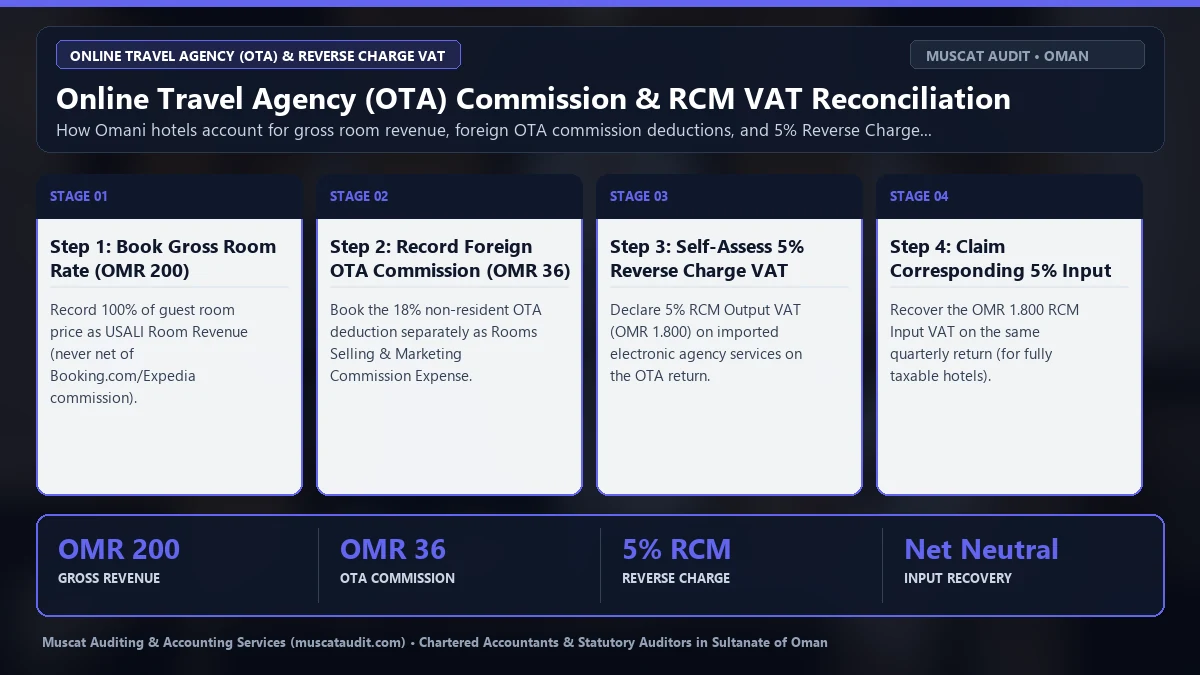
Suppose a boutique resort in Jabal Akhdar sells a villa stay via Booking.com for OMR 200.000 (before taxes), and the foreign OTA deducts an 18% commission (OMR 36.000), remitting only the net amount or charging a virtual credit card. A common bookkeeping mistake in smaller Omani hotels is recording only the net cash received (OMR 164.000) as room revenue. Doing so understates your taxable room revenue by 18%, underpays Municipality Tax, Tourism Levy, and Output VAT on the full guest price, and completely omits the mandatory 5% Reverse Charge Mechanism (RCM) VAT declaration (OMR 1.800) on the imported digital brokerage service! Our Tax & VAT Advisory specialists configure automated PMS rules so gross room revenue (OMR 200.000) and OTA commission expense (OMR 36.000) are recorded separately.

4. Bridging USALI Departmental Reporting with Statutory IFRS Audits & HMA Audits
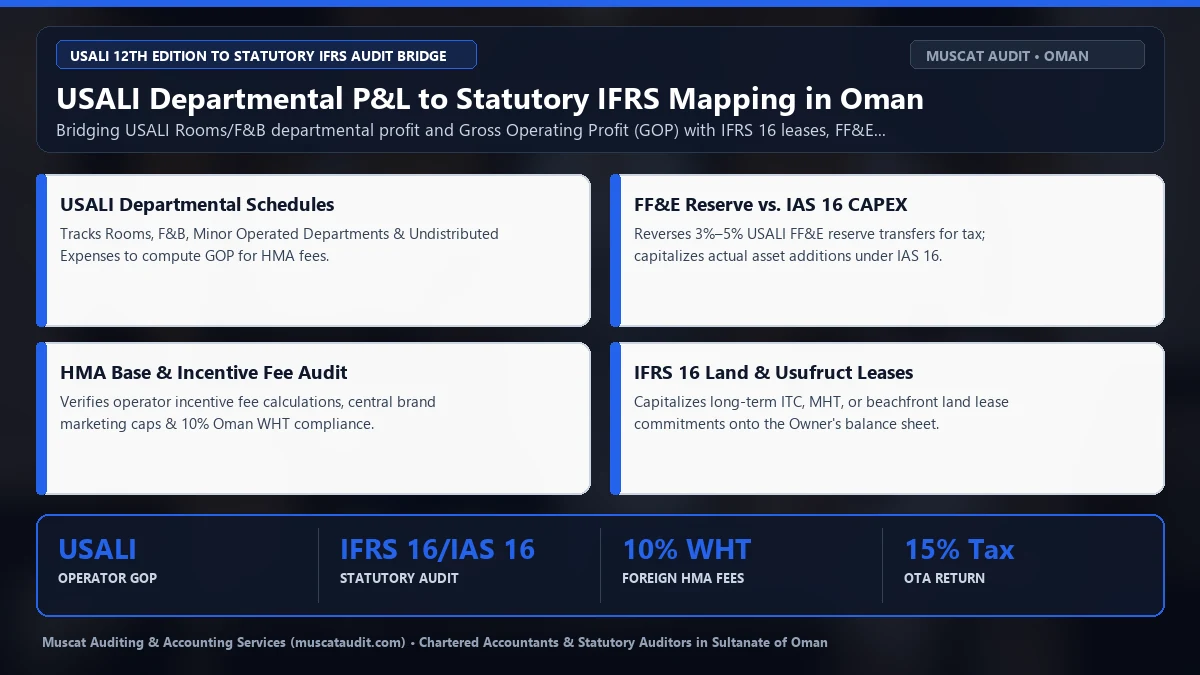
Most branded hotels in Muscat, Sohar, and Salalah operate under a Hotel Management Agreement (HMA) between an Omani property-owning company (often an SAOC, LLC, or sovereign hospitality vehicle) and an international hotel operator. Operational monthly packs are prepared under the Uniform System of Accounts for the Lodging Industry (USALI) because the operator’s Base Fee (typically 2%–3% of Total Operating Revenue) and Incentive Fee (typically 6%–10% of Gross Operating Profit [GOP] or Adjusted GOP) are calculated from USALI schedules.
However, when the Omani owning company files its statutory accounts with MoCIIP and the Oman Tax Authority, USALI management accounts must be converted into full IFRS financial statements. Key conversion adjustments audited by our Audit & Assurance team include:
- FF&E Reserve (3%–5% of Revenue) vs. IAS 16 Depreciation: Under USALI and HMA contracts, a contractual percentage of gross revenue is transferred into an escrow Furniture, Fixtures & Equipment (FF&E) Reserve. For IFRS and Oman Corporate Tax purposes, transfers to a reserve are not a deductible expense; instead, actual capital additions are capitalized under IAS 16 and depreciated over their useful lives (and adjusted to Oman Income Tax Law depreciation rates on the tax return).
- HMA Base & Incentive Fee Verification: Our Internal Audit & Risk Advisory team conducts independent Owner-side HMA Audits to verify that central brand marketing charges, loyalty program assessments, and expatriate executive recharges billed by the international operator strictly comply with the HMA cap and Oman’s 10% Withholding Tax (WHT) rules.
5. F&B Cost Control, Cash Leakage Prevention & Seasonal Khareef/Winter Working Capital
Hospitality in Oman exhibits distinct regional seasonality: Muscat, Jabal Akhdar, and Sharqiyah peak between October and April, whereas Dhofar (Salalah) experiences surging occupancy during the July–September Khareef monsoon season. Managing working capital and preventing F&B margin erosion across peak and off-peak months requires disciplined physical controls:
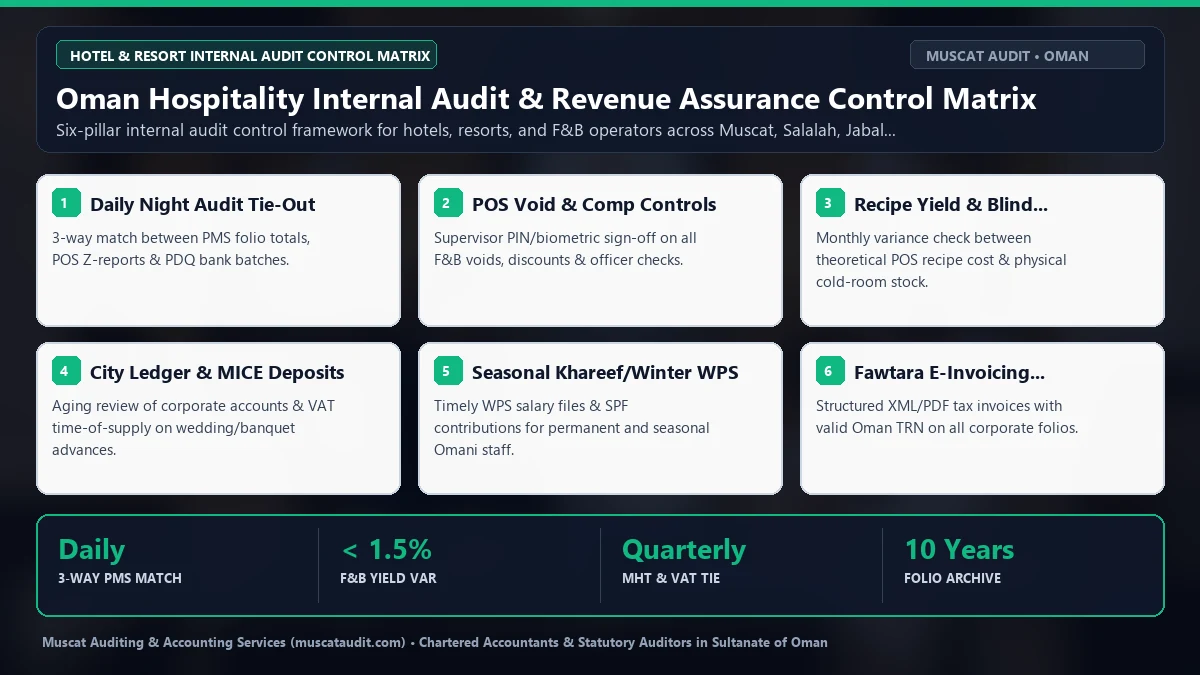
- Monthly Blind Receiving & Perishable Stock Counts: Reconcile theoretical food and beverage consumption (generated from POS sales multiplied by standardized recipe cards) against physical cold-room and dry-store counts every month-end.
- POS Void, Discount & Officer Check Audits: Restrict POS void and discount override privileges to duty managers using biometric or PIN logs, and audit daily “Officer/Entertainment Check” registers to ensure proper cost-center allocation and VAT treatment.
- Seasonal Staff Payroll, WPS & Social Protection Fund (SPF): Ensure temporary seasonal hires and permanent Omani staff are accurately processed through the Wage Protection System (WPS) and reconciled with monthly SPF contributions (see our detailed guide on Social Protection Fund (SPF) Oman & Payroll Audit).
Worked OMR Scenario: Guest Folio & Quarterly Levy Reconciliation
To illustrate how a Muscat 5-star hotel’s Income Auditor reconciles a monthly room and F&B summary before filing quarterly returns, suppose a corporate conference group books 100 room nights at a base rate of OMR 100.000 per night (OMR 10,000.000 total net room revenue) plus a banquet dinner for OMR 4,000.000 net F&B revenue. In the general ledger, only the OMR 14,000.000 is credited to USALI Departmental Operating Revenue (Rooms OMR 10,000.000; Food & Beverage OMR 4,000.000). The statutory levies collected on top—5% Municipality Tax (OMR 700.000), 4% Ministry of Heritage and Tourism Levy (OMR 560.000), and 5% OTA Output VAT—are credited directly to their respective current liability clearing accounts. At quarter-end, the Financial Controller performs a three-way tie-out between the PMS Tax Summary Report, the General Ledger trial balance, and the MHT/Municipality/OTA portal declarations, ensuring zero variance during statutory external audit verification.
6. Mandatory Hospitality Compliance vs. Hotel Controller Best Practices
Mandatory Statutory Requirements in Oman
- Segregated Statutory Levy Ledgers: 5% OTA VAT, 5% Municipality Tax, and 4% MHT Tourism Levy must be collected accurately on guest folios, excluded from IFRS 15 revenue, and remitted by their statutory quarterly/periodic deadlines.
- Compliant Tax Invoices & Fawtara Readiness: Corporate city-ledger and MICE invoices must display your valid Oman Tax Registration Number (TRN), sequential invoice numbering, and itemized tax breakdown.
- 5% Reverse Charge on Foreign OTAs & 10% WHT on Foreign Operator Fees: Self-account for RCM VAT on non-resident OTA commissions and assess WHT applicability on cross-border hotel management and franchise fees.
- 10-Year Record Retention: Retain PMS folio archives, POS Z-reports, supplier tax invoices, and customs declarations for 10 years under Omani tax and commercial law.
Professional Best-Practice Recommendations
- Daily Three-Way PMS-POS-Bank Match: Reconcile PMS credit card batch totals against physical PDQ merchant settlement slips and bank statements every morning.
- Quarterly Pre-Filing Tax Health Check: Reconcile your four quarterly MHT Tourism Levy declarations against your four OTA VAT returns so taxable hospitality turnover matches across regulators.
- Annual Owner-Side HMA Compliance Audit: Verify operator incentive-fee calculations, centralized marketing charges, and FF&E capex procurement bids independently.
- Automated Recipe Costing & Yield Variance Alerts: Flag any F&B outlet where actual food cost exceeds theoretical recipe cost by more than 1.5%.
7. Frequently Asked Questions on Hotel & Tourism Accounting in Oman
How are 5% VAT, 5% Municipality Tax, and 4% Tourism Tax calculated on hotel bills in Oman?
In Oman’s hospitality sector, hotels and tourist establishments must configure their Property Management Systems (PMS) and POS terminals to separate net revenue from statutory levies (5% Municipality Tax, 4% Ministry of Heritage and Tourism Levy where applicable, service charges, and 5% Value Added Tax). Crucially, collected taxes and levies must be posted to separate balance-sheet liability accounts and never recognized as top-line operating revenue under IFRS 15.
When must Omani hotels and tourist restaurants file their 4% Tourism Levy returns?
Establishments subject to the 4% Tourism Tax under Ministry of Heritage and Tourism regulations must submit their declarations and settle collected levies on a quarterly basis through the Ministry’s portal, in addition to submitting an annual audited reconciliation.
What is the VAT treatment of international Online Travel Agency (OTA) commissions such as Booking.com or Expedia for Omani hotels?
When an Omani hotel receives booking intermediation services from a non-resident Online Travel Agency (OTA) headquartered outside Oman, the commission invoice is subject to the 5% Reverse Charge Mechanism (RCM) under Oman VAT Law (Royal Decree 121/2020). The hotel must self-account for 5% Output VAT and—assuming it makes fully taxable supplies—simultaneously claim the corresponding 5% Input VAT on its quarterly Oman Tax Authority return.
How does USALI (Uniform System of Accounts for the Lodging Industry) align with IFRS statutory audits in Oman?
USALI is the global operational chart-of-accounts standard used by hotel operators and management brands in Muscat, Jabal Akhdar, and Salalah to track Departmental Profit (Rooms, F&B, Spa/Leisure) and Gross Operating Profit (GOP). For statutory filings with MoCIIP and the Oman Tax Authority, your external auditor maps USALI departmental schedules into full IFRS financial statements, incorporating IFRS 16 leases, IAS 16 FF&E depreciation, and FF&E reserve reconciliations.
Are hotel staff meals and complimentary rooms subject to 5% VAT in Oman?
Complimentary rooms, F&B hospitality exceeds thresholds, or goods supplied without consideration outside normal promotional/business thresholds can trigger Deemed Supply rules under Oman VAT regulations, requiring Output VAT assessment on cost unless specifically exempted under OTA guidelines.
Elevate Your Hotel, Resort, or Restaurant Group’s Financial Controls in Oman
From five-star beachfront resorts and Jabal Akhdar retreats to multi-branch restaurant chains in Muscat and Salalah, Muscat Auditing & Accounting Services provides USALI accounting, PMS/POS tax reconciliations, HMA owner audits, and statutory IFRS assurance.