
How to Register a Company in Oman: A Complete Step-by-Step Investor Guide (2026 Edition)
Starting a commercial business in the Sultanate of Oman has never been more attractive or accessible for international entrepreneurs and regional corporate investors. Under the landmark Foreign Capital Investment Law (FCIL – Royal Decree No. 50/2019) and The Commercial Companies Law (Royal Decree No. 18/2019), foreign investors can establish an Omani enterprise with 100% foreign ownership, eliminating the historical requirement for a local Omani sponsor or minimum capital lock-up for standard commercial activities.
Driven by the strategic diversification goals of Oman Vision 2040, the Ministry of Commerce, Industry and Investment Promotion (MOCIIP) has streamlined the corporate formation journey through the unified digital Oman Business Platform (formerly Invest Easy). However, successfully navigating business licensing requires careful legal structuring, selecting the appropriate corporate vehicle, registering with the Oman Tax Authority (OTA), fulfilling Oman Labour Law mandates, and securing municipal clearances.
At Muscat Auditing & Accounting Services, our corporate formation advisors, statutory auditors, and PRO specialists guide international founders through every phase of business setup in Muscat, Sohar, Salalah, and Duqm.
—
Looking to set up a 100% foreign-owned LLC or branch office in Muscat? Let our experienced corporate setup team handle your MOCIIP filings, articles of association, and bank accounts.
Schedule a Free Company Setup Consultation or call our Muscat office at Contact Muscat Audit.
—
Table of Contents
1. The Legal Framework: Foreign Capital Investment Law (FCIL)
2. Choosing the Right Corporate Legal Structure in Oman
3. Step-by-Step Company Registration Process via MOCIIP
4. Capital Requirements & Commercial Bank Account Opening
5. Post-Incorporation Compliance: Taxes, Labour & Municipal Licenses
6. Cost Breakdown of Setting Up a Business in Oman (in OMR)
7. Mainland Company vs. Free Zones (Duqm, Sohar, Salalah)
8. Frequently Asked Questions (FAQ)
—
1. The Legal Framework: Foreign Capital Investment Law (FCIL)
The promulgation of Royal Decree No. 50/2019 (The Foreign Capital Investment Law) dismantled long-standing barriers to foreign direct investment (FDI) in the Sultanate. Key legal advantages include:
– 100% Foreign Ownership: Foreign individuals and corporate entities can own 100% of the share capital in mainland commercial companies without requiring an Omani national shareholder.
– No Minimum Statutory Capital: Unlike older statutes requiring a minimum capital of OMR 150,000 for foreign-owned entities, standard mainland LLCs can now be incorporated with nominal paid-up capital (commonly OMR 20,000 or lower, depending on commercial activities).
– Streamlined Foreign Investment Approvals: Standard non-restricted business activities receive instant or expedited approvals through automated digital verification on the Oman Business Platform.
– Restricted Negative List: MOCIIP maintains a designated list of reserved commercial activities (such as traditional handicraft shops, small grocery stores, or domestic transportation) reserved exclusively for Omani citizens. All mainstream commercial, trading, technology, consulting, industrial, and contracting sectors remain fully open to foreign investment.
—
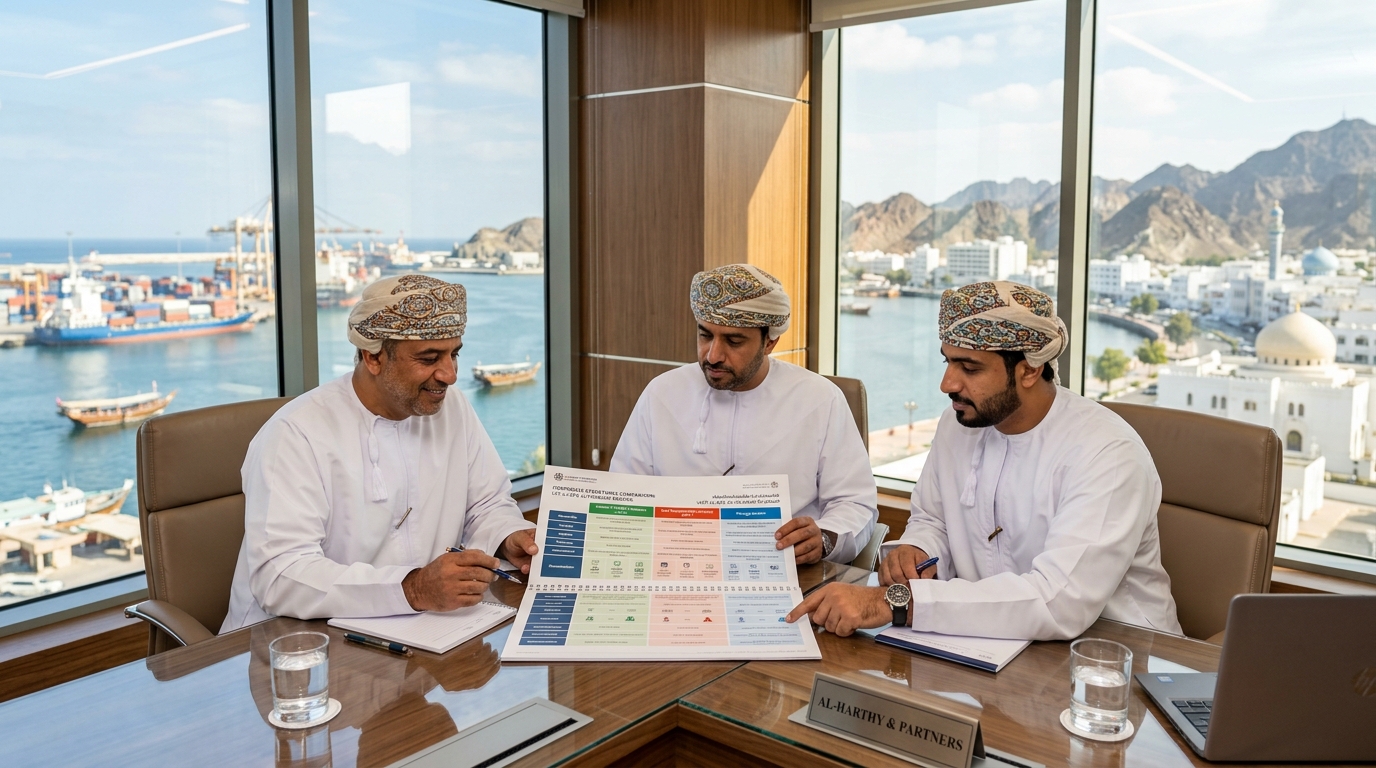
2. Choosing the Right Corporate Legal Structure in Oman
Selecting the correct legal vehicle is essential for limiting shareholder liability and optimizing tax exposure:
“`
- Minimum Shareholders: 2 | Maximum: 50
- Liability: Limited to share capital contribution.
- Best For: Multi-partner ventures, commercial trading, industrial operations.
- Sole Shareholder: 1 (Individual or Corporate Entity)
- Liability: Limited to registered capital.
- Best For: Solo entrepreneurs, foreign holding entities, boutique agencies.
- Ownership: 100% owned by foreign parent company.
- Requirement: Must hold an active government contract or ministerial concession.
- Best For: International engineering firms, EPC contractors, government vendors.
- Purpose: Market research, promotional activities; strictly non-trading.
- Best For: International brands exploring market entry prior to full launch.
1. Limited Liability Company (LLC)
2. Single Person Company (SPC)
3. Foreign Company Branch Office
4. Commercial Representative Office
“`
—
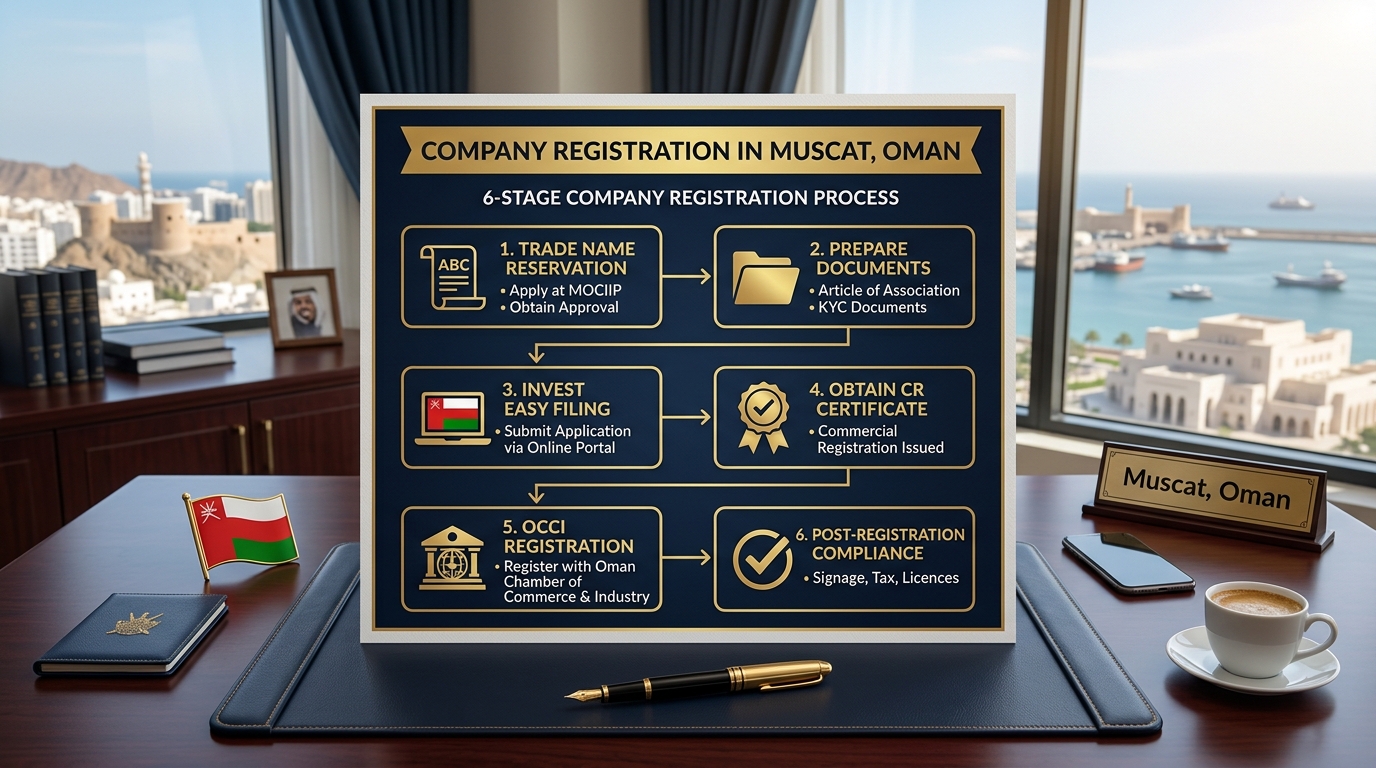
3. Step-by-Step Company Registration Process via MOCIIP
At Muscat Auditing & Accounting Services, our corporate PRO team manages the end-to-end incorporation lifecycle in six structured stages:
“`
[Trade Name Reservation] [Drafting Constitutive Documents] [MOCIIP Portal Filing] [Commercial Registration (CR) Issuance] [Chamber of Commerce Membership] [Municipal Licensing & Bank Account]
“`
Stage 1: Trade Name Reservation
Submit three prospective Arabic/English trade names through the Oman Business Platform. The name must be unique, non-misleading, and compliant with MOCIIP naming regulations (avoiding religious terms or unauthorized geographical designations).
Stage 2: Drafting the Constitutive Contract & Articles of Association
Prepare the company’s Constitutive Contract (MoA) and Articles of Association (AoA) outlining shareholder equity splits, voting thresholds, manager appointment terms, and financial year boundaries.
Stage 3: Digital Submission & Identity Verification
Foreign shareholders and authorized signatories complete digital identity verification via PKI (electronic Civil ID or Mobile PKI) or through accredited Omani Sanad service centers and authorized accounting firms.
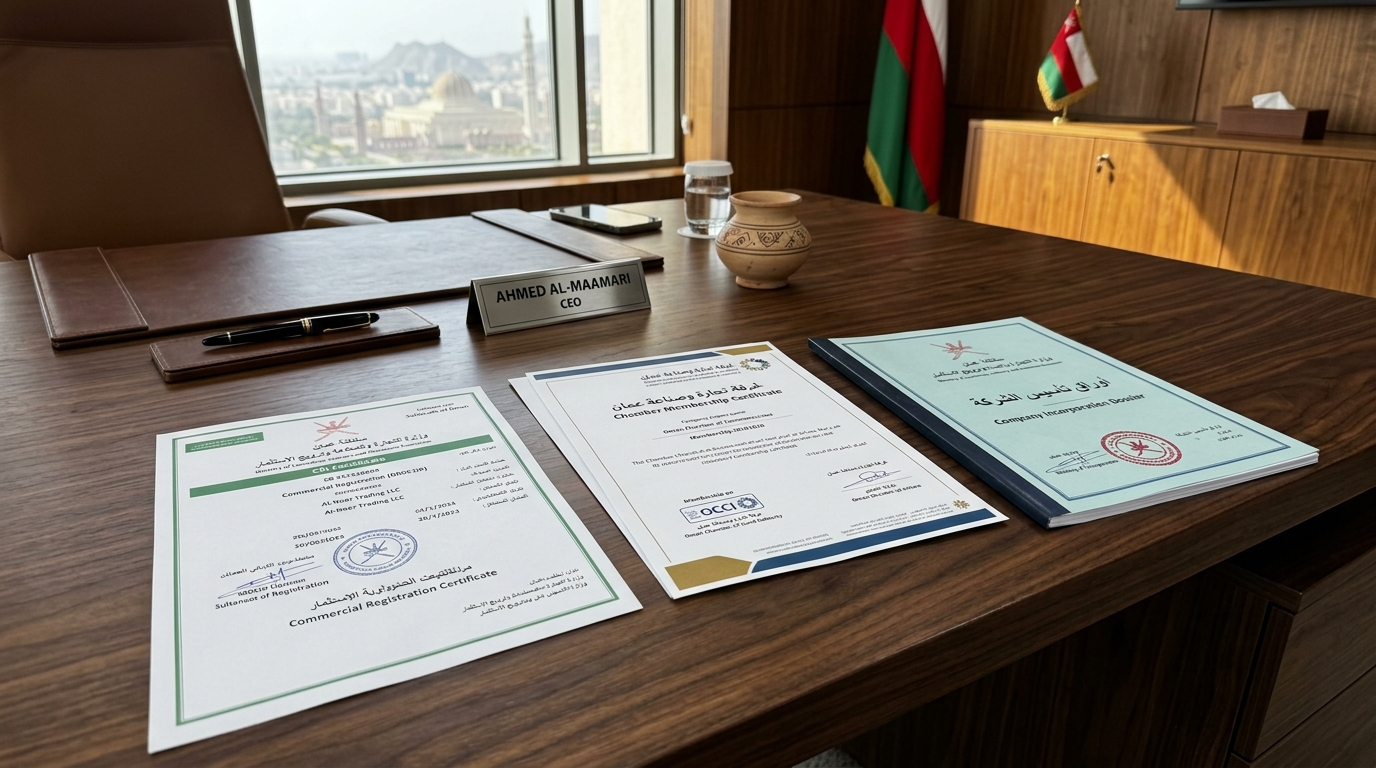
Stage 4: Issuance of Commercial Registration (CR) & Chamber Certificate
Upon MOCIIP approval and statutory fee settlement, the official Commercial Registration Certificate (CR), Computer Printout, and Oman Chamber of Commerce and Industry (OCCI) membership certificate are generated electronically.
—
Setting up operations in Oman? Ensure your accounting systems, chart of accounts, and VAT registrations are fully compliant from Day 1.
Explore Our Accounting & Bookkeeping Services
—
4. Capital Requirements & Commercial Bank Account Opening
Opening a corporate bank account is often the most time-consuming phase of corporate establishment due to rigorous international Know-Your-Customer (KYC) and Anti-Money Laundering (AML) standards enforced by the Central Bank of Oman (CBO).
Key banking requirements include:
1. Physical Office Presence: Commercial banks (such as Bank Muscat, Bank Dhofar, Sohar International) require proof of a registered commercial tenancy contract (Ejar lease agreement) registered with the Muscat Municipality.
2. Ultimate Beneficial Ownership (UBO) Disclosures: Detailed organizational charts tracing beneficial ownership down to individual natural persons holding 25% or more equity.
3. Managerial Residence Visas: The company’s registered General Manager must either possess a valid Omani resident Civil ID or submit foreign police clearances and professional qualification certificates attested under Ministerial Decision No. 245/2025.
Our corporate advisory team assists clients in preparing institutional bank account dossiers, significantly accelerating corporate account activation.
—
5. Post-Incorporation Compliance: Taxes, Labour & Municipal Licenses
Receiving your Commercial Registration is only the first milestone. To commence legal commercial operations, several statutory post-incorporation steps must be finalized:
- Muscat Municipality Trade License (Baladiya): Procuring an official municipal license and commercial signage permit for your commercial premises.
- Oman Tax Authority (OTA) Registration: Registering the entity on the Tax Authority portal within 60 days of incorporation to obtain an official Tax Card. The standard corporate income tax rate is 15%.
- Value Added Tax (VAT) Registration: Registering for VAT if anticipated annual taxable supplies exceed the mandatory registration threshold of OMR 38,500 (voluntary registration is available at OMR 19,250).
- Ministry of Labour & Wages Protection System (WPS): Opening a corporate file with the Ministry of Labour, complying with sector-specific Omanisation quotas, and processing monthly employee salaries through the mandatory Wages Protection System under Royal Decree No. 53/2023 (The Labour Law).
—
6. Cost Breakdown of Setting Up a Business in Oman (in OMR)
While official government fee structures depend on selected commercial activity codes and grade classifications, typical mainland LLC formation costs include:
| Expense Item | Estimated Fee (OMR) | Notes |
|---|---|---|
| MOCIIP Commercial Registration (CR) | OMR 30 – OMR 150 | Depends on registered capital bracket and activity licenses. |
| Trade Name Reservation | OMR 25 – OMR 50 | Higher for foreign or Latin-origin trade names. |
| Oman Chamber of Commerce (OCCI) | OMR 35 – OMR 150 | Determined by company grade classification. |
| Municipal License (Baladiya) | OMR 150 – OMR 400 | Calculated per square meter and activity risk level. |
| Commercial Tenancy Contract (Ejar) | OMR 100 – OMR 300+ | Official 4% municipality lease attestation fee. |
| Legal Drafting & PRO Advisory | OMR 500 – OMR 1,200 | Professional documentation, translation, and MOCIIP execution. |
*Total average government and setup overhead typically ranges between OMR 850 and OMR 2,200, depending on lease choices and activity licensing.*
—
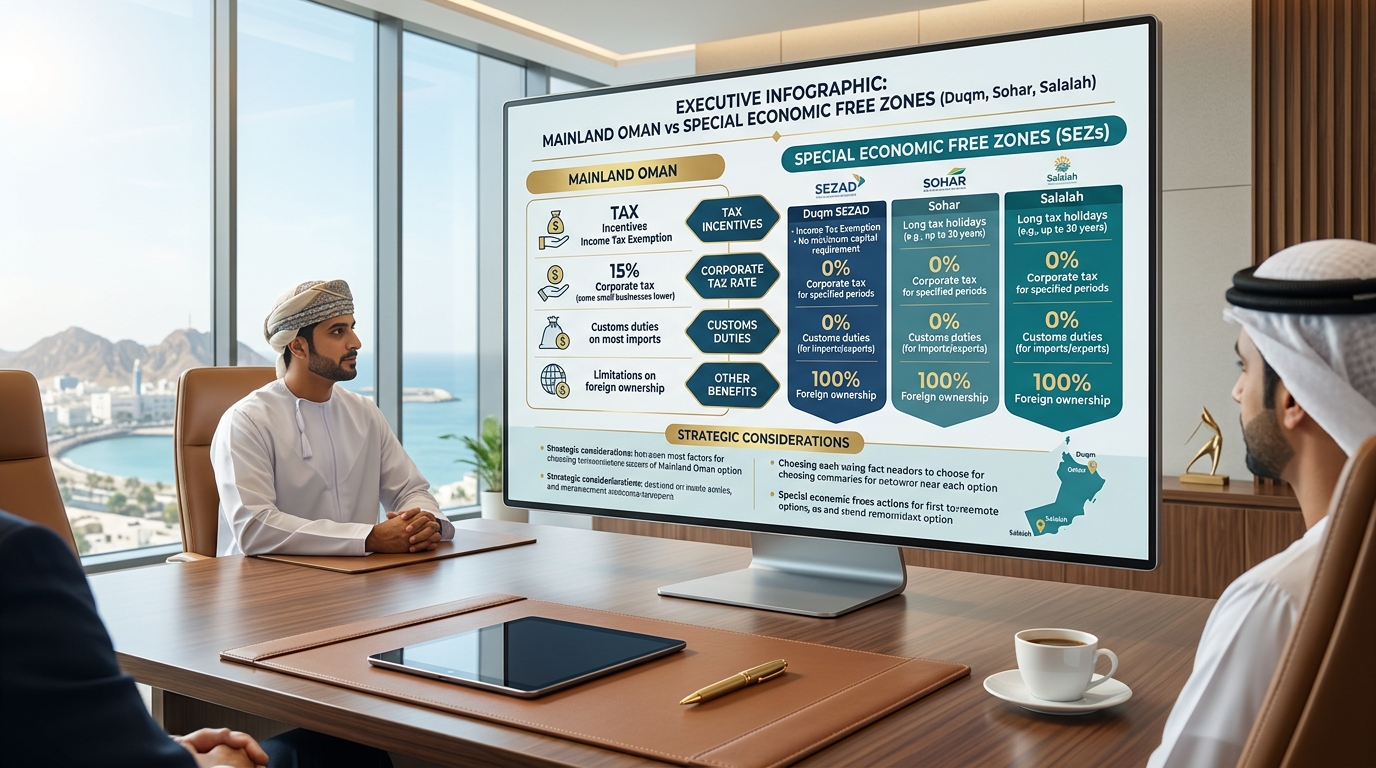
7. Mainland Company vs. Free Zones (Duqm, Sohar, Salalah)
Investors must decide whether a mainland registration or a special economic zone provides superior commercial advantages:
- Mainland Company (MOCIIP): Best for businesses wanting direct commercial access to the local Omani consumer and corporate market, municipal tenders, and domestic contracts without import tariff barriers.
- Special Economic Zone at Duqm (SEZAD): Offers 0% corporate tax holidays for up to 30 years, 100% foreign ownership, 0% customs duties, and relaxed Omanisation quotas (typically 10%), ideal for maritime logistics, heavy manufacturing, and green hydrogen ventures.
- Sohar Freezone & Salalah Freezone: Strategically located near deep-sea container ports, ideal for export-driven light manufacturing, warehousing, and international trading.
—
6. Practical Commercial Case Study: Real-World Implementation in Oman
To illustrate the concrete application of these regulatory requirements, consider a representative commercial enterprise operating in the Sultanate of Oman:
Commercial Context & Operating Background
A foreign-backed engineering and contracting entity operating in the Ghala Industrial Area in Muscat sought to renew its Commercial Registration (CR), expand its credit facilities with an Omani commercial bank, and bid on a major infrastructure development tender in the Special Economic Zone at Duqm (SEZAD). However, an internal compliance review identified critical gaps:
1. Historical general ledger records lacked formal reconciliation with customs declarations filed through the Royal Oman Police Directorate General of Customs Bayan single-window portal.
2. Intercompany management fees paid to a regional holding company in the UAE lacked contemporaneous transfer pricing documentation, exposing the entity to full disallowance under Tax Authority Decision 180/2026.
3. Monthly wage disbursements to foreign technical staff experienced occasional administrative delays, triggering automated compliance alerts on the Ministry of Labour Wages Protection System (WPS).
Strategic Remediation & Execution by Muscat Audit
The leadership team engaged Muscat Auditing & Accounting Services to conduct an end-to-end statutory diagnostic and implement an accelerated remediation roadmap:
– Phase 1: General Ledger & Tax Reconciliation: Our chartered accountants conducted a forensic reconciliation between physical import entries, audited trial balances, and submitted quarterly VAT returns. Discrepancies were regularized through formal voluntary disclosures submitted via the Oman Tax Authority digital portal.
– Phase 2: Transfer Pricing & Economic Substance Documentation: We established an arm’s length transfer pricing Local File and Master File demonstrating the economic commercial substance of all intercompany services, completely shielding the deductions from arbitrary tax reassessments.
– Phase 3: WPS & Payroll Automation: We overhauled the company’s payroll pipeline, structuring standard Salary Information Files (SIF) integrated with Bank Muscat corporate internet banking, ensuring 100% on-time wage settlement prior to the 10th of every calendar month.
– Phase 4: Statutory Certification & Tender Clearance: We prepared audited financial statements under International Financial Reporting Standards (IFRS) and issued a certified In-Country Value (ICV) certificate verifying Omani workforce development and local procurement spend.
Verified Commercial Outcome & Business Impact
Within 30 business days, the client successfully achieved:
– Unconditional renewal of their Commercial Registration (CR) through the Oman Business Platform (Invest Easy) with zero administrative holds.
– Issuance of an official Tax Clearance Certificate from the Oman Tax Authority, facilitating immediate commercial bank credit facility renewals.
– Prequalification and successful award of the SEZAD project contract backed by an accredited ICV score, driving a 35% increase in annual enterprise revenues.
8. Frequently Asked Questions (FAQ)
Can a foreigner own 100% of a company in Oman?
Yes. Under the Foreign Capital Investment Law (Royal Decree 50/2019), foreign investors can own 100% of shares in mainland Omani companies without an Omani partner for almost all commercial, industrial, and service activities.
What is the minimum capital required to start an LLC in Oman?
There is no longer a mandatory minimum capital requirement of OMR 150,000 for foreign investors. Most standard mainland LLCs are incorporated with nominal registered capital starting from OMR 20,000 or lower.
How long does it take to register a company in Oman?
Issuing the electronic Commercial Registration (CR) through the Oman Business Platform typically takes 24 to 72 hours. Finalizing bank accounts, municipal licenses, and investor visas usually takes 2 to 4 weeks.
Do I need a physical office space to register a company in Oman?
Yes. While preliminary CR reservation can occur online, securing municipal approvals and opening a corporate bank account requires an attested commercial tenancy agreement (Ejar) for physical office or commercial space.
What are the ongoing tax compliance requirements for an Omani company?
All registered companies must obtain a Tax Card, submit annual corporate tax returns (15% standard rate) accompanied by audited financial statements within four months of fiscal year-end, and file quarterly VAT returns if registered.
—
Launch your Omani business with total peace of mind. Our chartered accountants, tax advisors, and government relations team ensure rapid registration, compliant accounting, and complete statutory protection.
Contact Our Muscat Corporate Formation Team | Direct Phone: Contact Muscat Audit | Office: Muscat, Sultanate of Oman.
—