
Maritime, Port Logistics & Cold-Chain Supply Chain Auditing and Accounting in Oman: Sohar, Salalah, Duqm & Khazaen Financial Controls
Positioned strategically on the Indian Ocean outside the Strait of Hormuz, the Sultanate of Oman has invested billions of Omani Rials under the Sultanate of Oman Logistics Strategy (SOLS 2040) and Oman Vision 2040 to establish one of the world’s premier maritime and multimodal trade corridors. From deep-water container and industrial terminals at Port of Salalah, Sohar Port and Freezone, and Port of Duqm to inland dry ports and bonded cold-chain hubs at Khazaen Economic City, logistics, shipping agencies, 3PL warehousing, and cross-border GCC trucking fleets form the backbone of Oman’s non-oil economy.
Yet logistics and supply chain enterprises operate on high transaction volumes, multi-currency freight disbursements, complex customs suspension regimes, and tight operating margins where a 2% billing leakage or an Oman Tax Authority (OTA) VAT reclassification can wipe out a full year’s net profit. Partnering with a specialized provider of Auditing and Accounting Services in Oman ensures your freight, port, warehouse, and fleet accounting systems are structured for statutory compliance and margin protection.
1. Oman Vision 2040 & SOLS 2040: Why Logistics Accounting Requires Specialized Controls
Unlike standard trading or service businesses, an Omani freight forwarder, shipping agent, or 3PL operator processes thousands of job files each month—each combining ocean Bills of Lading, Air Waybills, Royal Oman Police (ROP) Directorate General of Customs Bayan declarations, port terminal handling charges (THC), container detention/demurrage fees, and domestic last-mile haulage. When a company’s freight operations software (such as CargoWise, Magaya, or custom WMS/TMS platforms) is not tightly integrated with its financial general ledger, three systemic problems emerge:
- Unreconciled Job-Level Work-in-Progress (WIP): Carrier invoices and port disbursements arrive weeks after a shipment is delivered, causing severe month-to-month gross margin distortion if job cost accruals are not automated.
- Customs Duty & VAT Pass-Through Confusion: Clearing agents frequently advance tens of thousands of OMR in customs duties and import VAT on behalf of importers; recording these client disbursements inside revenue or cost-of-sales accounts triggers both IFRS 15 errors and OTA VAT audit discrepancies.
- Demurrage, Detention & Fleet Cost Leakage: Without real-time internal controls, shipping line demurrage charges paid due to internal clearance delays are absorbed into cost of sales without management root-cause investigation.
2. IFRS 15 in Freight Forwarding & Shipping Agencies: Principal vs. Agent & Customs Disbursements
During our External & Statutory Audit engagements for Omani shipping and logistics groups, IFRS 15 Revenue from Contracts with Customers requires a clear separation between three transaction types on every customer invoice:
| Logistics Transaction Type | IFRS 15 Accounting Treatment | Oman VAT Treatment (RD 121/2020) | Required Audit Trail |
|---|---|---|---|
| 1. International Freight & Door-to-Door Multimodal Transport (Principal) | Gross Revenue & Gross Direct Cost recognized over time as voyage/transit progresses | 0% Zero-Rated (International transport of goods & directly connected services) | House/Master Bill of Lading (B/L), Air Waybill, or CMR + ROP Customs Bayan |
| 2. Shipping Agency & Customs Clearance Commission (Agent) | Net Commission / Agency Fee Revenue Only recognized upon completion of clearance/husbandry | 0% Zero-Rated if directly incidental to international import/export; 5% Standard for local admin services | Signed Agency Agreement, Vessel Disbursement Account (PDA/FDA), Customs Release |
| 3. Pure Client Disbursements (ROP Customs Duty, Import VAT paid in Customer’s Name) | Balance Sheet Pass-Through (Clearing Account Only) — excluded from P&L revenue and cost | Outside Scope of Agent’s VAT (exact 1:1 reimbursement of statutory fees in importer’s TIN) | Official ROP Bayan receipt in Customer’s Importer Code & separate Disbursement Line on invoice |
| 4. Standalone Domestic Haulage & Mainland Warehousing (e.g., Muscat to Nizwa) | Gross Revenue recognized upon delivery / monthly storage period | 5% Standard-Rated VAT (unless inside qualifying Special Economic / Free Zone conditions) | Signed Proof of Delivery (POD) / Waybill & compliant 5% Tax Invoice |
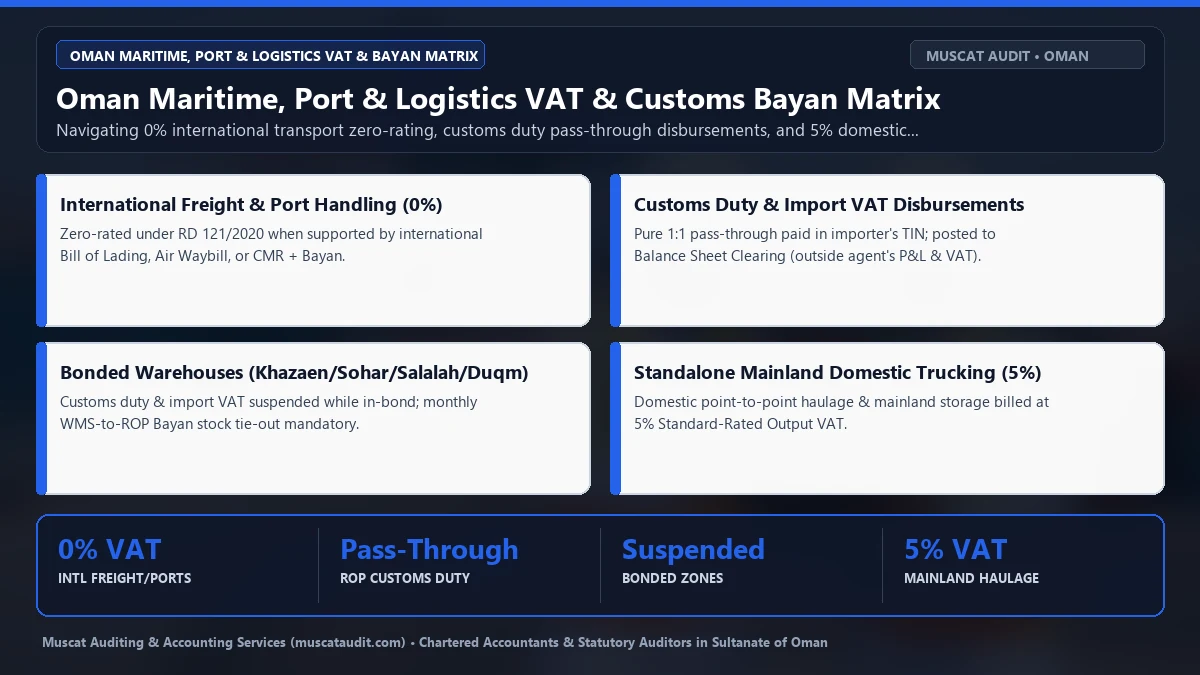
3. Oman VAT & ROP Customs ‘Bayan’ Compliance Across Ports, Bonded Zones & Domestic Trucking
Because the Oman Tax Authority (OTA) electronically cross-references corporate VAT returns against the Royal Oman Police (ROP) Directorate General of Customs Bayan database, logistics providers and importers/exporters must maintain a monthly Bayan-to-General-Ledger Reconciliation. Our Tax & VAT Advisory team assists bonded warehouse operators in Khazaen, Sohar, Salalah, and Duqm in verifying customs duty suspension bonds, Certificate of Origin documentation for GCC/FTA shipments, and documentary proof of export within statutory timeframes.
4. IFRS 16 Port/Usufruct Leases & IAS 16 Component Depreciation for Vessels, Reefers & Trucks
Capital-intensive logistics operators carry substantial fixed and leased assets on their balance sheets:
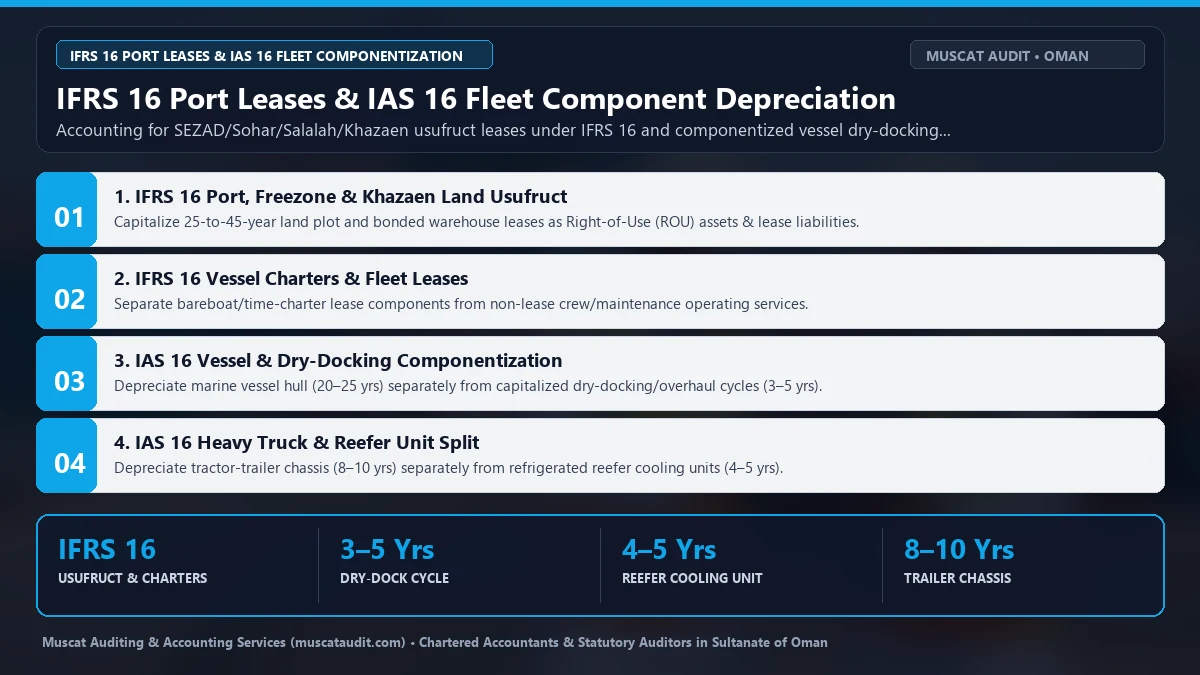
- Port Concessions, Warehouse Plots & Time Charters (IFRS 16): Long-term land usufruct agreements in Khazaen Economic City, Sohar Freezone, or Duqm—as well as multi-year vessel bareboat/time charters (for the lease component) and truck fleet leases—must be recognized as Right-of-Use (ROU) assets and discounted lease liabilities under IFRS 16.
- Componentized Fleet & Vessel Depreciation (IAS 16): Depreciating an entire marine support vessel or refrigerated reefer trailer at a single flat rate violates IAS 16 when major components have distinct economic lives. For example, marine dry-docking/overhaul costs (typically every 30 to 60 months) and reefer refrigeration units must be capitalized and depreciated separately from the vessel hull or trailer chassis.
5. Internal Audit for Logistics: Stopping Demurrage Leakage, Fuel Fraud & Cold-Chain Shrinkage
As demonstrated in our published client work on Internal Controls Enhancement for a Logistics Firm in Oman, a targeted Internal Audit & Risk Advisory review pays for itself many times over by sealing operational leakages across fleet and warehouse operations:
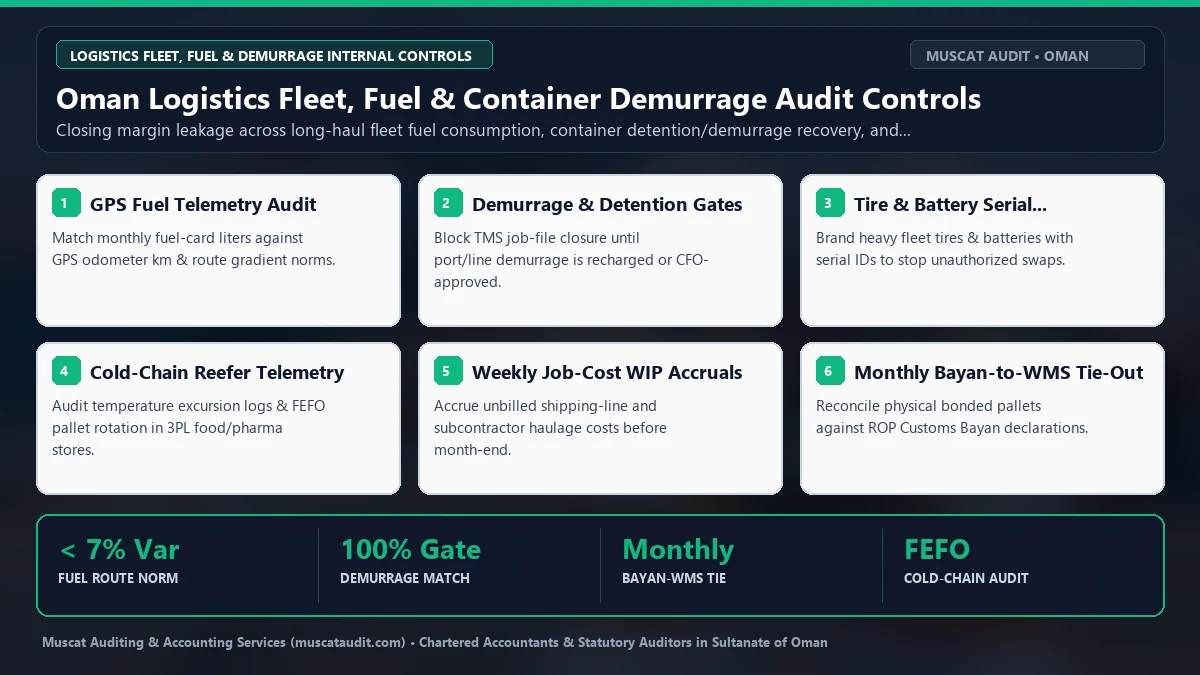
- Fleet Fuel Telemetry & Tire Serial Auditing: Reconciling monthly fuel-card statements (Shell/Oman Oil/Al Maha fleet cards) against GPS odometer kilometres and standard liter-per-100km load benchmarks per route (e.g., Sohar–Muscat vs. Salalah mountain gradients), and serial-branding heavy truck tires and batteries to prevent unauthorized workshop swaps.
- Automated Job-File Closure & Demurrage Recharge Gates: Implementing an ERP rule that no import/export job file can be closed in the TMS without matching every port/shipping-line outlay to a corresponding customer billing line or a CFO-signed exception memo.
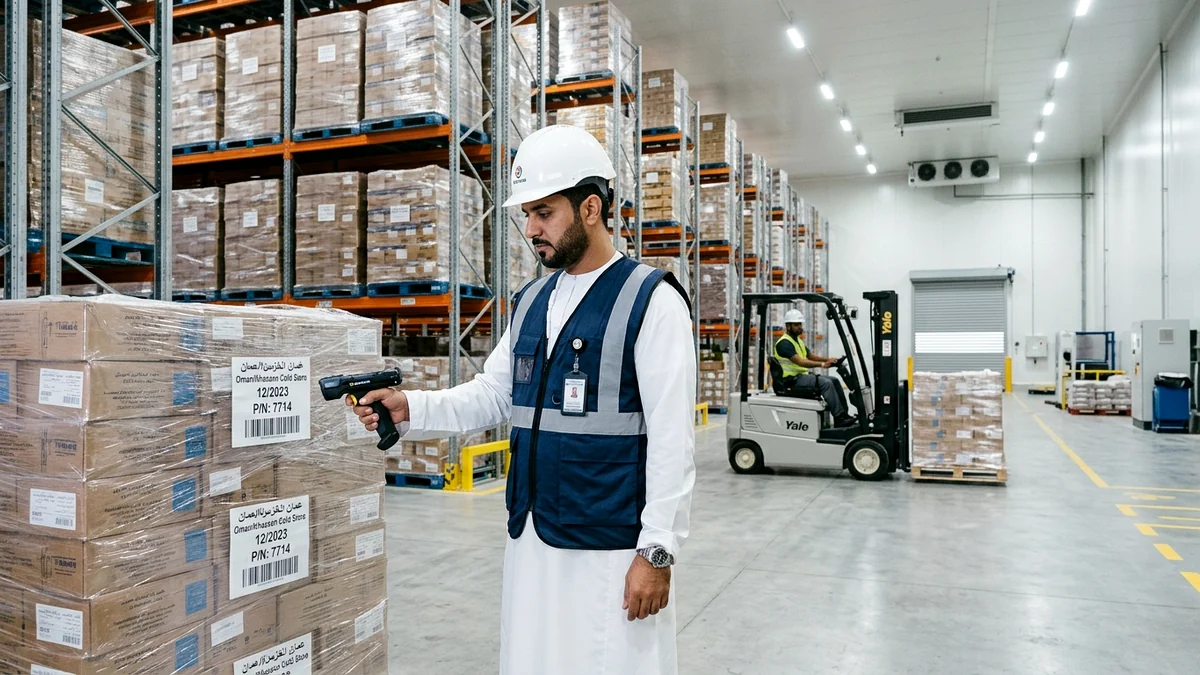
- Cold-Chain FEFO (First-Expired, First-Out) & Bonded Stock Counts: Conducting surprise cycle counts in temperature-controlled food and pharmaceutical 3PL warehouses, reconciling physical pallet positions against both client 3PL portals and ROP Customs bonded balances.
Worked OMR Scenario: Freight Forwarder Disbursement Accounting & Demurrage Recovery
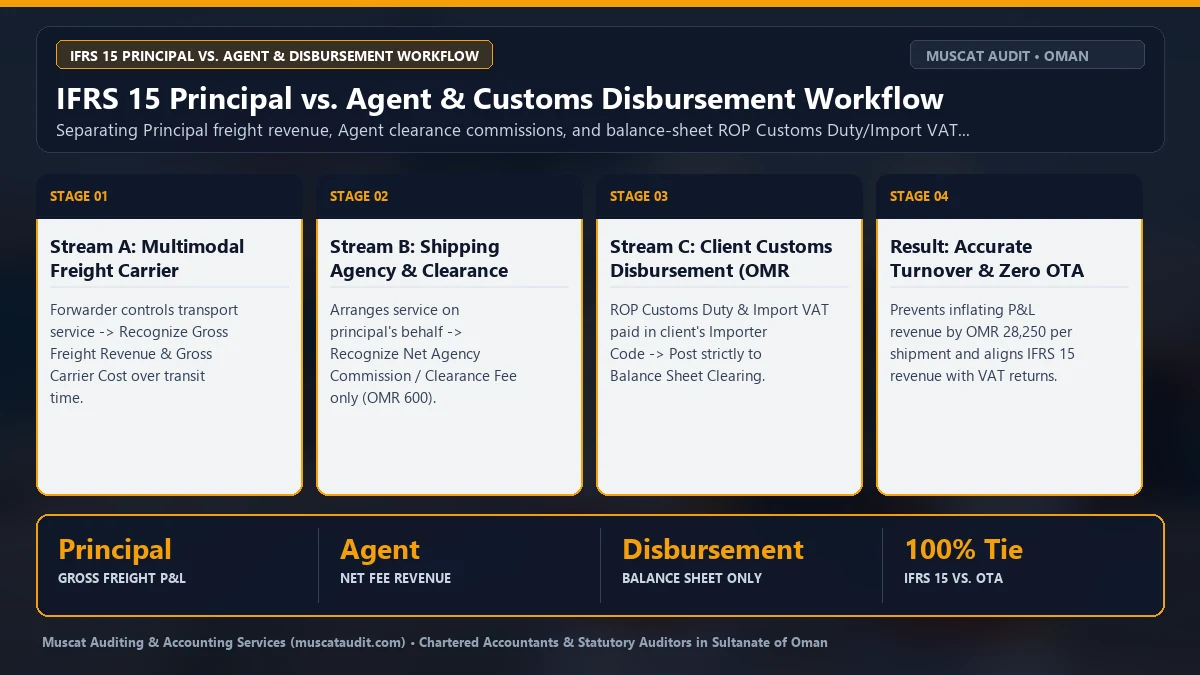
To see how proper IFRS 15 and Oman VAT segregation protects a freight forwarder in Sohar or Muscat during an OTA inspection, consider a clearing and forwarding job file where the logistics company clears 20 forty-foot containers of industrial machinery for a Muscat manufacturer: (a) the forwarder pays OMR 18,500 in ROP Customs Duty and OMR 9,750 in Import VAT directly under the importer’s Customs Code and Tax Identification Number (TIN); (b) the forwarder pays OMR 3,200 in ocean terminal handling and port stevedoring directly connected to the international Bill of Lading; (c) the forwarder provides domestic low-bed trucking from Sohar Port to Nizwa under a separate local haulage contract for OMR 2,400; and (d) the forwarder charges a customs clearance agency fee of OMR 600.
In an audit-compliant general ledger, the OMR 28,250 (Customs Duty + Import VAT paid in the client’s name) is posted strictly to a Client Disbursement Clearing Account on the balance sheet—never touching P&L revenue or Output VAT. The international port handling recharge (OMR 3,200) and international clearance fee (OMR 600) are documented with the Master Bill of Lading and ROP Bayan declaration to support 0% international transport treatment where applicable, while the standalone domestic haulage contract (OMR 2,400) is invoiced with 5% Standard-Rated Output VAT (OMR 120). Separating these three streams prevents the forwarder from accidentally inflating its statutory turnover by OMR 28,250 on that single shipment alone!
6. Mandatory Omani Customs/VAT/Maritime Rules vs. Supply Chain Finance Best Practices
Mandatory Statutory Requirements in Oman
- ROP Customs ‘Bayan’ & Bonded Warehouse Record Retention: Importers, exporters, clearing agents, and bonded warehouse operators must retain complete Bayan declarations, Bills of Lading, commercial invoices, and packing lists for statutory inspection.
- Documentary Proof for 0% International Transport VAT: To zero-rate freight and port-related services under Oman VAT Law (RD 121/2020), the supplier must hold valid transport documents (B/L, AWB, CMR) proving the cross-border movement.
- Strict Segregation of Client Customs Disbursements: Reimbursed customs duties paid in the importer’s name must meet strict OTA disbursement criteria to remain outside the clearing agent’s taxable VAT base.
- Ministry of Transport, Communications and Information Technology (MTCIT) Licensing: Land transport trucks, shipping agencies, and freight forwarders must maintain valid MTCIT operational permits and audited financials.
Professional Best-Practice Recommendations
- Separate Disbursement Clearing Accounts in the GL: Never book pass-through client customs duties or port outlays inside P&L revenue or cost-of-sales accounts.
- Close Job-Cost Accruals Weekly: Accrue estimated shipping-line and haulage costs on open job files at month-end so gross margin per shipment is accurate.
- Audit Fleet Fuel Consumption by Route & Tonnage Monthly: Investigate any truck exceeding route fuel norms by more than 7% within 48 hours.
- Reconcile WMS Bonded Inventory to Customs Bayan Monthly: Catch clerical unit-of-measure (carton vs. pallet vs. kg) discrepancies in Bayan filings before customs inspections.
7. Frequently Asked Questions on Maritime & Logistics Auditing in Oman
How does Oman VAT apply to international freight forwarding, shipping agency services, and port handling in Sohar, Salalah, and Duqm?
Under Oman’s Value Added Tax Law (Royal Decree 121/2020) and its Executive Regulations, the international transport of goods and passengers—as well as services directly connected and incidental to international transport (such as port handling, stevedoring, pilotage, customs clearance for export/import voyages, and container terminal charges tied to an international Bill of Lading)—generally qualify for 0% VAT (zero-rating), whereas purely domestic land transport between two points inside mainland Oman (not forming part of an international transport contract) is subject to standard 5% VAT.
How should freight forwarders and shipping agents in Oman recognize revenue under IFRS 15—Gross (Principal) or Net (Agent)?
Under IFRS 15 (Paragraphs B34–B38), a freight forwarder or customs clearing agent must evaluate whether it controls the transport service before it is transferred to the customer (Principal = recognize gross freight revenue and gross carrier costs) or whether it merely arranges for the shipping line/airline to provide the service or pays port/customs duties as a pure disbursement on the client’s behalf (Agent/Disbursement = recognize only the net agency/clearance fee). Misclassifying pure customs duty disbursements as gross revenue distorts both financial ratios and OTA tax reconciliations.
What customs and VAT controls are required for bonded warehouses and logistics operators in Khazaen Economic City, Sohar, Salalah, and Duqm?
Logistics operators operating inside Special Economic Zones, Free Zones, or Customs Bonded Warehouses must maintain perpetual inventory reconciliation between physical stock, the Warehouse Management System (WMS), and Royal Oman Police (ROP) Directorate General of Customs ‘Bayan’ import/in-bond/re-export declarations. Any unexplained inventory shortage discovered during a customs or statutory audit is deemed an irregular release into the local Omani market, triggering immediate customs duty (typically 5%) plus 5% import VAT and penalties.
How do Omani transport and cold-chain logistics companies account for fleet vessels, trucks, and warehouse leases under IFRS 16 and IAS 16?
Long-term land plots leased in Khazaen, Sohar Port & Freezone, Salalah, or Duqm—as well as multi-year time charters or truck fleet leases—must be capitalized on the balance sheet as Right-of-Use (ROU) assets and lease liabilities under IFRS 16. Owned commercial vessels, heavy tractor-trailers, and refrigerated reefers require componentized depreciation under IAS 16 (separating chassis, refrigerated cooling units, and major dry-docking/engine overhauls that have shorter useful lives).
What are the highest fraud and leakage risks in Omani trucking, cold-chain, and warehouse operations?
Internal audits of Omani logistics companies consistently uncover four major revenue and cost leakages: (1) fuel card and diesel siphoning across long-haul GCC trucking routes, (2) unbilled container demurrage, detention, and storage days waived informally without management approval, (3) phantom spare-parts and tire procurement in fleet workshops, and (4) cold-chain temperature excursion spoilage masked as routine inventory write-offs.
Strengthen Your Maritime, Port & Logistics Financial Controls in Oman
From Sohar, Salalah, and Duqm port operators to Khazaen 3PL warehouses and GCC trucking fleets, Muscat Audit delivers specialized external audit, internal audit, and customs/VAT advisory tailored to Oman’s logistics sector.