
Management Consultancy, Corporate Turnaround & Post-Merger Integration (PMI) Advisory in Oman: Cash Conversion Cycle & Operational Restructuring
In Oman’s competitive commercial environment, many established family groups, industrial manufacturers, and EPC contractors find themselves in a paradoxical position: their income statement shows healthy revenue and positive accounting profit, yet the treasury desk struggles every month to fund supplier Letters of Credit, quarterly VAT remittances, and bank loan installments. In other boardrooms across Muscat, executive teams that recently completed an acquisition or joint venture discover eighteen months later that expected cost synergies never materialized because the acquired entity continues to run on disconnected spreadsheets and legacy processes.
Solving deep operational and financial bottlenecks requires more than high-level strategy slides—it demands hands-on execution grounded in forensic accounting, working-capital engineering, and Omani regulatory precision. Recognized as a Top Audit Firm in Oman with a dedicated Management Consultancy & Corporate Advisory division, Muscat Audit partners with boards, shareholders, and private equity investors to execute measurable corporate turnarounds and seamless Post-Merger Integrations (PMI).
1. Closing the EBITDA-to-Cash Gap in Omani Conglomerates & Mid-Market Enterprises
Why do profitable Omani businesses run out of cash? In our management consultancy diagnostics across Muscat, Sohar, and Salalah, three operational leaks consistently explain the gap between reported EBITDA and cash in the bank:
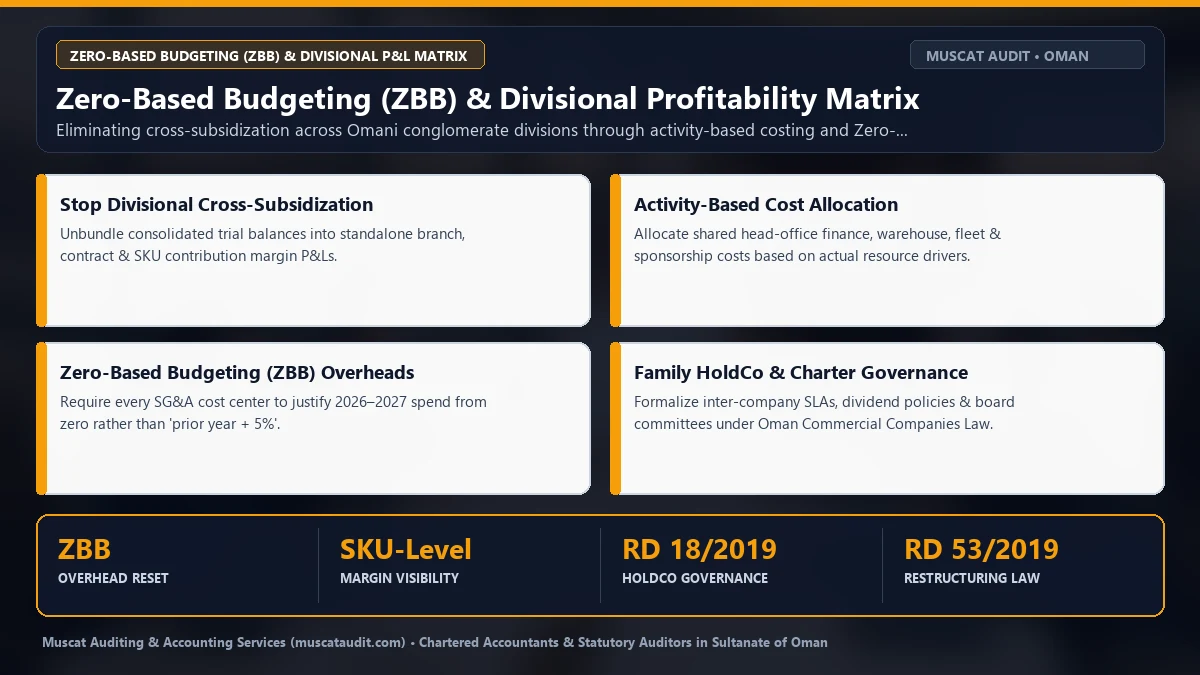
- Cross-Subsidization of Loss-Making Divisions: Multi-division LLCs often pool all revenues and overheads into a single consolidated trial balance. Without activity-based cost allocation by branch, contract, or SKU, a highly profitable trading or maintenance division silently subsidizes two loss-making retail or contracting units for years.
- Unbilled Work-in-Progress (WIP) & Disputed Retentions: Project teams recognize revenue under IFRS 15 percentage-of-completion rules, but commercial engineers fail to submit signed milestone completion certificates or variation orders on time—leaving hundreds of thousands of Omani Rials trapped in unbilled contract assets.
- Inventory Bloating & Uncontrolled Procurement: Purchasing managers order spare parts and raw materials in bulk without ERP min-max reorder controls, locking cash in slow-moving warehouse stock while incurring demurrage and storage costs.
2. The 4-Stage Corporate Turnaround & Operational Restructuring Playbook in Oman
| Turnaround Phase | Time Horizon | Primary Operational & Financial Actions | Target Measurable Outcome |
|---|---|---|---|
| Stage 1: Liquidity Stabilization & Cash War-Room | Days 1 – 30 | 13-week rolling cash flow model, freeze non-essential CAPEX, centralize bank payment approvals, accelerate overdue AR collections | Immediate cash runway visibility & protection of WPS payroll / OTA tax payments |
| Stage 2: Divisional & SKU Profitability Diagnostic | Days 31 – 60 | Contribution margin analysis by business unit/customer/SKU, Zero-Based Budgeting (ZBB) of SG&A overheads | Identification of bottom-20% margin-dilutive contracts/SKUs for repricing or exit |
| Stage 3: Working Capital & Process Redesign (BPR) | Days 61 – 120 | ERP credit-limit automation, deadstock liquidation, vendor consolidation, and procurement SOP overhaul | 15%–30% reduction in Cash Conversion Cycle (CCC) days |
| Stage 4: Capital Structure & Governance Reset | Days 121 – 180 | Bank facility reprofiling (matching LTRs to term debt), monthly KPI balanced scorecard, and internal audit monitoring | Restored DSCR ≥ 1.35x and sustainable cash-generative growth |
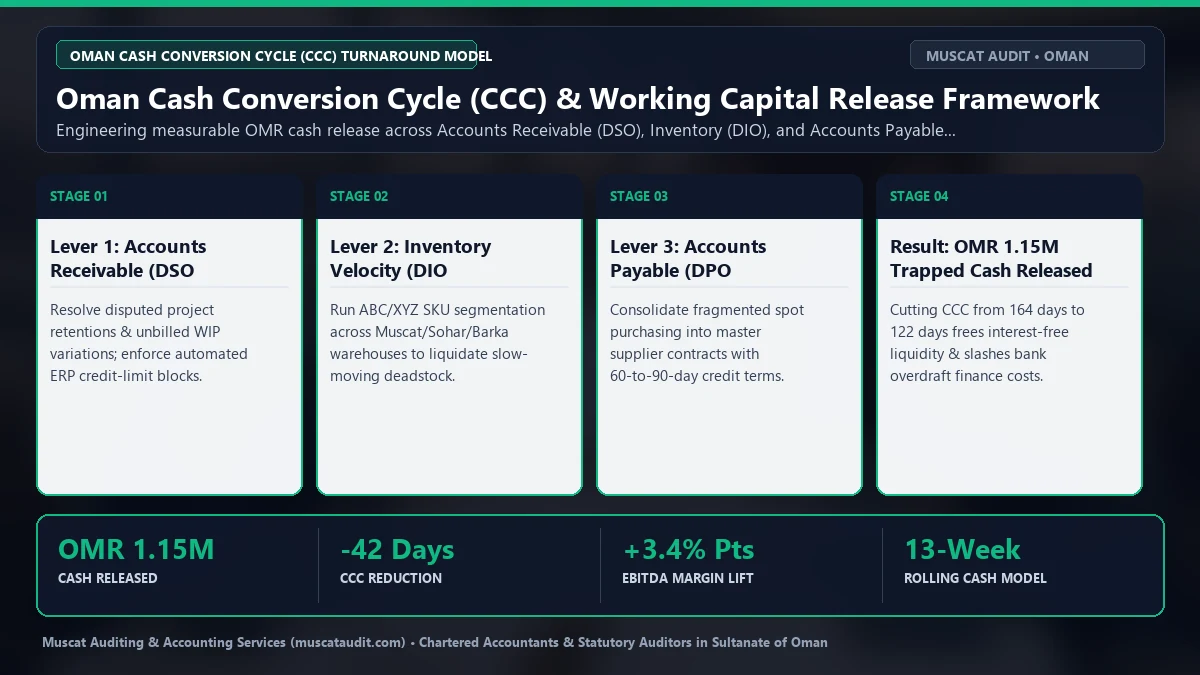
3. Unlocking Trapped OMR Liquidity: Optimizing the Cash Conversion Cycle (DSO, DIO & DPO)
Consider an Omani industrial distribution and contracting company generating OMR 7,300,000 in annual revenue (OMR 20,000 per day). Every single day by which management shortens its net Cash Conversion Cycle releases OMR 20,000 of interest-free cash directly onto the balance sheet—reducing reliance on bank overdrafts priced at 6.5%–7.5% per annum. Through our Business Process Redesign engagements, we embed automated ERP gates that prevent sales orders from being dispatched to overdue accounts without CFO digital sign-off, while linking sales team incentives to cash collected rather than invoices booked.
4. Post-Merger Integration (PMI): Executing the First 100 Days After an Omani M&A Deal
When an Omani group or regional investor completes an acquisition (building on the valuation and due diligence frameworks outlined in our guide to M&A Advisory and Business Valuation in Oman), the first 100 days determine whether the transaction creates or destroys shareholder value.

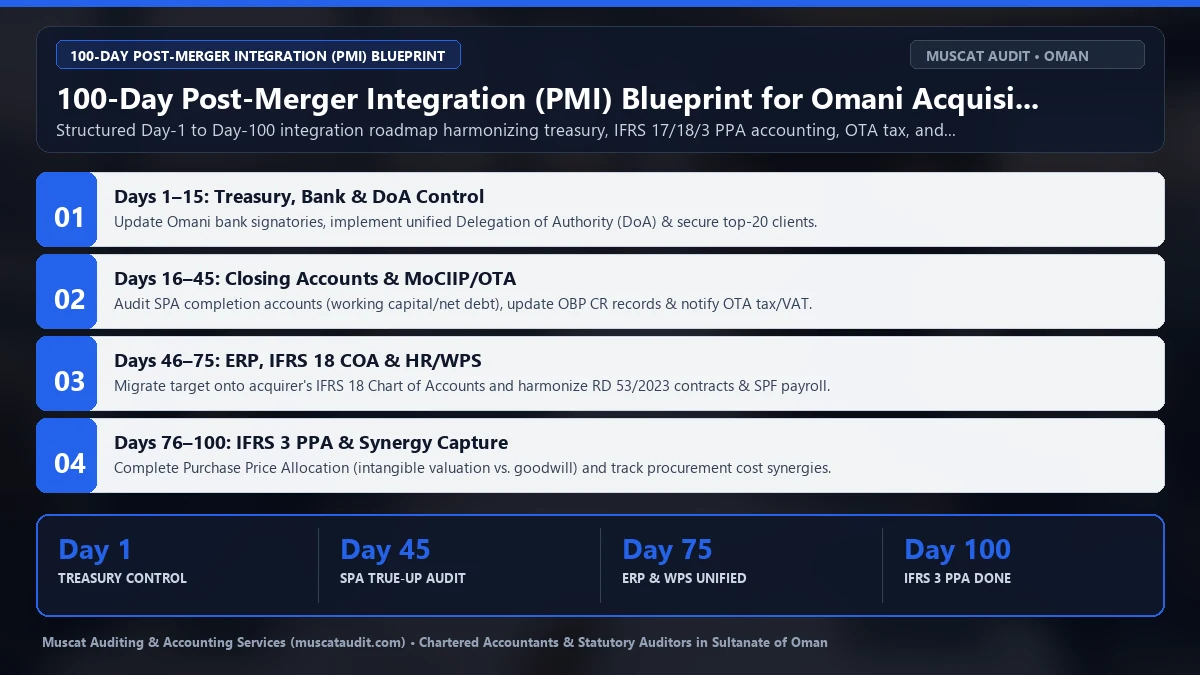
Our Post-Merger Integration PMO manages five critical workstreams simultaneously:
- Day-1 Treasury & Authority Matrix Control: Updating commercial bank mandates, revoking legacy power-of-attorney signatories, and implementing a unified Delegation of Authority (DoA) matrix across the acquired Omani entity.
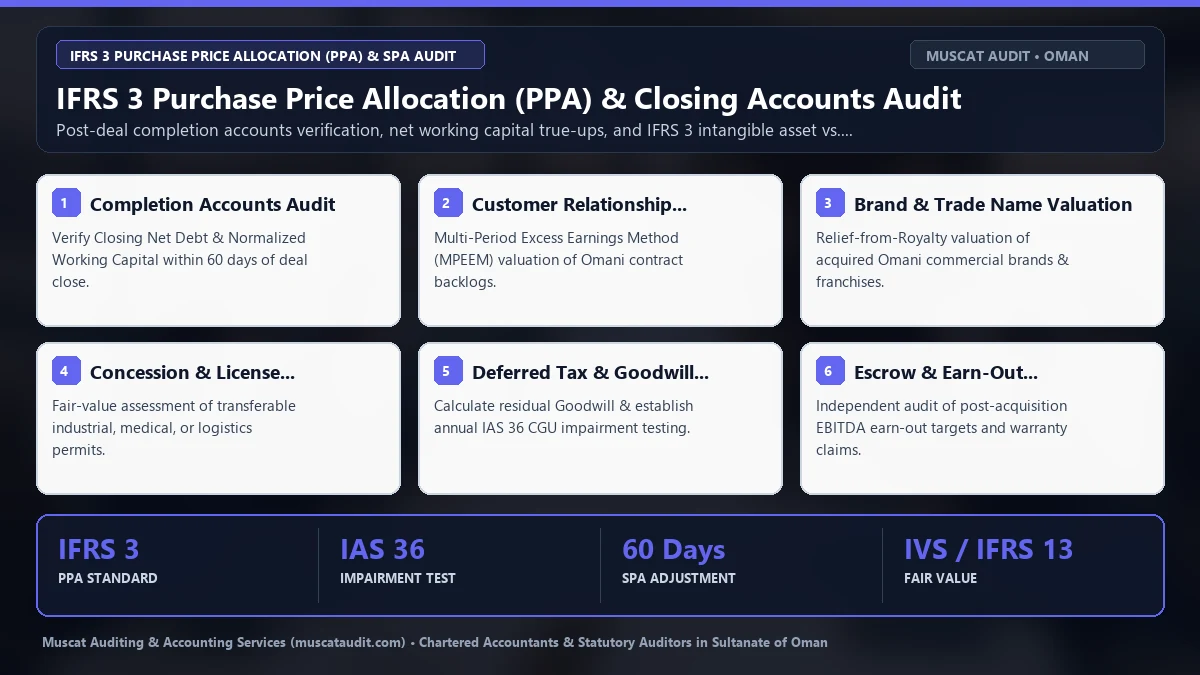
- IFRS 3 Purchase Price Allocation (PPA) & Opening Balance Sheet Audit: Conducting a rigorous closing-accounts audit (to calculate final working-capital and net-debt completion adjustments under the SPA) and valuing identifiable intangible assets (customer relationships, brand, licenses) vs. goodwill under IFRS 3.
- MoCIIP, OTA & Sectoral License Harmonization: Updating the Oman Business Platform Commercial Registration (CR) ownership records, notifying the Oman Tax Authority within statutory windows of shareholding or legal-form changes, and aligning VAT filing procedures.
- HR, WPS & Social Protection Fund (SPF) Integration: Harmonizing grading structures, sales commission plans, and Omani employment contracts under Royal Decree 53/2023 without disrupting workforce morale.
5. Business Process Redesign (BPR), Zero-Based Budgeting & Divisional Profitability
Whether we are advising a manufacturing plant, a healthcare group, or a national distribution company (explore our Oman Client Case Studies), sustainable turnaround requires replacing incremental “last year plus 5%” budgeting with Zero-Based Budgeting (ZBB) and cost-center accountability—ensuring every Omani Rial of overhead is justified by current revenue generation and strategic return.
Worked OMR Turnaround Case: Releasing OMR 1.15 Million in Trapped Working Capital for a Muscat Group
To illustrate how operational management consultancy translates directly into balance-sheet liquidity, consider a multi-division Omani building-materials and contracting group in Muscat with annual turnover of OMR 9,200,000. Despite reporting an accounting operating profit of OMR 410,000, the group’s net Cash Conversion Cycle had ballooned to 164 days (112 Receivable Days + 98 Inventory Days minus 46 Payable Days), forcing the company to pay over OMR 195,000 per year in bank overdraft and short-term LTR interest.
Deployed on a 120-day turnaround mandate, Muscat Audit’s Management Consultancy team established a weekly Cash War-Room and executed three structural interventions: (1) we segmented the OMR 2,820,000 Accounts Receivable ledger into four actionable buckets, resolving 34 stalled project variation and retention certificates worth OMR 490,000 within 45 days and embedding automated credit-hold blocks in the ERP; (2) we conducted an ABC/XYZ velocity audit of the OMR 1,750,000 warehouse inventory in Barka, liquidating OMR 310,000 of slow-moving SKUs through bundled contractor promotions and cutting average Inventory Days from 98 to 68 days; and (3) we restructured divisional P&L reporting to shut down a chronically loss-making fabrication sub-unit that had been draining OMR 140,000 annually. Within four months, the turnaround released OMR 1,150,000 in free cash flow, reduced annual finance costs by OMR 78,000, and lifted consolidated EBITDA margin by 3.4 percentage points.
Key Synergy & Control Workstreams in Post-Merger Integration (PMI)
- Commercial & Customer Retention Protection: Joint executive visits to top-20 Omani government and corporate accounts during Week 1 post-closing, ensuring contract novations and vendor registration codes (JSRS / tender board) remain uninterrupted.
- Procurement & Supply Chain Consolidation: Aggregating purchasing volumes across the acquirer and target entities to negotiate 5%–12% volume rebates and standardized 60-to-90-day payment terms from key regional suppliers.
- IT, Cybersecurity & ERP Migration: Decommissioning duplicate software licenses, unifying Fawtara-ready billing templates with Oman Tax Authority (OTA) requirements, and migrating historical sub-ledgers with a clean audit trail.
- Family Business Governance & HoldCo Restructuring: For second- and third-generation Omani family conglomerates transitioning from informal partnership management to an institutional Holding Company (SAOC/LLC) structure under the Commercial Companies Law (RD 18/2019), we draft the Family Charter, Board & Executive Committee terms of reference, dividend distribution policies, and inter-company Service Level Agreements (SLAs) so operational management is cleanly separated from shareholder ownership.
6. Mandatory Omani Corporate / Insolvency Laws vs. Turnaround Best Practices
Mandatory Statutory Requirements in Oman
- Capital Erosion Rules under Oman Commercial Companies Law (RD 18/2019): If accumulated losses reach statutory thresholds of share capital in an LLC or SAOC/SAOG, the Board/Managers must convene an Extraordinary General Meeting within the legally prescribed period to resolve capital restoration or restructuring.
- MoCIIP & Competition Protection Approvals in M&A: Mergers, share transfers, and economic concentrations exceeding statutory thresholds require formal MoCIIP approval and registration.
- Mandatory IFRS 3 PPA & IAS 36 Impairment Testing: Post-acquisition financial statements must recognize identifiable net assets at fair value under IFRS 3 and test goodwill annually for impairment under IAS 36.
- Oman Labour Law Protection on Transfer of Business (RD 53/2023): Employees’ continuity of service and statutory entitlements remain protected during corporate mergers or ownership transfers.
Professional Best-Practice Recommendations
- Launch a 13-Week Rolling Cash Forecast Immediately: Manage turnaround liquidity on weekly cash receipts and disbursements rather than monthly accrual P&Ls.
- Audit Completion Accounts Within 60 Days of Deal Closing: Verify net working capital and net debt adjustments before escrow holdbacks expire.
- Unify ERP Charts of Accounts Within 90 Days of Acquisition: Map the target company onto the acquirer’s IFRS 18-compliant Chart of Accounts in Quarter 1.
- Appoint a Dedicated Turnaround / PMI Project Management Office (PMO): Track synergy capture and working-capital KPIs weekly with board-level accountability.
7. Frequently Asked Questions on Management Consultancy & Turnaround in Oman
What are the early warning signs that an Omani company needs a formal corporate turnaround and operational restructuring?
The five clearest early warning indicators in Oman are: (1) positive reported accounting EBITDA accompanied by chronic negative operating cash flow, (2) a Cash Conversion Cycle (DSO + DIO minus DPO) stretching beyond 120–150 days, (3) permanent reliance on fully drawn bank overdrafts or revolving LTR facilities to pay routine monthly payroll and VAT, (4) gross margin erosion masked by cross-subsidization between profitable and loss-making divisions, and (5) delayed supplier payments leading to vendor credit holds.
Why do Mergers and Acquisitions (M&A) in Oman often fail to deliver their projected synergies after deal signing?
While buyers invest heavily in pre-deal financial and tax due diligence, value destruction typically happens during the first 100 days after closing due to fragmented Post-Merger Integration (PMI)—such as operating two incompatible ERP systems and Charts of Accounts, failing to harmonize Ministry of Labour employment contracts and Social Protection Fund (SPF) structures, overlooking Oman Tax Authority (OTA) VAT group or tax registration notifications, and losing key commercial staff during leadership transitions.
How does Muscat Audit unlock trapped working capital inside Omani trading, contracting, and manufacturing businesses?
We execute a forensic Cash Conversion Cycle (CCC) diagnostic across three levers: (1) Accounts Receivable (DSO)—resolving disputed retention certificates and unbilled contract variations while enforcing credit-limit blocks in the ERP; (2) Inventory (DIO)—liquidating slow-moving and obsolete SKU deadstock through ABC/XYZ velocity segmentation; and (3) Accounts Payable (DPO)—consolidating fragmented local purchasing into master vendor agreements with structured 60-to-90-day credit terms.
How does Oman’s Bankruptcy and Insolvency Law (Royal Decree 53/2019) support preventative corporate restructuring?
Royal Decree No. 53/2019 introduced a modern preventative composition and restructuring regime in Oman, allowing financially distressed but economically viable enterprises to apply for court-supervised restructuring before liquidation becomes unavoidable. Having an independent Management Consultancy and Turnaround advisor prepare a credible operational recovery plan and creditor waterfall is essential to achieving stakeholder consensus.
What is included in a 100-Day Post-Merger Integration (PMI) Blueprint for Omani acquisitions?
A 100-Day PMI Blueprint covers Day-1 Treasury & Bank Signatory Control, ERP & Chart of Accounts unification (IFRS 18 ready), MoCIIP Commercial Registration (CR) and Articles of Association updates, OTA Corporate Tax & VAT registration harmonization, HR/WPS/Omanisation workforce integration under RD 53/2023, and procurement/facility synergy tracking with weekly PMO KPI reporting to the Board.
Transform Operational Performance & Unlock Cash Flow with Muscat Audit
Whether your enterprise requires a rapid working-capital turnaround, divisional cost restructuring, or a 100-day Post-Merger Integration (PMI) PMO in Oman, Muscat Audit’s Management Consultancy partners deliver measurable balance-sheet results.