
Upstream Oil, Gas, Mining & Green Hydrogen (Hydrom) Joint Venture Audits and Cost Recovery Accounting in Oman
The Sultanate of Oman sits at the epicenter of two multi-billion-dollar capital cycles. On one side stands a mature, technologically advanced upstream hydrocarbon and commercial mining sector anchored by the Ministry of Energy and Minerals (MEM), Energy Development Oman (EDO), Petroleum Development Oman (PDO), OQ, and Minerals Development Oman (MDO). On the other stands one of the world’s most ambitious giga-scale renewable energy and green molecule programs orchestrated by Hydrogen Oman SPC (Hydrom) across Al Wusta (Duqm) and Dhofar (Salalah).
Both capital ecosystems share a defining financial structure: they are executed through multi-party Joint Ventures (JVs), Exploration and Production Sharing Agreements (EPSAs), and Joint Operating Agreements (JOAs) uniting Omani state-backed energy holdings with international oil companies, global utilities, and EPC contractors. Among leading Audit Firms in Oman, Muscat Audit provides specialized JOA cost-recovery audits, Non-Operator joint venture inspections, Feasibility Study & LCOH financial modelling, and statutory IFRS assurance tailored to Oman’s energy and mineral concessions.
1. From Hydrocarbon EPSAs to Hydrom Green Hydrogen Blocks: Oman’s Energy Capital Landscape
When international consortia sign a hydrocarbon concession with MEM or a Project Development Agreement (PDA) and sub-usufruct land agreement with Hydrom for a green hydrogen and green ammonia block in Duqm, billions of dollars in capital expenditure (solar/wind arrays, electrolyzers, desalination plants, pipelines, drilling rigs, and processing terminals) flow through a single Joint Account managed by the designated Operator.
Without rigorous, independent joint venture auditing, non-operating equity partners and government concession authorities face severe financial exposure:
- Affiliate & Parent-Company Recharge Overbillings: Under JOA Accounting Procedures, an Operator is strictly required to charge the Joint Account on a “no profit, no loss” basis. Yet forensic JOA audits frequently uncover foreign technical headquarters billing expatriate engineers at commercial consulting tariff rates rather than actual cost, or applying double-counted administrative overhead percentages.
- Shared Infrastructure Cost Allocation Disputes: In green hydrogen valleys and mining corridors where multiple consortia share common-user water pipelines, high-voltage grid interconnects, and port export terminals at Duqm or Salalah, misallocating shared CAPEX/OPEX distorts project IRR and Levelized Cost of Hydrogen (LCOH).
- Unreconciled Cash Calls & Working Capital Interest: Failing to reconcile monthly Partner Cash Call advances against actual accrued Work Program and Budget (WP&B) Authority for Expenditure (AFE) milestones.
2. IFRS 11 Joint Arrangements, Cash Call Accounting & Cutback Reconciliations
From an IFRS & Financial Reporting perspective, the first technical milestone in any Omani energy or mining consortium is classifying the arrangement correctly under IFRS 11 (Joint Arrangements) and aligning tax schedules with the Oman Tax Authority (OTA):
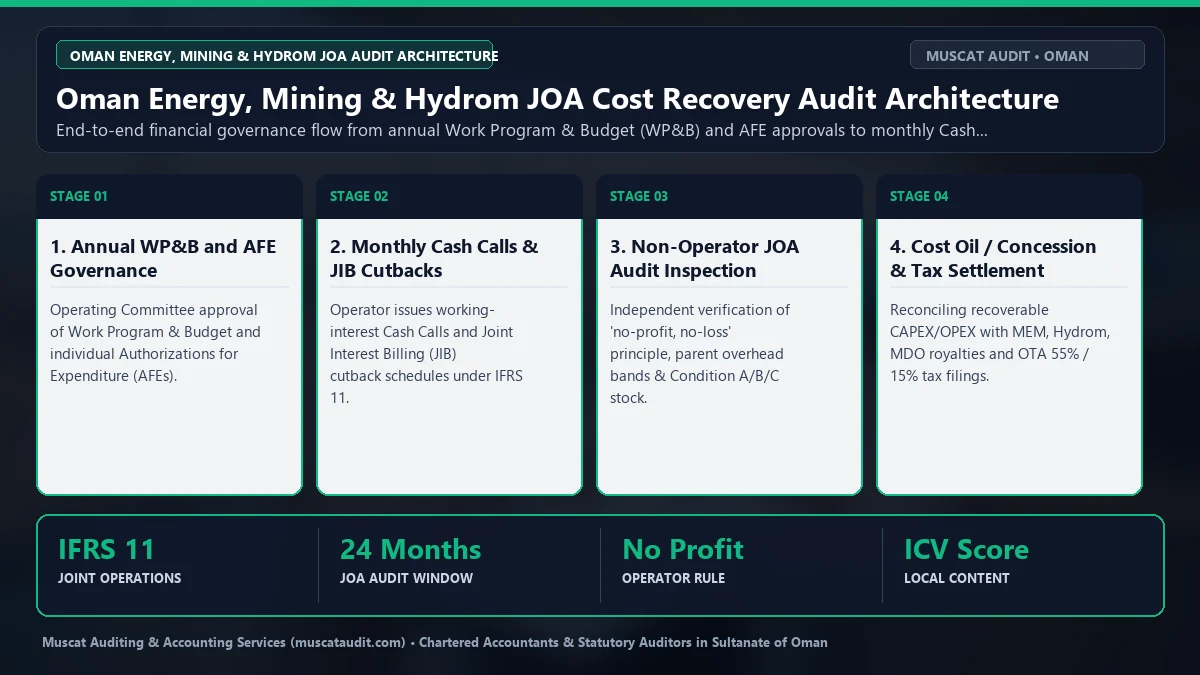
- Joint Operations (IFRS 11.15): Typical of unincorporated Omani oil & gas blocks and mineral exploration licenses where each working-interest partner has direct rights to the assets and direct obligations for the liabilities. Each month, the Operator issues a Joint Interest Billing (JIB) / Cutback Statement, and each partner books its exact participating percentage (e.g., 40%) of exploration assets (IFRS 6), development PP&E (IAS 16), inventory, payables, and operating costs directly onto its own balance sheet.
- Joint Ventures (IFRS 11.16 & IAS 28): Common in downstream refining, LNG, green ammonia synthesis plants, and incorporated SPVs (SAOC/LLC) where the project company owns the assets and raises non-recourse project finance debt in its own name, while shareholders account for their equity stake under IAS 28 (and classify their share of profit/loss in the Investing category under IFRS 18!).
3. Inside a Non-Operator JOA Cost Recovery & Forensic Audit in Oman
When our Forensic Audit & Assurance partners are appointed by a Non-Operator partner or concession holder to audit an Operator’s Joint Account in Muscat, Sohar, or Duqm, we execute a targeted six-point audit program:

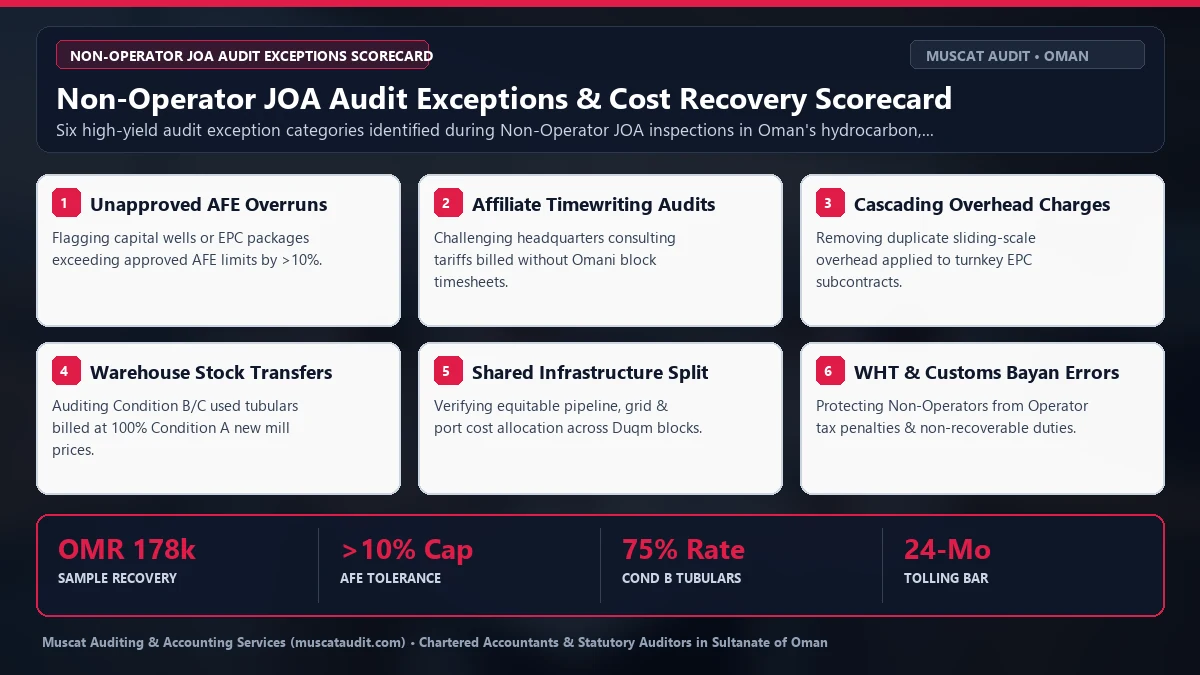
- AFE (Authorization for Expenditure) Overrun Testing: Cross-checking every capital well, seismic survey, mining pit expansion, or solar/electrolyzer package against approved AFE thresholds (typically requiring formal Partner Operating Committee re-approval if costs exceed budget by more than 10%).
- Timewriting & Expatriate Secondment Audits: Verifying that technical specialists seconded from an international partner’s home office have contemporaneously signed time-sheets allocating hours exclusively to the Omani block—and that 10% Oman Withholding Tax (WHT) and Reverse Charge VAT have been properly handled on cross-border technical service charges.
- Materials & Tubular Inventory Pricing (Condition A, B, and C Stock): Auditing warehouse transfers between an Operator’s wholly owned operations and the Joint Venture block to confirm that used or surplus materials (Condition B/C) are not charged to the JV at 100% new replacement cost (Condition A).
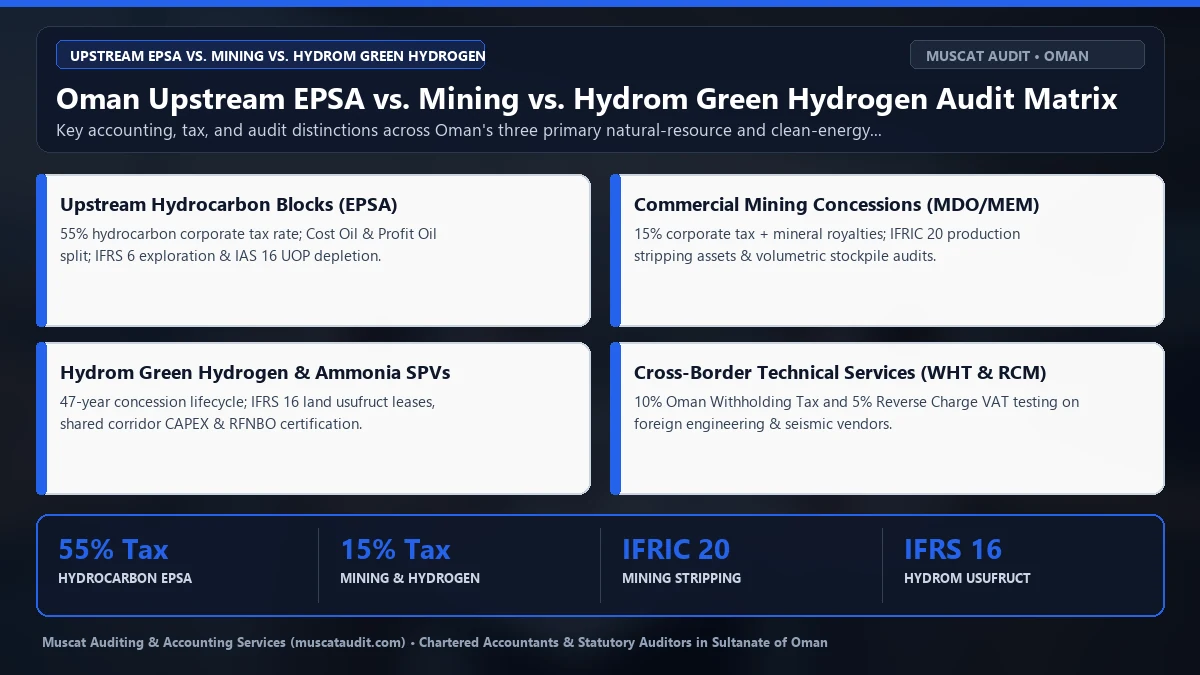
4. Comparative Audit & Tax Matrix: Upstream Oil & Gas vs. Mining vs. Green Hydrogen
| Dimension | Upstream Oil & Gas (EPSA) | Commercial Mining (MDO / MEM) | Green Hydrogen (Hydrom / SEZAD) |
|---|---|---|---|
| Primary Regulator | Ministry of Energy & Minerals (MEM) / EDO | MEM & Minerals Development Oman (MDO) | Hydrogen Oman SPC (Hydrom) / OPAZ (SEZAD) |
| Oman Corporate Tax Rate | 55% Hydrocarbon Tax Rate (settled under EPSA Profit Oil mechanics) | 15% Standard Corporate Tax + Statutory Mineral Royalties | 15% Standard Rate (or Free Zone / SEZAD Tax Incentives) + Land/Royalty Fees |
| Key IFRS Standards | IFRS 6, IFRS 11, IAS 16 (Units of Production), IAS 36, IAS 37 (ARO) | IFRS 6, IFRIC 20 (Stripping Costs in Production Phase), IAS 16, IAS 37 | IFRS 11, IFRS 16 (Usufruct Land Leases), IAS 16, IFRS 9 (Power/Offtake Hedging) |
| Special Audit Focus | Cost Oil recovery eligibility, JOA overhead bands, and ICV scorecards | Stockpile survey volumetric reconciliation & export assay revenue cut-off | Shared corridor CAPEX allocation, Guarantee of Origin (RFNBO) audit & EPC retentions |
5. IAS 37 Decommissioning Provisions, IFRS 6 Exploration Assets & ICV Assurance
Energy and mining financial statements in Oman also require specialized valuation and assurance across three technical areas:
- Exploration & Evaluation (E&E) Impairment Triggers (IFRS 6): When an exploratory oil well, chromite/copper mining license, or wind/solar measurement campaign in Oman encounters dry holes or non-commercial yields, IFRS 6 requires immediate impairment testing before transferring costs to development assets.
- IFRIC 20 Surface Mining Stripping Costs: For open-pit mining operators in Sohar, Ibri, and Yanqul, overburden removal costs incurred during the production phase must be carefully split between current inventory cost (IAS 2) and a non-current “Stripping Activity Asset” depreciated over the specific ore body component benefited.
- In-Country Value (ICV) Audit & Supplier Score Optimization: Every operator and Tier-1 EPC contractor supplying PDO, OQ, EDO, MDO, or Hydrom consortia must undergo independent ICV verification (see our dedicated analysis on ICV Formula 2026 & Supplier Score Optimization for PDO and OQ Tenders).
Worked JOA Audit Exception Case: Parent-Company Overhead & Warehouse Pricing
To see how a Non-Operator JOA audit protects equity returns in practice, consider an Omani block where the Operator billed USD 48,000,000 (OMR 18,480,000) in annual CAPEX and OPEX to the Joint Account. During our field inspection of the Operator’s SAP joint-interest ledger, our audit team identified three recoverable exceptions: (1) the Operator applied its sliding-scale 3% Parent Company Overhead charge to OMR 2,100,000 of sub-surface directional drilling contracts that already included dedicated contractor project management (disallowed cascading overhead of OMR 63,000); (2) surplus Condition B casing pipe transferred from the Operator’s neighboring block was billed at 100% Condition A mill-certificate price instead of the JOA-mandated 75% Condition B transfer rate (overcharge of OMR 115,000); and (3) foreign technical consultancy invoices totaling OMR 450,000 were paid gross without deducting or accounting for statutory Oman Withholding Tax. Issuing formal Audit Exceptions within the 24-month JOA tolling window enabled the Non-Operator partners to credit OMR 178,000 directly back to the Joint Account and insulate the consortium from OTA tax penalties.
6. Mandatory Concession/JOA Rules vs. Energy CFO Best Practices
Mandatory Statutory Requirements in Oman
- Contractual JOA Audit Window (24-Month Toll): Non-Operators must exercise their contractual right to audit the Operator’s Joint Account and issue formal Audit Exceptions within the JOA time bar (typically 24 months from year-end), or historical charges become permanently binding.
- Separate Concession / Block Books of Account: Operators holding multiple blocks or concessions in Oman must maintain ring-fenced general ledgers and cost-recovery schedules for each individual block.
- Withholding Tax (10%) & RCM VAT on Technical Services: Cross-border geological, engineering, and parent-company technical support charges must be assessed for 10% Oman WHT and 5% Reverse Charge VAT.
- Audited ICV & Local Content Reporting: Submit certified ICV expenditure and Omanisation reports to MEM/PDO/OQ/Hydrom within contractual deadlines.
Professional Best-Practice Recommendations
- Exercise Annual Non-Operator Audit Rights Proactively: Do not wait until the end of a 2-year window; conduct annual joint-venture audits with a local Omani audit firm to recover overcharged overheads and unapproved AFE overruns.
- Automate IFRS 16 Usufruct & Rig Lease Schedules: Model long-term Hydrom/SEZAD land usufruct agreements and drilling rig contracts under IFRS 16, separating lease components from non-lease operating crew services.
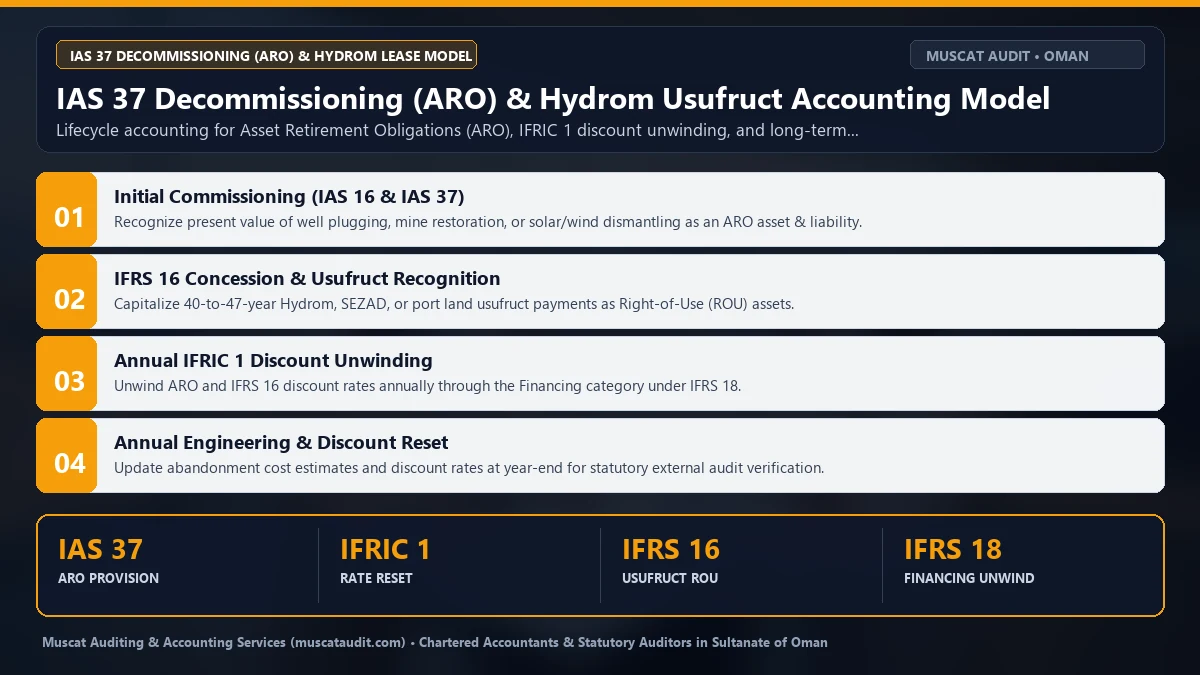
- Perform Annual IAS 37 ARO Discount-Rate Reviews: Re-estimate well abandonment and mine restoration provisions annually under IFRIC 1 using updated Omani sovereign/corporate discount rates.
- Pre-Audit Affiliate Timewriting Protocols: Require all seconded headquarters staff to log daily project task codes linked to approved Omani AFEs.
7. Frequently Asked Questions on Energy, Mining & Hydrom JV Audits
What is the difference between a Joint Operation and a Joint Venture under IFRS 11 in Oman’s energy sector?
Under IFRS 11 (Joint Arrangements), classification depends on the parties’ rights and obligations arising from the contractual arrangement. Most upstream Oil & Gas Exploration and Production Sharing Agreements (EPSAs) and unincorporated Joint Operating Agreements (JOAs) in Oman are classified as Joint Operations—meaning each participating partner recognizes its direct proportionate share of assets, liabilities, revenues, and expenses. Conversely, when a green hydrogen consortium or downstream petrochemical project incorporates a separate SPV (such as an SAOC or LLC) where partners have rights only to the net assets, it is generally accounted for as a Joint Venture using the equity method (IAS 28).
What is a Non-Operator Joint Venture (JOA) Cost Recovery Audit?
In an upstream hydrocarbon block, mining concession, or green hydrogen consortium, one partner is designated as the Operator responsible for executing CAPEX/OPEX, issuing monthly Cash Calls, and maintaining the Joint Account. Under the JOA Accounting Procedure (typically modeled on AIPN/Association of International Energy Negotiators standards), Non-Operator partners have the contractual right—usually within 24 months of calendar year-end—to send independent auditors to inspect the Operator’s books and challenge unapproved overheads, affiliate markups, or misallocated costs.
How are upstream oil and gas companies taxed in the Sultanate of Oman compared to green hydrogen projects?
Under Oman’s Income Tax Law (Royal Decree 28/2009), taxpayers engaged in upstream petroleum exploration and production are subject to a specialized 55% corporate income tax rate governed by their Exploration and Production Sharing Agreement (EPSA) mechanics. By contrast, renewable energy, green hydrogen, and green ammonia ventures developed under Hydrom block agreements or within Special Economic Zones (such as SEZAD in Duqm) are governed by standard corporate tax frameworks (15%) or applicable free-zone/strategic-investment fiscal incentives.
How are Decommissioning and Site Restoration obligations accounted for in Omani energy and mining blocks?
Under IAS 37 (Provisions, Contingent Liabilities and Contingent Assets) and IFRIC 1, operators must estimate the present value of future well plugging, abandonment, and mine site restoration costs upon initial asset commissioning, capitalizing the asset retirement obligation (ARO) into Property, Plant & Equipment (IAS 16) and unwinding the discount annually through Financing costs.
Why is In-Country Value (ICV) auditing critical for energy and mining contractors in Oman?
Ministry of Energy and Minerals (MEM), Energy Development Oman (EDO), Petroleum Development Oman (PDO), OQ, and Minerals Development Oman (MDO) enforce strict ICV targets across upstream and midstream tenders. Independent ICV certification and quarterly ICV expenditure audits verify local Omani workforce retention, Riyada SME procurement, and domestic manufacturing spend.
Safeguard Your Joint Venture Capital in Oman’s Energy, Mining & Green Hydrogen Sectors
Whether you are an international Non-Operator equity partner exercising your JOA audit rights, a mining concession holder, or an EPC contractor bidding on Hydrom and Duqm energy infrastructure, Muscat Audit delivers specialized cost-recovery audits, IFRS 11 accounting, and ICV certification.