
Oman Golden Visa Net-Worth Audit: Certified Financial Verification for 5-Year and 10-Year Investor Residency
Obtaining long-term residency in the Sultanate of Oman requires meeting rigorous statutory capital thresholds and submitting a certified Oman Golden Visa Net-Worth Audit prepared by an accredited Omani auditing firm. Under the executive directives governing the Oman Investor Residency Programme (IRP)—managed collaboratively by the Ministry of Commerce, Industry and Investment Promotion (MOCIIP) and the Royal Oman Police (ROP)—foreign investors, entrepreneurs, and high-net-worth individuals must provide independent financial proof that their qualifying assets meet or exceed statutory benchmarks.
Whether an applicant is pursuing the 10-Year Investor Residency (Tier 1 – OMR 500,000 minimum) or the 5-Year Investor Residency (Tier 2 – OMR 250,000 minimum), the financial verification dossier represents the single most critical clearance document. Government approval committees will not accept unverified personal financial statements, foreign appraisals without local apostille, or unencumbered claims unsupported by contemporaneous documentation.
At Muscat Auditing & Accounting Services, our team of certified chartered accountants and statutory auditors specializes in preparing forensic-grade net-worth verification reports that satisfy all statutory requirements of MOCIIP, the Ministry of Housing and Urban Planning (MHUP), and the Royal Oman Police Directorate General of Passports and Civil Status.
—
Need your investment assets or company valuation audited for the Oman Golden Visa? Schedule a confidential meeting with our senior partners to ensure complete compliance.
Book a Free Consultation with Our Golden Visa Audit Team or call our Muscat office directly at Contact Muscat Audit.
—
Table of Contents
1. The Strategic Mandate: Oman Vision 2040 & Investor Residency
2. Statutory Thresholds: Tier 1 (OMR 500k) vs. Tier 2 (OMR 250k)
3. Eligible Asset Classes for Financial Verification
4. The Role of an Accredited Omani Audit Firm
5. Step-by-Step Net-Worth Audit Methodology
6. Real Estate Valuation & Ministry of Housing Clearance
7. Corporate Share Capital & Commercial Registry Audits
8. Government Development Bonds & Central Bank Deposits
9. Common Regulatory Bottlenecks & How to Prevent Rejection
10. Frequently Asked Questions (FAQ)
—
1. The Strategic Mandate: Oman Vision 2040 & Investor Residency
The Sultanate of Oman has entered an era of sustained regulatory modernization and fiscal expansion. Guided by the overarching socio-economic pillars of Oman Vision 2040, government entities including the Ministry of Commerce, Industry and Investment Promotion (MOCIIP), the Oman Tax Authority (OTA), the Ministry of Labour (MOL), and the Central Bank of Oman (CBO) have accelerated the enforcement of international compliance standards, digital tax governance, and corporate transparency. Within this high-velocity commercial landscape, mastering Oman Golden Visa Net-Worth Audit has become an absolute operational imperative for business founders, foreign direct investors, chief financial officers, and executive boards operating across the Sultanate.
Historically, commercial organizations operating in Muscat, Sohar, Salalah, and Duqm operated within flexible administrative guidelines characterized by periodic retroactive reporting. Today, that legacy paradigm has been entirely dismantled. The rollout of real-time electronic tax surveillance, stringent anti-base erosion measures under OECD Pillar Two frameworks, strict beneficial ownership disclosures on the unified Oman Business Platform (Invest Easy), and rigorous wage compliance under Royal Decree 53/2023 leave zero margin for administrative ambiguity. Corporate enterprises that fail to proactively adapt face automated commercial registry freezes, punitive tax penalties, cancellation of municipal trade licenses, and disqualification from lucrative government and energy sector tenders.
At Muscat Auditing & Accounting Services, our multidisciplinary team of licensed statutory auditors, chartered accountants, and corporate tax specialists monitors these regulatory shifts on a daily basis. This authoritative manual delivers an exhaustive, practical breakdown of Oman Golden Visa Net-Worth Audit, equipping corporate leadership with the actionable legal insights, financial models, compliance checklists, and audit defense strategies necessary to achieve enduring operational resilience in the Sultanate of Oman.
—

2. Statutory Thresholds: Tier 1 (OMR 500k) vs. Tier 2 (OMR 250k)
The Omani Investor Residency Programme is categorized into two distinct operational tiers based on verified capital deployment:
“`
- Minimum Capital Commitment: OMR 500,000 (Approx. USD 1,300,000)
- Validity: 10 Years (Renewable)
- Key Privilege: Right to reside outside Oman for extended periods without loss
- Minimum Capital Commitment: OMR 250,000 (Approx. USD 650,000)
- Validity: 5 Years (Renewable)
- Key Privilege: Multi-entry residency; sponsorship for spouse and children
Tier 1: 10-Year Investor Residency
of visa status; sponsorship for spouse, children (no age cap), and parents.
Tier 2: 5-Year Investor Residency
under 21; direct property ownership rights in designated freehold zones.
“`
Accredited auditors must verify that the applicant’s qualifying financial assets meet the statutory capital floor at the time of application submission. In cases where investments are distributed across multiple eligible asset classes—such as combining commercial company equity with freehold real estate—the auditor must prepare a consolidated verification balance sheet confirming that the aggregate investment satisfies statutory requirements.
—

3. Eligible Asset Classes for Financial Verification
Government regulations strictly define which assets qualify for the Oman Golden Visa Net-Worth Audit:
A. Commercial Company Equity
Capital invested in an Omani commercial company—such as a Limited Liability Company (LLC) or Single Person Company (SPC)—registered under Royal Decree No. 18/2019 (The Commercial Companies Law). The investor must be recorded as a registered partner or sole shareholder on the Commercial Registration (CR) issued through the Oman Business Platform (Invest Easy).
B. Freehold Real Estate in Integrated Tourism Complexes (ITCs)
Direct ownership of residential or commercial property in designated Integrated Tourism Complexes, including Al Mouj Muscat (The Wave), Muscat Bay, Jebel Sifah, Hawana Salalah, and Barr Al Jissah. Properties situated outside designated freehold ITC zones do not qualify for foreign freehold title or Golden Visa residency privileges.
C. Government Development Bonds (GDBs)
Sovereign bonds issued by the Ministry of Finance and administered through the Central Bank of Oman (CBO) with a designated maturity period.
D. Fixed Term Deposits with Licensed Omani Commercial Banks
Term deposits placed in licensed Omani commercial banks (such as Bank Muscat, Bank Dhofar, or National Bank of Oman) with a certified lock-in agreement that meets ministerial directives.
—
Structuring a business venture or cross-border investment in Oman? Let our certified statutory audit team handle your company registration, financial statements, and regulatory approvals.
Explore Our Complete Business Advisory Services in Oman
—
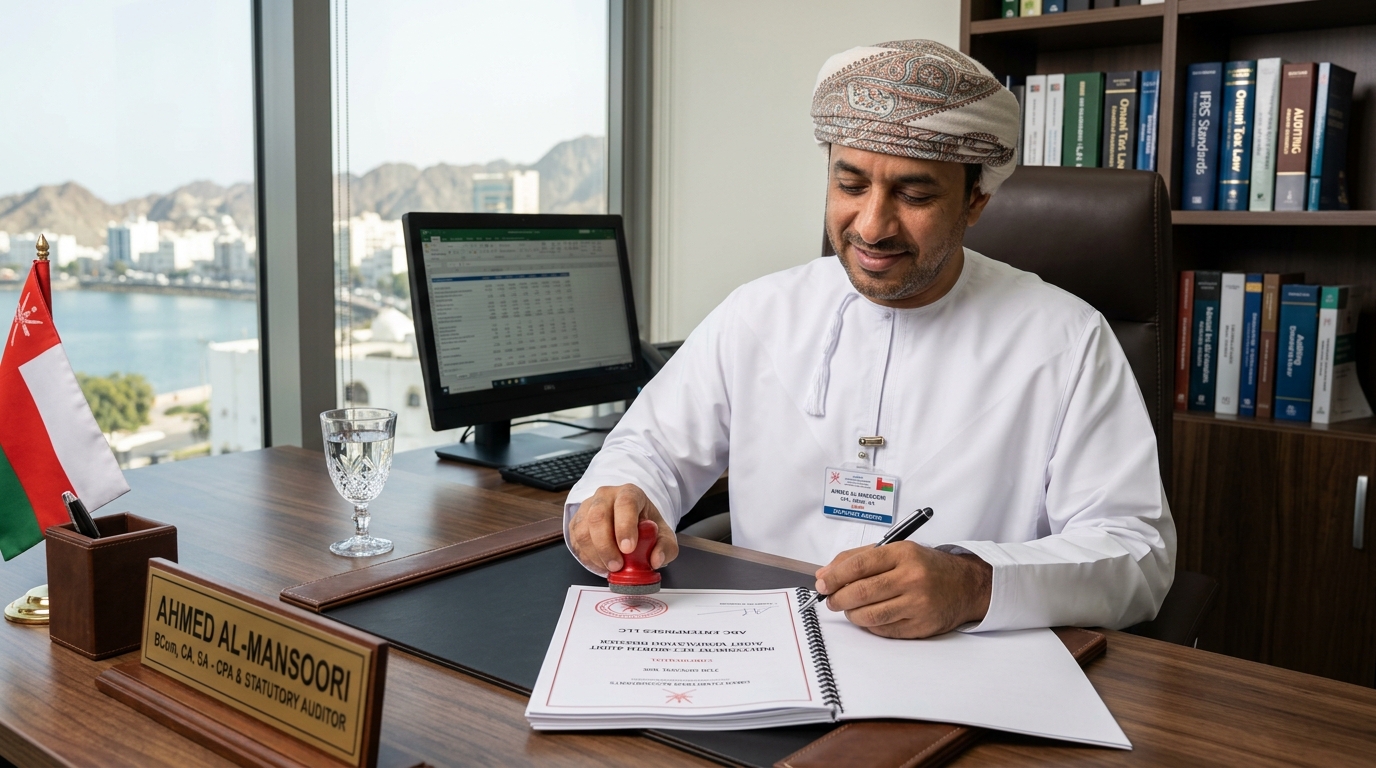
4. The Role of an Accredited Omani Audit Firm
Why cannot an investor simply present bank statements or property sale deeds directly to the Royal Oman Police? Under joint ministerial directives, government immigration officers do not perform forensic accounting or title encumbrance analyses. Government departments require an independent, certified opinion signed by a licensed statutory auditor registered with the Ministry of Commerce, Industry and Investment Promotion.
The certified audit firm serves as an objective fiduciary party responsible for:
1. Verifying Legal Ownership: Confirming that the investor is the sole or majority beneficial owner of the recorded assets.
2. Confirming Encumbrance Status: Inspecting municipal land registries, mortgage charges, and bank hypothecation agreements to ensure the asset is unencumbered up to the required equity threshold.
3. Validating Lawful Source of Funds: Conducting Anti-Money Laundering (AML) reviews to verify that capital transferred into Oman originated from verified international banking channels.
4. Drafting the Official Attestation Certificate: Generating a formal, bilingual (Arabic and English) Net-Worth Assurance Report bearing the auditor’s official stamp and license number.
—
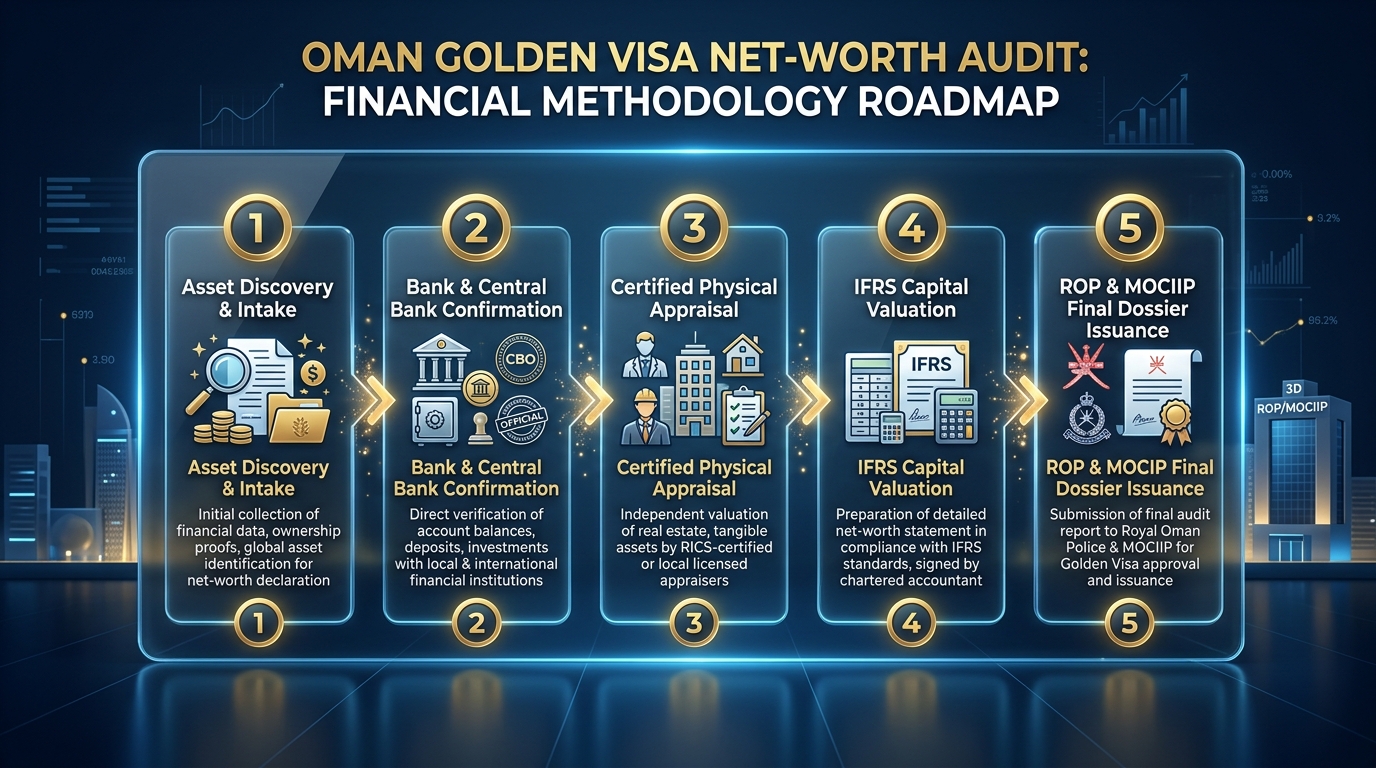
5. Step-by-Step Net-Worth Audit Methodology
At Muscat Auditing & Accounting Services, our team follows a five-stage verification lifecycle designed to eliminate regulatory delays:
“`
[Phase 1: Document Ingestion] [Phase 2: Registry & Bank Verification] [Phase 3: Valuation Analysis] [Phase 4: Encumbrance Audit] [Phase 5: Bilingual Report Issuance]
“`
- Document Ingestion & KYC: Ingesting title deeds (Mulkiya), corporate share registers, commercial registration certificates, audited balance sheets, and SWIFT bank confirmation statements.
- Registry Verification: Independent verification directly with issuing commercial banks, the Muscat Clearing and Depository (MCD), and the Oman Business Platform.
- Valuation Reconciliation: Appraising property market value via MHUP-accredited valuers and assessing company net assets under International Financial Reporting Standards (IFRS).
- Encumbrance Check: Identifying outstanding mortgages, credit facility hypothecations, or commercial liens to isolate net unencumbered equity.
- Dossier Issuance: Drafting the formal attestation dossier in accordance with ISAE 3000 assurance standards for direct submission to MOCIIP and ROP officers.
—

6. Real Estate Valuation & Ministry of Housing Clearance
For investors qualifying via real estate in Integrated Tourism Complexes, property valuation requires specialized auditing scrutiny:
– Title Deed (Mulkiya) Verification: The property must have an unencumbered title deed issued by the Ministry of Housing and Urban Planning. Off-plan properties under construction qualify only when the developer has established a government-regulated project escrow account and reached statutory construction milestones verified by certified engineering consultants.
– Approved Valuer Valuation: Purchase contracts are cross-checked against independent valuations prepared by real estate valuation firms accredited by MHUP.
– Joint Spousal Ownership: Where a property is owned jointly by husband and wife, MOCIIP regulations allow the combined equity to qualify the primary applicant, provided an attested marriage certificate is attached to the audit file.
—

7. Corporate Share Capital & Commercial Registry Audits
Foreign investors establishing or investing in Omani enterprises can qualify by verifying equity in local operating companies:
– Paid-Up Share Capital: Under The Foreign Capital Investment Law (Royal Decree No. 50/2019), foreign investors may hold up to 100% foreign equity in Omani companies. The investor’s individual paid-up share capital or cumulative shareholder equity must equal or exceed OMR 500,000 (Tier 1) or OMR 250,000 (Tier 2).
– Audited Financial Statements: The company must present audited financial statements for the preceding fiscal year prepared under IFRS. If the company has accumulated operational losses that have depleted net equity below statutory thresholds, additional equity injections must be completed and audited before filing.
– Omanisation & Tax Compliance: The operating company must maintain an active commercial registry status, possess an up-to-date Tax Clearance Certificate from the Oman Tax Authority (OTA), and be fully compliant with the Wages Protection System (WPS) under Royal Decree No. 53/2023 (The Labour Law).
—
8. Government Development Bonds & Central Bank Deposits
Investing in Omani sovereign instruments offers one of the most straightforward paths to Golden Visa residency:
– Central Bank of Oman Bonds: The investor purchases Government Development Bonds (GDBs) directly through licensed brokerage firms registered with the Muscat Stock Exchange (MSX) and the Muscat Clearing and Depository (MCD).
– Bank Fixed Deposits: Fixed-term deposits must be held in an Omani commercial bank with a formal letter confirming a minimum lock-in period corresponding to the visa duration, free from liens, third-party performance guarantees, or credit-facility hypothecation.
—
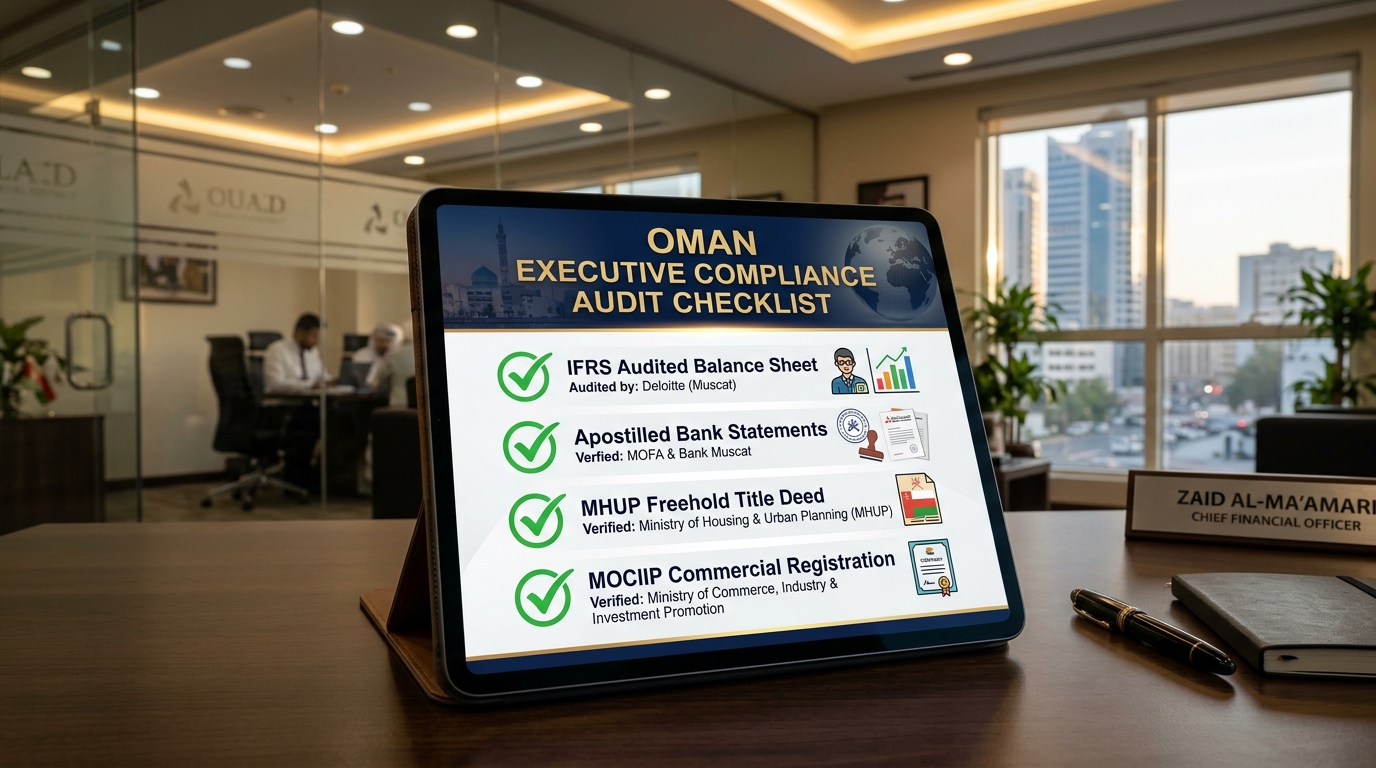
9. Common Regulatory Bottlenecks & How to Prevent Rejection
| Bottleneck / Delay Factor | Regulatory Root Cause | Auditor Remediation Strategy |
|---|---|---|
| Mortgage Deductions Ignored | Investor calculated gross property value rather than net unencumbered equity. | Conduct thorough land registry checks and obtain official bank mortgage payoff statements. |
| Unattested Foreign Inward Remittances | Funds entered Oman without documented international banking origin. | Trace fund movements back to original overseas bank accounts with SWIFT MT103 confirmation. |
| Non-ITC Real Estate Purchases | Investor bought freehold property outside approved tourism zones. | Verify zoning status against the official Ministry of Housing list of designated ITCs. |
| Operating Losses in Company Equity | Balance sheet losses reduced net shareholder equity below the statutory floor. | Advise on capital restructuring, capital injections, or shareholder loan conversions. |
| Expired Tax Clearances | Target corporate vehicle lacked current clearance from the Oman Tax Authority. | Expedite annual corporate tax filing and settle outstanding VAT balances prior to submission. |
—
10. Frequently Asked Questions (FAQ)
Who is authorized to issue a net-worth audit report for the Oman Golden Visa?
Only independent statutory audit firms licensed by the Ministry of Commerce, Industry and Investment Promotion (MOCIIP) and registered with the Omani Association of Chartered Accountants are authorized to issue net-worth audit reports. Unlicensed financial consultants or foreign accounting firms cannot provide valid verification for ROP immigration filings.
Can off-plan real estate qualify for the 5-year or 10-year investor residency?
Yes, off-plan properties located within approved Integrated Tourism Complexes (ITCs) qualify, provided the developer has established a government-registered project escrow account and the investor has already paid the required minimum capital (OMR 250,000 or OMR 500,000). The audit firm must verify bank receipts, escrow statements, and developer milestones.
How long does the certified net-worth audit take to complete in Oman?
When all primary documents—such as title deeds, bank certificates, and commercial registration papers—are in order, Muscat Auditing & Accounting Services completes the comprehensive audit and issues the bilingual attestation dossier within 3 to 5 business days.
What happens if my investment property is mortgaged with an Omani bank?
If your property is mortgaged, only your net unencumbered equity (the appraised market value minus the remaining mortgage principal) counts toward the Golden Visa threshold. For example, if a property is valued at OMR 320,000 with a remaining bank loan of OMR 60,000, your qualifying equity is OMR 260,000, which satisfies the Tier 2 (OMR 250,000) threshold.
Can family members be sponsored under the primary investor’s Golden Visa?
Yes. The Tier 1 (10-Year) visa permits the primary investor to sponsor their spouse, children with no age limitations, and first-degree parents. The Tier 2 (5-Year) visa allows sponsorship of spouses and children under the age of 21. All sponsored family members receive official Omani Civil ID cards without requiring separate employment or commercial sponsorship.
—
Secure your long-term future in the Sultanate of Oman with full statutory compliance. Our experienced audit partners will evaluate your asset portfolio, perform all necessary verifications, and draft an authoritative net-worth certificate.
Contact Our Muscat Team Today | Phone: Contact Muscat Audit | Office: Muscat, Sultanate of Oman.
—