
Oman VAT Number Verification (VATIN Lookup): Official OTA Portal Check, 15-Digit Format & 5% Input VAT Protection Guide (2026)
Every quarter across Muscat, Sohar, Duqm, Salalah, and Nizwa, accounts payable departments and corporate controllers process thousands of vendor tax invoices before submitting their quarterly Value Added Tax returns. Under the Oman Value Added Tax Law (Royal Decree 121/2020) and Executive Regulations (Decision 53/2021), claiming a 5% Input VAT deduction is strictly contingent upon holding a compliant tax invoice issued by a supplier whose VAT registration is genuinely active on the date of supply via the Oman Tax Authority (OTA) portal.
When an Omani LLC, SAOC, SAOG, or foreign branch claims Input VAT on an invoice bearing a mistyped, suspended, deregistered, or fictitious 15-character OM1 VAT Identification Number (VATIN)—or confuses a 6-digit MoCIIP Commercial Registration (CR) number with a VATIN—OTA desk and field inspectors routinely disallow the entire tax credit and levy administrative penalties. Prepared by practicing Chartered Accountants in Oman at Muscat Audit (MAAS), this comprehensive guide details the exact VAT number Oman verification workflow, the structural anatomy of an Omani VATIN, automated ERP controls for Fawtara electronic invoicing, and how to safeguard your company’s Input VAT claims.
1. Structural Anatomy of an Official 15-Character Oman VAT Number (VATIN)
Before querying the Oman Tax Authority Taxpayer Register, accounts payable accountants and ERP master-data rules should verify the syntactic format of every VAT number printed on vendor quotations, contracts, and tax invoices. Under the Unified GCC VAT Agreement and Omani administrative procedures, every genuine Omani VAT Identification Number (VATIN) follows an exact 15-character alphanumeric specification:
- Characters 1–2 (ISO Country Code —
OM): Designates the Sultanate of Oman for domestic supplies, GCC intra-regional reporting, and electronic invoice routing. - Character 3 (Tax Regime Digit —
1): Standard Omani VATINs begin withOM1followed by central zero-padded taxpayer serial digits (for example,OM11000XXXXXX...totaling exactly 15 characters with zero spaces or hyphens). - Characters 4–14 (Unique Taxpayer Serial): Issued upon OTA approval of mandatory VAT registration (annual taxable supplies exceeding OMR 38,500), voluntary registration (taxable supplies or expenses exceeding OMR 19,250), or non-resident registration (nil threshold—from the first OMR 1 of taxable supply to non-VAT-registered Omani customers).
- Character 15 (Modulo Check Digit): Mathematical validation digit used by OTA online portals and Fawtara-compliant ERP connectors to flag typing and transposition errors immediately at invoice entry.
Whenever a local contractor or supplier submits a bill charging 5% VAT while displaying only a 6- or 7-digit MoCIIP Commercial Registration (CR) number, an Oman Chamber of Commerce (OCCI) membership number, or an 8-digit Corporate Income Tax Card number, your finance team must place the 5% tax portion on hold immediately. Our Accounting & Bookkeeping Services in Oman build automated 15-character OM1 validation rules directly into vendor onboarding workflows so defective invoices never contaminate your Input VAT ledger.
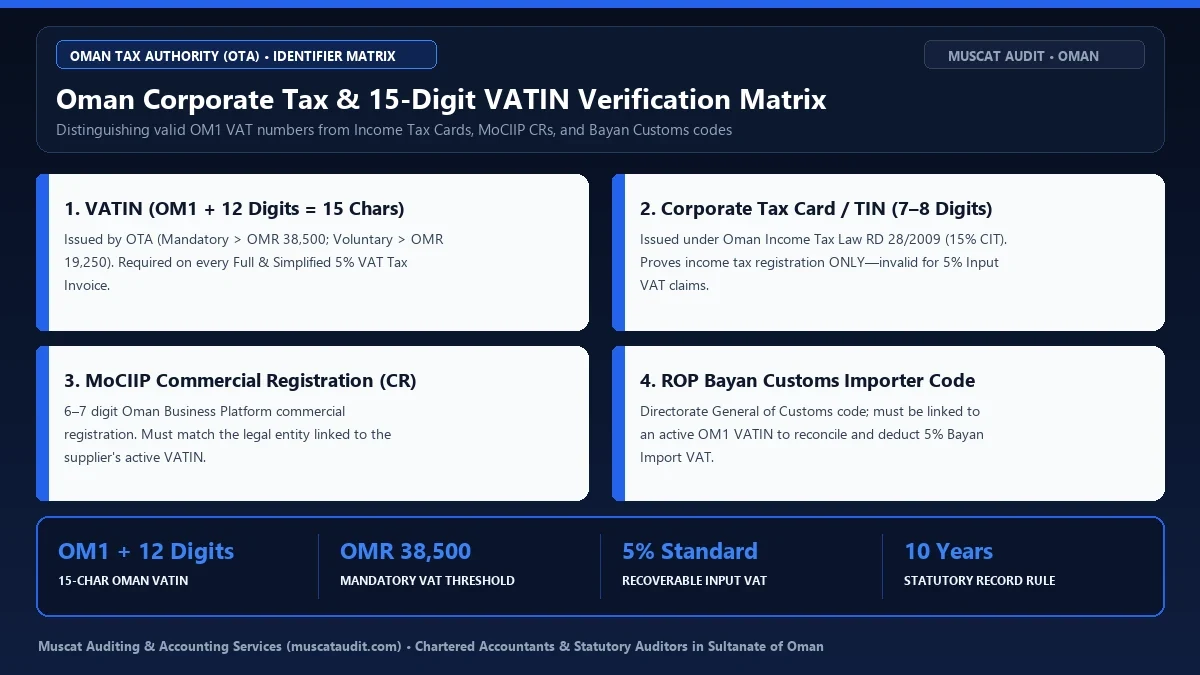
2. Oman Tax Identifier Matrix: VATIN vs. Corporate Tax Card (TIN) vs. MoCIIP CR vs. Bayan Code
During quarterly pre-filing reviews conducted by our Taxation & VAT Compliance Desk, one of the most frequent causes of Input VAT adjustments is confusing Oman’s four corporate regulatory identifiers. Use the benchmark comparison table below across procurement, logistics, and accounts payable teams:
| Oman Regulatory Identifier | Issuing Authority | Official Format | Statutory Trigger & Threshold | Valid for 5% Input VAT Deduction? |
|---|---|---|---|---|
| VATIN (VAT Identification Number) | Oman Tax Authority (OTA) | OM1 + 12 digits (15 chars) |
Mandatory > OMR 38,500; Voluntary > OMR 19,250; Non-resident from OMR 1 | Yes — Mandatory on all Full & Simplified Tax Invoices |
| Corporate Tax Card Number (TIN) | Oman Tax Authority (OTA) | Numeric Tax Card ID (7–8 digits) | Mandatory registration under Income Tax Law RD 28/2009 (15% Corporate Tax) | No — Proves Corporate Income Tax registration only |
| Commercial Registration (CR) | MoCIIP (Oman Business Platform) | Numeric CR (6–7 digits) | Issued upon Company Registration in Oman (LLC, SAOC, SPC, Foreign Branch) | No — Legal trade registration identity only |
| Bayan Customs Importer Code | Royal Oman Police — DG of Customs | Bayan Commercial Code linked to CR | Required for commercial imports/exports & Import VAT postponement | Must be linked to active OM1 VATIN in Bayan Single Window |
3. Step-by-Step: How to Verify Any Oman VAT Number on the Official OTA Portal
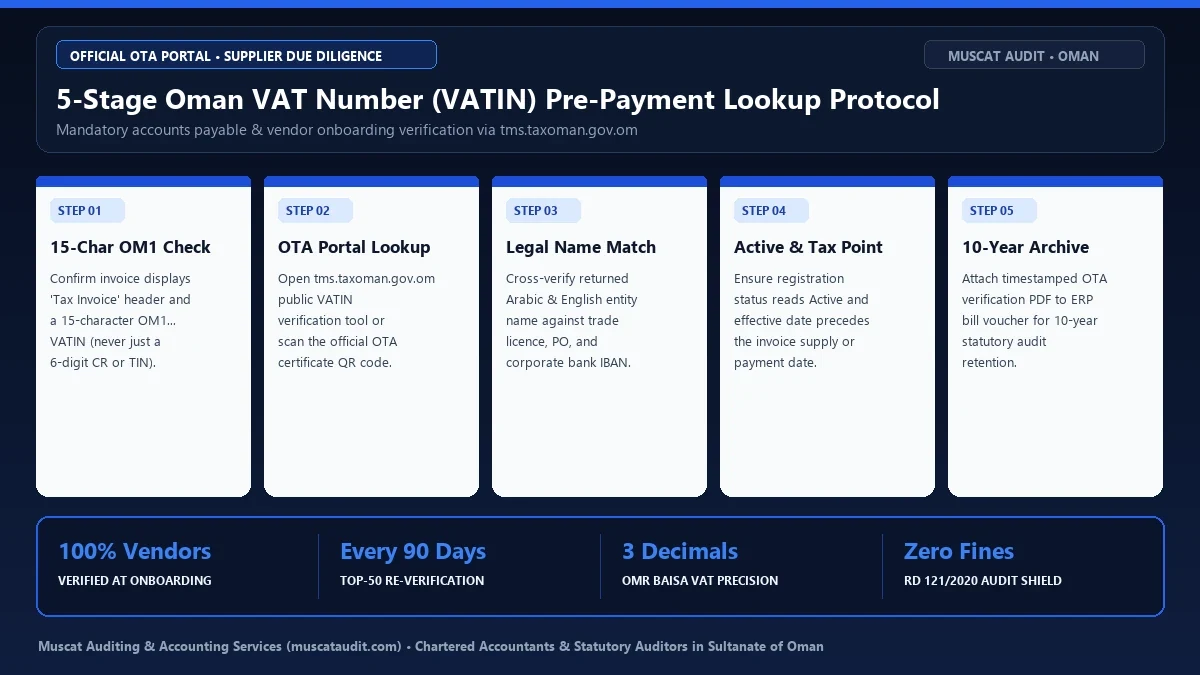
The Oman Tax Authority provides a free, public online lookup tool on its Tax Management System (TMS) so finance teams, government tender committees, and external Statutory IFRS Auditors can verify any Omani taxpayer’s live VAT status in seconds without requiring PKI login credentials:
- Navigate to the Official OTA Verification Endpoint: Open
https://tms.taxoman.gov.om/and select e-Services → Verify VATIN / VAT Certificate Verification. Always confirm the browser address bar ends strictly in.gov.om—especially when scanning QR codes printed on unfamiliar supplier certificates. - Enter the Complete 15-Character
OM1String: Type or paste the exact 15-character VATIN printed on the supplier’s tax invoice with zero spaces, dashes, or punctuation, complete the security check, and submit the query. - Match the Legal Entity Name & CR Against Bank KYC Details: Confirm that the Arabic and English legal name returned by OTA matches the invoicing company name, MoCIIP CR certificate, and corporate bank IBAN. Inside Omani family business groups, Subsidiary A may hold an active VATIN while Subsidiary B remains unregistered; unless both entities appear on an official OTA VAT Group Schedule (Articles 11–13 of the VAT Law), Subsidiary B cannot issue VAT invoices using Subsidiary A’s individual VATIN.
- Verify Active Status & Effective Registration Date: Ensure the status reads Active (never Suspended, Cancelled, or Deregistered) and confirm that the invoice’s tax point—the earlier of goods delivery, service completion, or advance payment—fell on or after the vendor’s official VAT effective date.
- Archive Timestamped Verification Evidence for 10 Years: Save a dated PDF printout of the OTA verification result inside your ERP vendor master record and payment voucher. Oman VAT Law Article 59 mandates retaining complete tax invoice and audit-trail records for 10 years (and 15 years for real estate and capital asset adjustments).
4. Mandatory Oman Tax Invoice Fields & Fawtara E-Invoicing ERP Gatekeeping
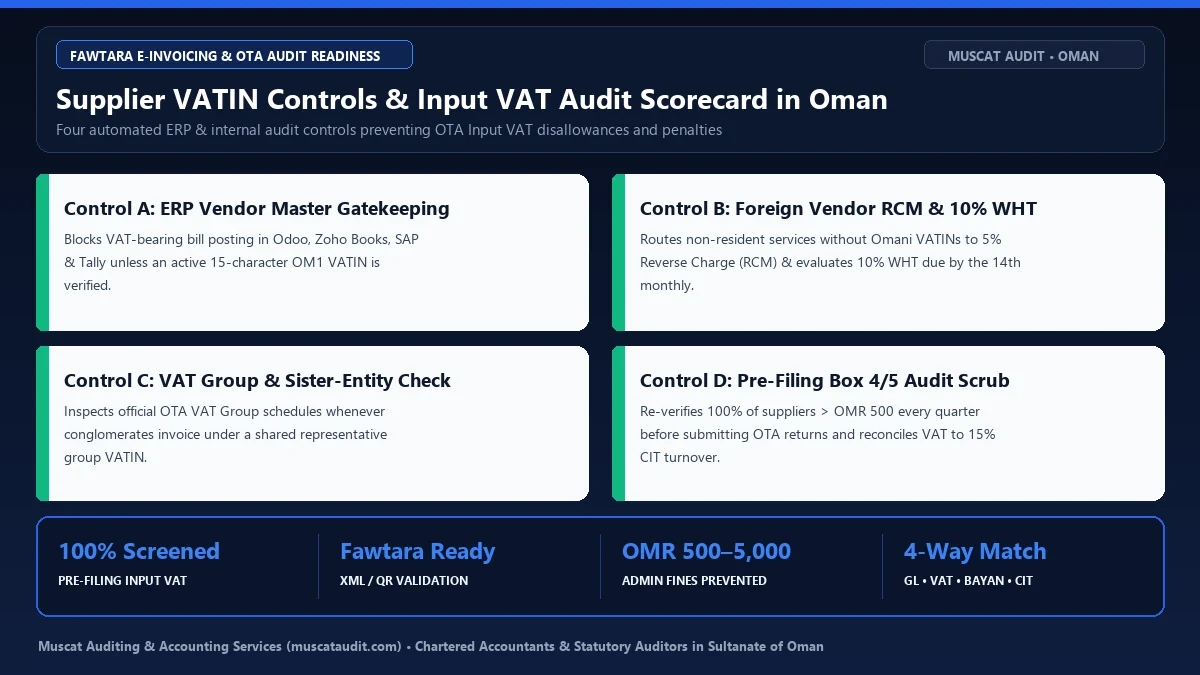
Confirming an active supplier VATIN is step one; verifying that the tax invoice itself complies with Article 144 of the Oman VAT Executive Regulations is step two. Through our Cloud ERP & Fawtara E-Invoicing Implementation practice in Muscat, we train accounts payable teams to audit six mandatory fields before posting recoverable Input VAT:

- Explicit “Tax Invoice” (فاتورة ضريبية) Header & Sequential Numbering: Documents titled “Proforma Invoice”, “Quotation”, or “Payment Request” are legally invalid for Input VAT recovery—even if 5% VAT and a valid VATIN are printed on them.
- Both Seller AND Buyer 15-Character VATINs on Full Tax Invoices: For B2B supplies exceeding OMR 500 (or wherever Simplified Tax Invoices are not explicitly authorized), the invoice must display both the supplier’s active
OM1VATIN and your own company’s legal name, address, and 15-character buyer VATIN. - VAT Stated in Omani Rials (OMR) to Three Decimal Places (Baisa): Even when an engineering, shipping, or IT contract is billed in USD, EUR, AED, or GBP, the 5% VAT amount must be converted at Central Bank of Oman (CBO) rates and displayed in OMR to three decimal places (e.g.,
OMR 245.750). - Automated Fawtara XML/UBL & Foreign RCM Routing: As Oman rolls out structured Fawtara electronic invoicing across B2B and B2G taxpayers, Odoo, Zoho Books, SAP Business One, and TallyPrime must automatically distinguish domestic
OM1vendors from GCC or overseas suppliers without an Omani Permanent Establishment—routing foreign service bills to the 5% Reverse Charge Mechanism (RCM) while screening for 10% Withholding Tax (WHT) filings due on the 14th of each month.
5. Case Study & 4-Stage Vendor VATIN Audit Methodology for Omani Enterprises
Proactive VATIN governance protects cash flow directly. Through our Internal Audit & Risk Advisory and Business Advisory divisions, we conduct pre-OTA-inspection Input VAT health checks for trading, contracting, manufacturing, and logistics enterprises across the Sultanate (explore more client outcomes in our Client Case Studies, including our Contracting Firm Payroll & Compliance Overhaul).
Case Study: Safeguarding OMR 64,200 in Input VAT Credits for a Sohar & Muscat Contracting Group
A mid-market civil contracting and MEP group operating across Muscat and Sohar Port engaged Muscat Audit ahead of an Oman Tax Authority comprehensive VAT review covering eight quarterly periods. Processing over 1,900 subcontractor, equipment-hire, and material-supply invoices per quarter across three site offices, the group’s accounts payable clerks had manually keyed vendor tax details into their ERP without standardized OTA portal verification.
Our tax audit team extracted 100% of the group’s Input VAT purchase register and ran automated format diagnostics paired with OTA Taxpayer Register checks across all 412 active suppliers. We uncovered 27 high-risk vendor exceptions representing OMR 64,200 in vulnerable Input VAT credits: 11 subcontractors had printed their 7-digit MoCIIP CR numbers instead of VATINs while still charging 5% VAT; 9 equipment suppliers had issued USD invoices without displaying OMR Baisa VAT equivalents or the buyer’s VATIN; 4 sister-company vendors were billing under a parent company’s VATIN without VAT Group registration; and 3 small suppliers had voluntarily deregistered mid-year while continuing to use old invoice templates.
Within 21 business days, Muscat Audit executed a structured remediation sprint: obtaining compliant re-issued tax invoices and verified VATIN certificates for OMR 58,900 of legitimate supplies, recovering OMR 5,300 directly via credit notes and vendor short-settlements on unregistered bills, filing a clean pre-inspection Voluntary Disclosure adjustment, and deploying mandatory ERP vendor-master VATIN locks. When the OTA completed its review the following quarter, the contracting group achieved zero Input VAT disallowances on remediated filings and cut quarterly VAT preparation time from 9 days to 2.5 days.
Our 4-Stage Supplier VATIN & Input Tax Assurance Protocol
- Stage 1 — Bulk Vendor Master & Purchase Ledger Extraction: We extract your complete supplier master and 4-to-12 quarters of Input VAT transactions from SAP, Odoo, Zoho Books, TallyPrime, or Oracle to flag invalid 15-character
OM1strings, duplicate VATINs, and self-VATIN clerical errors. - Stage 2 — Live OTA Status & Tax Group Verification: Every VAT-charging vendor is cross-verified against official OTA registration statuses, effective dates, MoCIIP CR ownership, and VAT Group certificates.
- Stage 3 — Defective Invoice Cure & Voluntary Disclosure Advisory: We coordinate vendor credit notes, compliant bilingual tax invoice re-issuance, suspense account reclassifications, and timely OTA Voluntary Disclosures where historical periods require correction.
- Stage 4 — Fawtara-Ready ERP Controls & 4-Way Reconciliation: We embed automated ERP validation rules and align quarterly VAT returns with Bayan customs imports, WPS / operational expense ledgers, and annual 15% Corporate Income Tax turnover declarations.

6. Mandatory Statutory VAT Rules vs. Accounts Payable Best Practices in Oman
Mandatory Statutory Requirements in Oman
- Active Supplier VATIN on Supply Date (RD 121/2020): 5% Input VAT can only be deducted on supplies from taxpayers holding an active 15-character
OM1VATIN at the tax point. - Article 144 Full Tax Invoice Compliance: B2B tax invoices must display “Tax Invoice”, sequential numbering, both seller and buyer VATINs, line-item values, and VAT in OMR to three decimal places.
- 10-Year Record Retention (15 Years Real Estate): All tax invoices, Bayan import declarations, and accounting ledgers must be archived in Oman-accessible systems for 10–15 years.
Professional Best-Practice Recommendations
- Mandatory Onboarding OTA Screenshot: Require AP clerks to attach a timestamped
tms.taxoman.gov.omlookup PDF before activating any VAT-bearing vendor card in your ERP. - Quarterly Top-50 Supplier Re-Screening: Re-verify your 50 largest domestic vendors every 90 days prior to filing your quarterly OTA VAT return to catch mid-year suspensions.
- Hold Unverified 5% VAT in Suspense: Never book disputed or unverified vendor VAT into recoverable Input Tax accounts—withhold the 5% component until a compliant tax invoice is delivered.
- 4-Way Annual Tax Reconciliation: Reconcile annual VAT return boxes against audited IFRS revenue/purchases, Bayan imports, and your 15% Corporate Tax return before April 30.
7. Frequently Asked Questions on Oman VAT Number (VATIN) Verification
How do I check if a supplier’s VAT number is valid in Oman?
Open the official Oman Tax Authority Taxpayer Portal (tms.taxoman.gov.om), navigate to the public Verify VATIN / VAT Lookup e-service, enter the complete 15-character OM1 VAT Identification Number without spaces, and confirm that the returned legal company name matches the supplier’s tax invoice and the registration status reads Active on the date of supply.
How many characters is an official Oman VAT number (VATIN)?
An official Oman VAT Identification Number consists of exactly 15 characters: the two-letter ISO country prefix OM followed by 13 numeric digits starting with 1 (OM1...). A 6- or 7-digit MoCIIP Commercial Registration (CR) number or an 8-digit Corporate Income Tax Card number is not a valid VATIN and cannot be used to charge or recover 5% VAT.
Can my company claim 5% Input VAT if a vendor’s Oman VATIN is suspended or invalid?
No. Under Oman VAT Law (Royal Decree 121/2020) and Executive Regulations Article 144, claiming 5% Input VAT requires holding a compliant tax invoice issued by a supplier with an active VAT registration on the supply date. Deducting Input VAT on suspended, deregistered, or invalid VATINs leads to credit disallowance and OTA administrative penalties ranging from OMR 500 to OMR 5,000+.
What are the mandatory and voluntary VAT registration thresholds in the Sultanate of Oman?
Resident businesses in Oman must register mandatorily for 5% VAT once annual taxable supplies exceed OMR 38,500 over a preceding or upcoming 12-month period, and may apply for voluntary registration once taxable supplies or taxable expenses exceed OMR 19,250. Non-resident suppliers making taxable supplies to non-VAT-registered customers in Oman must register from their first OMR 1 of supply.
What should we do if we discover we already claimed Input VAT on an invalid supplier VATIN in a past quarter?
First, check whether the supplier belongs to an approved OTA VAT Group or merely had a typographical error on their invoice that can be cured with a compliant replacement tax invoice. If the supplier was genuinely unregistered or suspended, Omani VAT Regulations require adjusting the error or submitting a formal Voluntary Disclosure via the OTA portal promptly—significantly reducing penalty exposure compared to waiting for an OTA tax audit notice.
Book a Pre-Audit Oman VAT Health Check & Bulk Supplier VATIN Review
Safeguard your 5% Input VAT deductions, prepare your ERP for Oman’s Fawtara e-invoicing rollout, and ensure seamless reconciliation with your annual 15% Corporate Tax and IFRS statutory audit. Contact Muscat Audit’s OTA-registered tax specialists in Muscat today.