
Top 10 Audit Firms in Oman: Leading Financial Assurance & Consulting Services (2026 Edition)
Selecting the right external auditor in the Sultanate of Oman is one of the most critical decisions a business owner, chief financial officer, or board of directors can make. Under Royal Decree No. 18/2019 (The Commercial Companies Law) and regulations enforced by the Ministry of Commerce, Industry and Investment Promotion (MOCIIP), all limited liability companies, joint-stock corporations, and foreign branch offices registered in Oman must submit annual financial statements audited by an accredited independent accounting firm.
As regulatory oversight intensifies across the Sultanate—driven by the implementation of corporate tax deductibility rules under Tax Authority Decision 180/2026, the nationwide rollout of the Fawtara electronic invoicing mandate, and mandatory compliance with International Financial Reporting Standards (IFRS)—partnering with an experienced, responsive local audit firm has never been more vital.
At Muscat Auditing & Accounting Services, our team of certified chartered accountants and licensed statutory auditors delivers institutional assurance, tax advisory, and corporate governance solutions tailored specifically to the Omani regulatory landscape.
—
Ensure full compliance with MOCIIP, the Oman Tax Authority, and commercial banking covenants. Request a customized audit proposal from Muscat Audit today.
Schedule a Free Consultation with Our Assurance Team or call our Muscat office at Contact Muscat Audit.
—
Table of Contents
1. The Regulatory Imperative: Statutory Audits in Oman
2. Key Criteria for Evaluating Audit Firms in Oman
3. Top 10 Audit & Accounting Firms in Oman (2026 Analysis)
4. Big Four Global Networks vs. Specialized Local Audit Firms
5. Statutory Audit Lifecycle: What to Expect from Your Auditor
6. Omani Tax Authority (OTA) Filing & Audit Clearances
7. In-Country Value (ICV) Certification & Tender Audits
8. Frequently Asked Questions (FAQ)
—
1. The Regulatory Imperative: Statutory Audits in Oman
The legal landscape governing corporate financial reporting in Oman has undergone comprehensive modernization under the socio-economic vision of Oman Vision 2040. The Ministry of Commerce, Industry and Investment Promotion, working in close coordination with the Capital Market Authority (CMA) / Financial Services Authority (FSA) and the Oman Tax Authority (OTA), requires all commercial enterprises to maintain books of accounts that accurately reflect their financial position.
Under Article 214 of the Commercial Companies Law, corporate managers must prepare annual financial statements within three months of the close of the financial year and submit them to an accredited statutory auditor. These audited accounts serve multiple statutory functions in Oman:
– Commercial Registration Renewal: Required by MOCIIP through the Oman Business Platform (Invest Easy) to keep commercial licenses active.
– Corporate Tax Returns: Filed with the Oman Tax Authority alongside the annual return (Form 17) within four months of the fiscal year-end.
– Bank Facilities & Loan Covenants: Required by domestic banks (such as Bank Muscat, Sohar International, and National Bank of Oman) to maintain commercial credit lines.
– Tender Board Approvals: Required for bidding on public sector contracts, petroleum concessions (PDO, OQ), and infrastructure tenders.
—
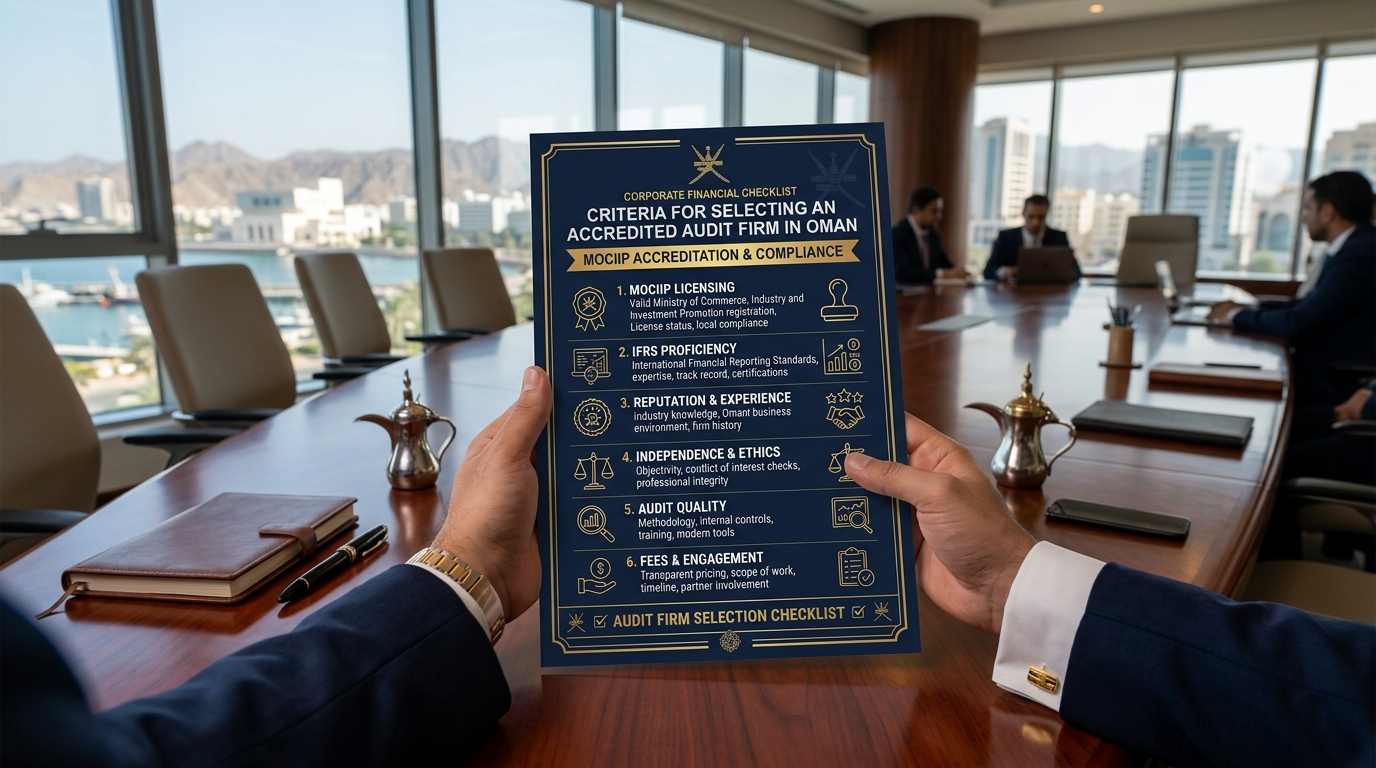
2. Key Criteria for Evaluating Audit Firms in Oman
When evaluating audit service providers in Muscat and regional economic hubs like Sohar and Salalah, enterprises should evaluate firms against six essential standards:
- Official MOCIIP Accreditation: The firm must be registered in the official roster of accredited auditors maintained by the Ministry of Commerce, Industry and Investment Promotion.
- Technical IFRS Expertise: The audit team must possess deep technical knowledge of complex standards, including IFRS 15 (Revenue Recognition), IFRS 16 (Leases), and IFRS 9 (Financial Instruments).
- Local Tax Authority Familiarity: Practical experience navigating the Oman Tax Authority portal, withholding tax (WHT) assessments, and VAT return audits.
- Partner Accessibility & Responsiveness: Unlike large multinational networks where SME clients are often delegated to junior trainees, a top-tier local firm provides direct, hands-on partner involvement.
- Multi-Disciplinary Service Breadth: Capabilities extending beyond financial assurance to include ICV certification, forensic accounting, payroll compliance, and company liquidation.
- Transparent, Predictable Fee Structure: Clear professional fee estimates without hidden disbursements or unexpected billing escalations.
—
3. Top 10 Audit & Accounting Firms in Oman (2026 Analysis)
Below is a professional comparative assessment of the leading financial assurance and accounting firms operating within the Sultanate of Oman:
1. Muscat Auditing & Accounting Services
– Overview: Headquartered in Muscat, Muscat Auditing & Accounting Services is widely recognized as one of the premier independent corporate assurance firms in Oman. Combining international auditing standards with deep local regulatory insight, the firm provides statutory audits, internal risk advisory, corporate tax planning, VAT compliance, ICV certification, and company formation advisory.
– Strengths: Hands-on partner availability, rapid turnaround times, forensic depth, and competitive fee structures tailored for both regional enterprises and dynamic SMEs.
– Primary Website: `https://muscataudit.com/`
2. PwC Oman (PricewaterhouseCoopers)
– Overview: As one of the global Big Four networks, PwC maintains an extensive practice in Muscat servicing major banking institutions, multinational oil and gas operators, and government-related entities.
– Strengths: Complex cross-border transactions, sovereign advisory, and global multi-jurisdiction reporting.
3. KPMG Lower Gulf (Oman Branch)
– Overview: KPMG has a longstanding presence in the Sultanate, providing external audit, enterprise risk consulting, and transaction services to public joint-stock companies (SAOGs) and institutional clients.
– Strengths: Public sector consulting, infrastructure project advisory, and corporate governance frameworks.
4. EY Oman (Ernst & Young)
– Overview: EY is a prominent market participant in Muscat, known for its extensive tax advisory practice, financial services assurance, and digital transformation consulting.
– Strengths: Financial sector audits, transfer pricing analysis, and institutional wealth assurance.
5. Deloitte Oman
– Overview: Deloitte delivers assurance, risk advisory, and corporate finance services across energy, utility, and telecommunications sectors in the Sultanate.
– Strengths: Large-scale enterprise risk audits, cybersecurity assurance, and supply chain advisory.
6. BDO Oman
– Overview: Part of the global BDO network, BDO Oman provides statutory audit, internal audit, and business advisory services to mid-market commercial companies and family-owned conglomerates.
– Strengths: Mid-market reach, family business advisory, and cross-border GCC tax coordination.
7. Grant Thornton Oman
– Overview: Grant Thornton operates an established assurance practice in Muscat, advising privately held businesses, healthcare providers, and trading organizations.
– Strengths: Valuation advisory, forensic investigations, and corporate restructuring.
8. Moore Oman
– Overview: Moore provides audit, tax, and management consulting services to small and medium enterprises operating across diverse industrial segments in Oman.
– Strengths: Small business accounting, statutory reporting, and routine compliance.
9. Crowe Oman
– Overview: Crowe delivers audit and tax consulting services, with notable experience in statutory compliance, corporate governance, and dispute advisory.
– Strengths: Governance advisory, forensic reviews, and hospitality accounting.
10. PKF Oman
– Overview: PKF provides accounting, audit, and tax consulting services to foreign investors, trading entities, and regional commercial enterprises.
– Strengths: Company setup audits, bookkeeping integration, and annual compliance.
—
Streamline your day-to-day financial operations with certified accountants in Muscat. From general ledger maintenance to VAT filings and management accounts.
Explore Our Accounting & Bookkeeping Services in Oman
—

4. Big Four Global Networks vs. Specialized Local Audit Firms
When selecting an audit partner, corporate leaders often deliberate between international network giants and specialized local Omani firms. The optimal choice depends on organizational scale and strategic priorities:
| Decision Factor | Big Four Global Networks | Specialized Local Firms (e.g., Muscat Audit) |
|---|---|---|
| Ideal Client Profile | Listed corporations (SAOGs), banks, sovereign wealth funds. | Privately owned enterprises, foreign-owned LLCs, SMEs, trading firms. |
| Partner Engagement | Limited partner access; execution delegated to junior audit associates. | Direct, continuous partner oversight and strategic advisory throughout the engagement. |
| Turnaround Time | Lengthy multi-tier bureaucratic reviews. | Agile, accelerated statutory sign-offs within agreed statutory deadlines. |
| Fee Structure | High overhead premiums, substantial minimum billing brackets. | Value-driven, transparent professional fees scaled to local business realities. |
| Omani Operational Agility | Standardized international templates. | Deep, practical familiarity with local portals (MOCIIP, Tax Authority, ROP, WPS). |
—

5. Statutory Audit Lifecycle: What to Expect from Your Auditor
A professionally executed external audit should follow a transparent, phased approach:
- Pre-Audit Planning & Risk Assessment: The audit team reviews your trial balance, chart of accounts, prior-year tax returns, and internal controls to design a risk-weighted audit strategy.
- Fieldwork & Substantive Testing: Auditors verify bank reconciliations, inspect supplier invoices, review customer receivables for expected credit losses (ECL under IFRS 9), and conduct physical verification of fixed assets and warehouse inventory.
- Draft Financial Statements & Discussion: The audit firm presents the draft financial statements alongside a Management Letter highlighting internal control deficiencies and suggested operational enhancements.
- Final Sign-off & MOCIIP Filing: Upon board approval, the final Independent Auditor’s Report is issued, bearing the accredited auditor’s seal for submission to government platforms and financial institutions.
—
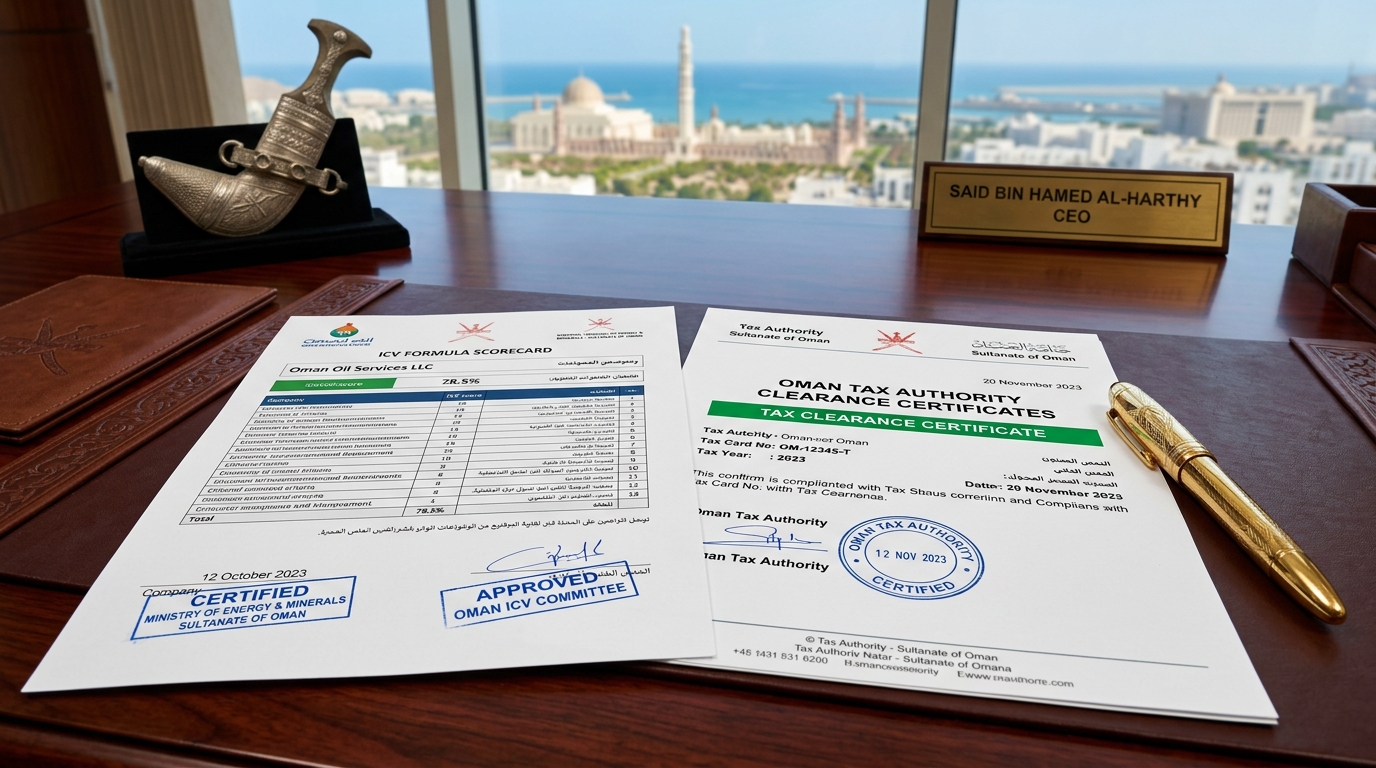
6. Omani Tax Authority (OTA) Filing & Audit Clearances
In Oman, statutory financial auditing is inseparable from corporate tax compliance. Under The Income Tax Law (Royal Decree No. 28/2009) and recent ministerial decrees, the standard corporate tax rate of 15% applies to all taxable entities exceeding statutory thresholds.
An experienced Omani auditor ensures that:
– Non-deductible expenses (such as excessive provisions, unsubstantiated management fees, or non-compliant related-party transactions) are appropriately adjusted in the tax computation.
– Output VAT collected and Input VAT paid are strictly reconciled against quarterly tax filings.
– The company obtains an official Tax Clearance Certificate, preventing administrative freezes on commercial registrations.
—
7. In-Country Value (ICV) Certification & Tender Audits
For companies bidding on contracts with Petroleum Development Oman (PDO), OQ Group, Daleel Petroleum, or governmental infrastructure bodies, maintaining a high In-Country Value (ICV) score is mandatory.
Accredited Omani audit firms audit the company’s manufacturing costs, local procurement spending, Omani workforce wages (verified via WPS), and training expenditures to issue a certified ICV Certificate. This score directly determines a contractor’s commercial evaluation weighting in competitive tenders.
—
6. Practical Commercial Case Study: Real-World Implementation in Oman
To illustrate the concrete application of these regulatory requirements, consider a representative commercial enterprise operating in the Sultanate of Oman:
Commercial Context & Operating Background
A foreign-backed engineering and contracting entity operating in the Ghala Industrial Area in Muscat sought to renew its Commercial Registration (CR), expand its credit facilities with an Omani commercial bank, and bid on a major infrastructure development tender in the Special Economic Zone at Duqm (SEZAD). However, an internal compliance review identified critical gaps:
1. Historical general ledger records lacked formal reconciliation with customs declarations filed through the Royal Oman Police Directorate General of Customs Bayan single-window portal.
2. Intercompany management fees paid to a regional holding company in the UAE lacked contemporaneous transfer pricing documentation, exposing the entity to full disallowance under Tax Authority Decision 180/2026.
3. Monthly wage disbursements to foreign technical staff experienced occasional administrative delays, triggering automated compliance alerts on the Ministry of Labour Wages Protection System (WPS).
Strategic Remediation & Execution by Muscat Audit
The leadership team engaged Muscat Auditing & Accounting Services to conduct an end-to-end statutory diagnostic and implement an accelerated remediation roadmap:
– Phase 1: General Ledger & Tax Reconciliation: Our chartered accountants conducted a forensic reconciliation between physical import entries, audited trial balances, and submitted quarterly VAT returns. Discrepancies were regularized through formal voluntary disclosures submitted via the Oman Tax Authority digital portal.
– Phase 2: Transfer Pricing & Economic Substance Documentation: We established an arm’s length transfer pricing Local File and Master File demonstrating the economic commercial substance of all intercompany services, completely shielding the deductions from arbitrary tax reassessments.
– Phase 3: WPS & Payroll Automation: We overhauled the company’s payroll pipeline, structuring standard Salary Information Files (SIF) integrated with Bank Muscat corporate internet banking, ensuring 100% on-time wage settlement prior to the 10th of every calendar month.
– Phase 4: Statutory Certification & Tender Clearance: We prepared audited financial statements under International Financial Reporting Standards (IFRS) and issued a certified In-Country Value (ICV) certificate verifying Omani workforce development and local procurement spend.
Verified Commercial Outcome & Business Impact
Within 30 business days, the client successfully achieved:
– Unconditional renewal of their Commercial Registration (CR) through the Oman Business Platform (Invest Easy) with zero administrative holds.
– Issuance of an official Tax Clearance Certificate from the Oman Tax Authority, facilitating immediate commercial bank credit facility renewals.
– Prequalification and successful award of the SEZAD project contract backed by an accredited ICV score, driving a 35% increase in annual enterprise revenues.
8. Frequently Asked Questions (FAQ)
Are all companies in Oman legally required to conduct an annual financial audit?
Yes. Under the Omani Commercial Companies Law (Royal Decree 18/2019), all Limited Liability Companies (LLCs), Single Person Companies (SPCs), and Joint Stock Companies (SAOGs/SAOCs) must prepare annual accounts audited by an accredited auditor registered with MOCIIP.
What is the deadline for submitting audited financial statements in Oman?
Audited financial statements must be approved by shareholders within three months of the fiscal year-end. Corporate tax returns accompanied by audited accounts must be submitted to the Oman Tax Authority within four months of the financial year-end.
How much do audit services cost in Oman?
Audit fees in Oman vary based on company turnover, transaction volume, industry complexity, and inventory distribution. Specialized independent firms like Muscat Auditing offer competitive, tailored fee schedules that reflect the specific operating scope of your enterprise.
Can a foreign accounting firm sign an audit report in Oman?
No. Only statutory audit firms licensed by the Ministry of Commerce, Industry and Investment Promotion (MOCIIP) and based within the Sultanate of Oman have legal authority to issue statutory audit opinions for Omani commercial registrations.
What documents are required to begin an external audit in Oman?
Your audit team will require the trial balance, general ledger, bank statements and reconciliations, fixed asset register, payroll records (WPS reports), VAT return copies, commercial registration papers, and legal agreements.
—
Experience seamless statutory audits, proactive tax defense, and strategic financial advice from Oman’s trusted corporate assurance firm.
Contact Muscat Auditing & Accounting Services Today | Direct Phone: Contact Muscat Audit | Office: Muscat, Sultanate of Oman.
—