
VAT in Oman: The Complete Strategic Guide for Businesses (2026 Edition)
Navigating Value Added Tax (VAT) in the Sultanate of Oman requires continuous regulatory vigilance and robust financial control. Since its formal implementation under Royal Decree No. 121/2020 (The Value Added Tax Law) and Executive Regulations promulgated under Ministerial Decision No. 53/2021, the standard 5% VAT rate has become a central component of corporate cash flow, supply chain pricing, and tax reporting across all commercial sectors in Oman.
As the Oman Tax Authority (OTA) expands its digital surveillance capabilities—cross-referencing quarterly tax filings with customs clearance data from the Bayan single-window portal and preparing for the nationwide rollout of the Fawtara electronic invoicing mandate—unintentional filing errors, improper input tax claims, or missing tax invoice elements can result in severe statutory fines, commercial registry holds, and costly tax audits.
At Muscat Auditing & Accounting Services, our certified tax advisors, chartered accountants, and VAT specialists assist Omani enterprises and multinational corporate branches with tax registration, quarterly return preparation, input VAT optimization, and audit defense before the Tax Authority in Muscat.
—
Avoid administrative penalties and ensure full reconciliation between your sales ledgers, customs imports, and quarterly VAT returns. Request a comprehensive VAT health check today.
Schedule a Consultation with Our Muscat VAT Advisory Team or call our office at Contact Muscat Audit.
—
Table of Contents
1. Statutory Foundation: The Omani VAT Legal Architecture
2. Registration Thresholds: Mandatory vs. Voluntary (in OMR)
3. Tax Categorization: Standard Rate (5%), Zero-Rated, and Exempt
4. Mandatory Tax Invoicing Requirements in Oman
5. Input VAT Recovery & Blocked Expense Categories
6. Cross-Border GCC Transactions & The Reverse Charge Mechanism
7. Filing Deadlines, Digital Portal Navigation, and Penalties
8. Frequently Asked Questions (FAQ)
—
1. Statutory Foundation: The Omani VAT Legal Architecture
The implementation of Value Added Tax in Oman represents a structural milestone under the GCC Common VAT Agreement framework and the national diversification priorities of Oman Vision 2040. Enacted by His Majesty the Sultan via Royal Decree No. 121/2020, the law imposes a single-tier consumption tax of 5% on the import and supply of goods and services at each stage of the production and distribution chain.
Key statutory principles include:
– Territorial Scope: Applies across all mainland governorates (Muscat, Dhofar, Al Batinah, Al Dakhiliyah, Musandam) and designated economic areas unless specific legislative exemptions apply.
– Tax Authority Oversight: Administered strictly by the Oman Tax Authority (OTA), which maintains independent investigative authority, audit powers, and judicial enforcement rights.
– Continuous Record Retention: Registered taxable persons must retain all commercial books, general ledgers, original purchase invoices, and customs documentation for a minimum statutory period of 10 years (extended to 15 years for real estate assets).
—

2. Registration Thresholds: Mandatory vs. Voluntary (in OMR)
The Omani VAT Law establishes specific monetary turnover thresholds based on an enterprise’s annual taxable supplies:
“`
- Annual Taxable Turnover: Exceeds OMR 38,500 (Approx. USD 100,000)
- Requirement: Must register within 30 days of crossing or anticipating crossing
- Annual Taxable Turnover or Expenses: Exceeds OMR 19,250 (Approx. USD 50,000)
- Advantage: Allows early-stage startups and high-capex businesses to recover
- Threshold: OMR 0 (Zero Threshold)
- Requirement: Any foreign non-resident entity making taxable supplies in Oman
1. Mandatory Registration Threshold
the turnover threshold. Non-registration incurs statutory fines up to OMR 10,000.
2. Voluntary Registration Threshold
Input VAT incurred on capital equipment, commercial leases, and raw materials.
3. Non-Resident Suppliers
where the reverse charge mechanism does not apply must register immediately.
“`
—

3. Tax Categorization: Standard Rate (5%), Zero-Rated, and Exempt
Correct tax categorization is essential. Applying the incorrect treatment can lead to unrecovered tax expenses or severe underpayment penalties:
A. Standard-Rated Supplies (5%)
The baseline rate applying to the vast majority of commercial goods, technical services, professional consulting, commercial retail, construction contracting, and hospitality in Oman.
B. Zero-Rated Supplies (0% VAT with Input Tax Recovery)
Under Article 51 of the VAT Law, zero-rated supplies carry 0% output VAT, yet permit the supplier to recover input VAT incurred in producing the goods/services. Qualifying supplies include:
– Export of Goods & Services: Outbound exports outside the GCC territory.
– Essential Food Items: An expanded national list of over 500 staple food commodities (including fresh meats, dairy, rice, tea, and cooking oils) designated by ministerial decree.
– Healthcare & Pharmaceuticals: Prescription medicines, authorized medical equipment, and qualified healthcare services.
– Education: Educational supplies provided by government-recognized primary, secondary, and tertiary educational institutions.
– International Passenger & Freight Transportation: Cross-border maritime and air transport.
– Investment Precious Metals: Gold, silver, and platinum of 99% purity traded for investment purposes.
C. Exempt Supplies (No VAT, No Input Tax Recovery)
Exempt supplies do not carry output VAT, but the business cannot recover input tax incurred on related expenses:
– Financial Services: Core banking transactions, margin-based lending, interest charges, life insurance, and currency exchange.
– Residential Real Estate: Sale, lease, or rental of residential properties (commercial real estate remains subject to standard 5% VAT).
– Bare Land: Supply of undeveloped commercial or residential plots.
– Local Passenger Transport: Domestic public bus, ferry, and taxi services.
—
Operating across multiple business entities or cross-border supply chains? Let our tax advisory partners optimize your group structure and VAT recovery.
Explore Our Corporate Taxation & Advisory Services
—
4. Mandatory Tax Invoicing Requirements in Oman
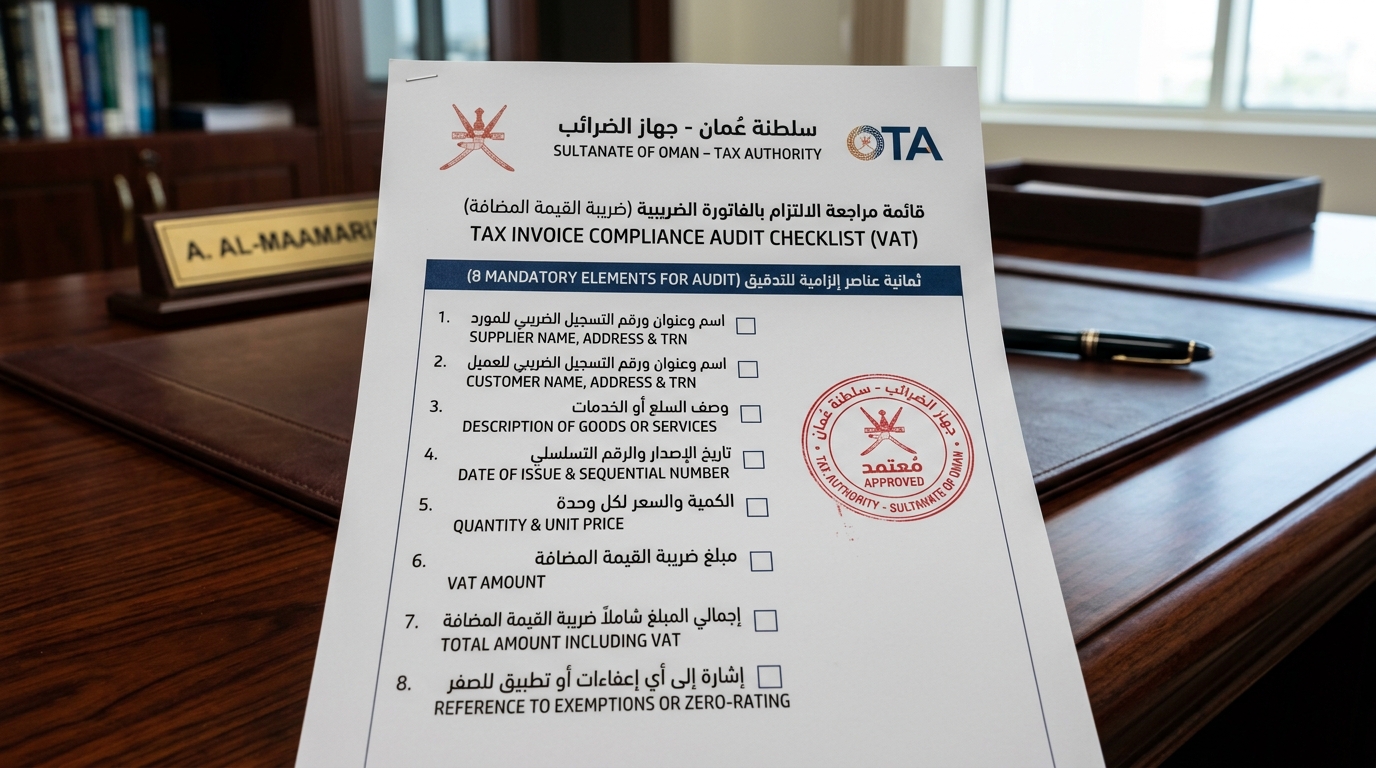
Under Article 67 of the Executive Regulations, every registered taxable person must issue an official Tax Invoice within 14 days of making a taxable supply.
A fully compliant Omani Tax Invoice must contain the following statutory data elements:
1. The clear label: “Tax Invoice” (or “Simplified Tax Invoice” for retail sales under OMR 500).
2. Date of invoice issuance and date of supply.
3. Sequential invoice identification number.
4. Supplier’s legal trade name, address, and 10-digit VAT Identification Number (Tax Identification Number).
5. Customer’s legal name, address, and VAT number (if registered).
6. Description and quantity of goods supplied or scope of services rendered.
7. Unit price excluding tax, applicable VAT rate (5% or 0%), and total VAT amount charged in Omani Rials (OMR).
8. Total gross amount payable including VAT.
Failure to issue a compliant tax invoice invalidates the buyer’s right to claim input tax deductions and exposes the vendor to statutory penalties.
—

5. Input VAT Recovery & Blocked Expense Categories
A major advantage of VAT registration is the ability to offset Input VAT paid on commercial purchases against Output VAT collected from clients. However, the Omani Tax Authority strictly prohibits input tax recovery on several “blocked” expenditure categories:
| Expenditure Category | Recoverable Status | Statutory Reason / Exclusion |
|---|---|---|
| Capital Equipment & Machinery | Fully Recoverable | Used directly for commercial business operations. |
| Raw Materials & Commercial Stock | Fully Recoverable | Standard cost of goods sold for taxable supplies. |
| Commercial Office Rent (Ejar) | Fully Recoverable | Backed by attested commercial tenancy contract. |
| Entertainment & Hospitality Expenses | Blocked (Non-Recoverable) | Client dinners, entertainment events, corporate gifts. |
| Motor Vehicles for Non-Business Use | Blocked (Non-Recoverable) | Passenger vehicles available for personal employee use. |
| Personal & Domestic Goods for Staff | Blocked (Non-Recoverable) | Personal mobile devices, club memberships, personal travel. |
Where an enterprise incurs overhead expenses that support both taxable and exempt activities (such as a commercial bank providing both interest-bearing loans and fee-based advisory), the firm must apply an approved Input Tax Apportionment Method to determine the allowable recovery percentage.
—
6. Cross-Border GCC Transactions & The Reverse Charge Mechanism
For businesses procuring foreign software, consulting services, or importing equipment from overseas suppliers, the Reverse Charge Mechanism (RCM) applies:
- Operational Mechanism: Instead of the foreign non-resident vendor charging Omani VAT, the Omani registered recipient accounts for both output tax and input tax simultaneously on their domestic VAT return.
- Customs Import Integration (Bayan Portal): On commercial imports cleared through Omani seaports (Port Sultan Qaboos, Sohar Port, Salalah Port) or Muscat International Airport, VAT is assessed by Oman Customs on the CIF value (Cost, Insurance, Freight) plus customs duties. Taxpayers with approved deferred payment status can declare import VAT directly on their quarterly return rather than settling at the port gate.
—
7. Filing Deadlines, Digital Portal Navigation, and Penalties
VAT reporting in Oman follows a calendar-quarter cycle:
“`
Quarter 1 (Jan 1 – Mar 31) Filing & Payment Deadline: April 30
Quarter 2 (Apr 1 – Jun 30) Filing & Payment Deadline: July 31
Quarter 3 (Jul 1 – Sep 30) Filing & Payment Deadline: October 31
Quarter 4 (Oct 1 – Dec 31) Filing & Payment Deadline: January 31
“`
Returns must be submitted electronically through the Oman Tax Authority Online Portal. Statutory payment must clear on or before the due date.
Statutory Penalties for Non-Compliance:
– Late Return Submission: Fines ranging from OMR 500 to OMR 2,000.
– Late Tax Payment: Surcharge of 1% per month calculated on the unpaid tax balance.
– Failure to Register for VAT: Fines ranging from OMR 1,000 to OMR 10,000.
– Intentional Tax Evasion or Falsified Invoices: Fines up to OMR 20,000 and potential criminal referral with custodial sentencing under the penal provisions of the VAT Law.
—
6. Practical Commercial Case Study: Real-World Implementation in Oman
To illustrate the concrete application of these regulatory requirements, consider a representative commercial enterprise operating in the Sultanate of Oman:
Commercial Context & Operating Background
A foreign-backed engineering and contracting entity operating in the Ghala Industrial Area in Muscat sought to renew its Commercial Registration (CR), expand its credit facilities with an Omani commercial bank, and bid on a major infrastructure development tender in the Special Economic Zone at Duqm (SEZAD). However, an internal compliance review identified critical gaps:
1. Historical general ledger records lacked formal reconciliation with customs declarations filed through the Royal Oman Police Directorate General of Customs Bayan single-window portal.
2. Intercompany management fees paid to a regional holding company in the UAE lacked contemporaneous transfer pricing documentation, exposing the entity to full disallowance under Tax Authority Decision 180/2026.
3. Monthly wage disbursements to foreign technical staff experienced occasional administrative delays, triggering automated compliance alerts on the Ministry of Labour Wages Protection System (WPS).
Strategic Remediation & Execution by Muscat Audit
The leadership team engaged Muscat Auditing & Accounting Services to conduct an end-to-end statutory diagnostic and implement an accelerated remediation roadmap:
– Phase 1: General Ledger & Tax Reconciliation: Our chartered accountants conducted a forensic reconciliation between physical import entries, audited trial balances, and submitted quarterly VAT returns. Discrepancies were regularized through formal voluntary disclosures submitted via the Oman Tax Authority digital portal.
– Phase 2: Transfer Pricing & Economic Substance Documentation: We established an arm’s length transfer pricing Local File and Master File demonstrating the economic commercial substance of all intercompany services, completely shielding the deductions from arbitrary tax reassessments.
– Phase 3: WPS & Payroll Automation: We overhauled the company’s payroll pipeline, structuring standard Salary Information Files (SIF) integrated with Bank Muscat corporate internet banking, ensuring 100% on-time wage settlement prior to the 10th of every calendar month.
– Phase 4: Statutory Certification & Tender Clearance: We prepared audited financial statements under International Financial Reporting Standards (IFRS) and issued a certified In-Country Value (ICV) certificate verifying Omani workforce development and local procurement spend.
Verified Commercial Outcome & Business Impact
Within 30 business days, the client successfully achieved:
– Unconditional renewal of their Commercial Registration (CR) through the Oman Business Platform (Invest Easy) with zero administrative holds.
– Issuance of an official Tax Clearance Certificate from the Oman Tax Authority, facilitating immediate commercial bank credit facility renewals.
– Prequalification and successful award of the SEZAD project contract backed by an accredited ICV score, driving a 35% increase in annual enterprise revenues.
8. Frequently Asked Questions (FAQ)
What is the standard VAT rate in Oman?
The standard Value Added Tax rate in the Sultanate of Oman is 5%, applying to the majority of goods and services supplied domestically or imported.
What is the mandatory VAT registration turnover threshold in Oman?
Any business whose annual taxable supplies exceed OMR 38,500 must register for VAT with the Oman Tax Authority within 30 days. Businesses with turnover exceeding OMR 19,250 may register voluntarily.
When are VAT returns due in Oman?
VAT returns must be submitted quarterly, within 30 days following the end of each tax quarter (April 30, July 31, October 31, and January 31).
Can foreign companies claim back VAT incurred on business expenses in Oman?
Under specific reciprocal agreements, non-resident foreign businesses that do not make taxable supplies in Oman may apply for input tax refunds on qualified business expenditures, subject to Tax Authority verification.
How does the upcoming Fawtara e-invoicing mandate affect VAT in Oman?
The Fawtara mandate will require all VAT-registered taxpayers to generate electronic invoices in structured XML/UBL format with certified cryptographic stamps, integrating enterprise ERP systems directly with the Oman Tax Authority server.
—
Shield your business against penalties, audit disputes, and cash flow bottlenecks. Our dedicated VAT compliance partners review your ledgers, prepare quarterly returns, and ensure seamless Tax Authority clearance.
Contact Muscat Auditing & Accounting Services Today | Direct Phone: Contact Muscat Audit | Office: Muscat, Sultanate of Oman.
—