
WPS Salary Transfer & Audit Compliance under Oman Labour Law (Royal Decree 53/2023)
Operating a commercial enterprise in the Sultanate of Oman requires continuous alignment with an evolving statutory framework. Guided by the economic diversification imperatives of Oman Vision 2040, regulatory bodies including the Ministry of Commerce, Industry and Investment Promotion (MOCIIP), the Oman Tax Authority (OTA), the Ministry of Labour (MOL), and the Central Bank of Oman (CBO) have instituted comprehensive corporate governance standards. In this competitive commercial environment, mastering WPS Salary Transfer Oman Labour Law is essential for safeguarding institutional compliance, maintaining fiscal integrity, and unlocking sustainable growth.
Whether your organization operates out of the capital city of Muscat, the industrial port of Sohar, the Freezone in Salalah, or the Special Economic Zone at Duqm (SEZAD), navigating Wages Protection System (WPS) compliance under Royal Decree No. 53/2023 (The Labour Law) demands rigorous financial planning and procedural clarity. Outdated legacy methods or generic accounting approaches frequently lead to administrative delays, commercial registry freezes, and avoidable statutory fines under prevailing Omani laws.
At Muscat Auditing & Accounting Services, our multidisciplinary team of licensed statutory auditors, chartered accountants, and corporate legal specialists delivers practical, end-to-end guidance tailored specifically to the Omani business environment.
—
Need professional support with Wages Protection System (WPS) compliance under Royal Decree No. 53/2023 (The Labour Law)? Schedule a strategic consultation with our senior advisory team to protect your business and streamline regulatory compliance.
Schedule a Free Consultation with Muscat Audit or call our Muscat headquarters directly at Contact Muscat Audit.
—
Table of Contents
1. Regulatory Foundation & Omani Statutory Directives
2. Core Principles & Institutional Framework in Oman
3. Step-by-Step Implementation Roadmap for Businesses
4. Commercial Impact: Financial Risks vs. Strategic Value
5. Documentation, Filing Portals & Ministry Procedures
6. Internal Controls, Oversight & Audit Defense Protocols
7. Common Regulatory Bottlenecks & Practical Solutions
8. Frequently Asked Questions (FAQ)
—
1. Regulatory Foundation & Omani Statutory Directives
The enforcement of Wages Protection System (WPS) compliance under Royal Decree No. 53/2023 (The Labour Law) is firmly anchored in the modern legislative architecture of the Sultanate of Oman. The primary corporate framework derives authority from Royal Decree No. 18/2019 (The Commercial Companies Law), which establishes managerial responsibility, shareholder rights, and mandatory financial disclosure rules for all commercial entities operating within the country.
Parallel to corporate statutes, corporate taxation directives under The Income Tax Law (Royal Decree No. 28/2009), recent royal amendments including Royal Decree No. 70/2024, and executive decisions issued by the Oman Tax Authority mandate complete transparency in commercial transactions. In the employment and payroll sector, Royal Decree No. 53/2023 (Promulgating the Labour Law) has established strict statutory protections regarding employee wage transparency and sector-specific Omanisation targets.
By standardizing organizational policies around these royal decrees and ministerial decisions, corporate executives establish an audit-ready posture that satisfies inspectors from MOCIIP, the Tax Authority, and the Ministry of Labour.
—
2. Core Principles & Institutional Framework in Oman
Executing a robust strategy for WPS Salary Transfer Oman Labour Law requires corporate leadership to understand the key operational dimensions governing the Omani business ecosystem:
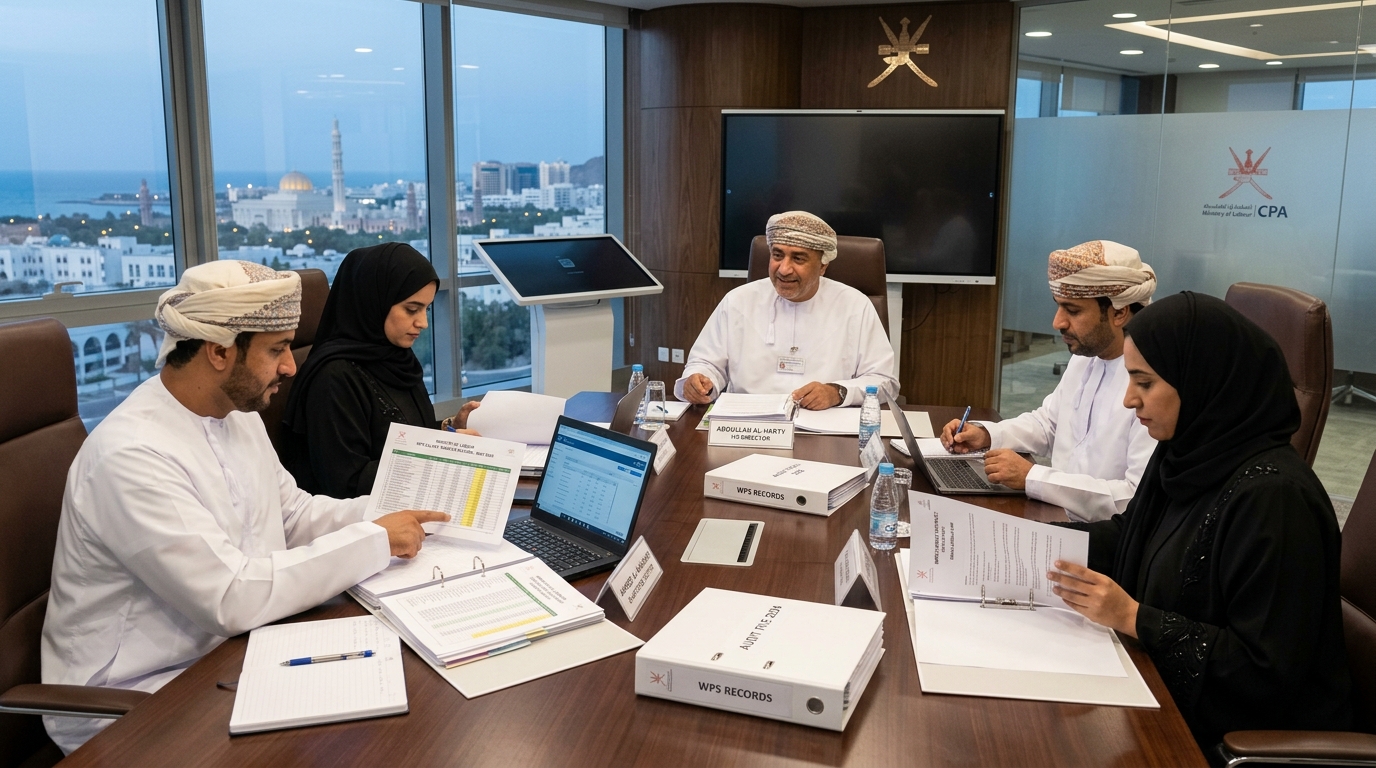
Institutional Stakeholders & Portals
– MOCIIP & The Oman Business Platform: All company registry updates, activity additions, and beneficial ownership filings are administered through the unified Invest Easy digital portal.
– The Oman Tax Authority Portal: Direct handling of corporate income tax returns (standard 15% rate), withholding tax (WHT) assessments, and quarterly Value Added Tax (VAT) filings.
– Central Bank of Oman & Commercial Banking Sector: Domestic commercial banks (such as Bank Muscat, Sohar International, Bank Dhofar, and National Bank of Oman) enforce strict Know-Your-Customer (KYC) and Anti-Money Laundering (AML) standards based on audited accounts.
– Ministry of Labour & WPS: Continuous tracking of workforce compensation through the electronic Wages Protection System to ensure timely wage settlement in Omani Rials (OMR).
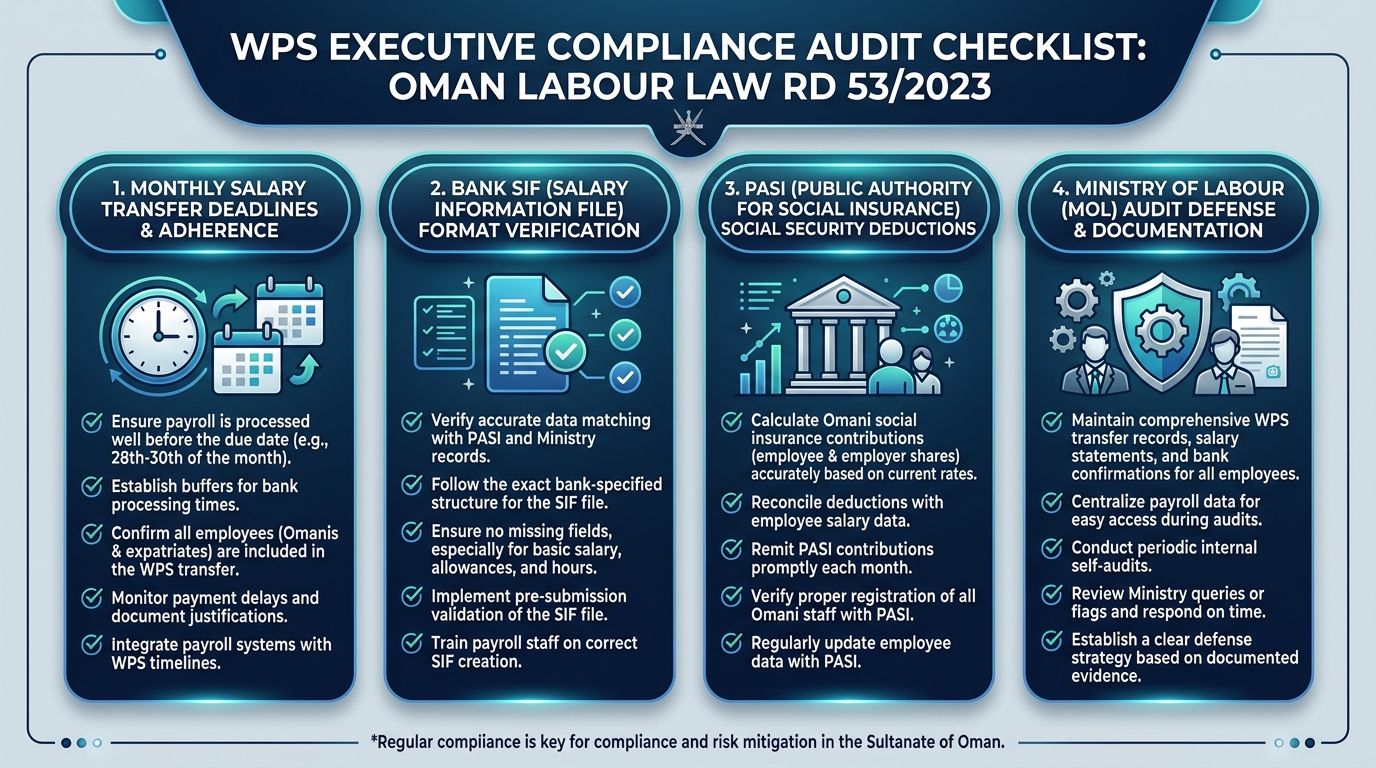
The Five Operational Pillars
1. Contemporaneous Documentation: Maintaining complete, verifiable audit trails for every transaction, backed by contracts, bank advice, and stamped commercial documentation.
2. IFRS Compliance: Aligning general ledgers and financial statement disclosures with International Financial Reporting Standards as enforced by Omani regulatory bodies.
3. Internal Governance & Segregation of Duties: Implementing dual-authorization protocols to mitigate financial fraud and administrative errors.
4. Digital Record Archiving: Preserving all commercial invoices, accounting books, and tax correspondence for the statutory minimum of 10 years.
5. Proactive Advisory Review: Engaging accredited independent auditors to review corporate filings before formal submission to regulatory platforms.
—
Ensure your general ledgers, financial statements, and tax provisions comply with prevailing Omani regulations.
Explore Our Accounting & Bookkeeping Services in Oman
—
3. Step-by-Step Implementation Roadmap for Businesses
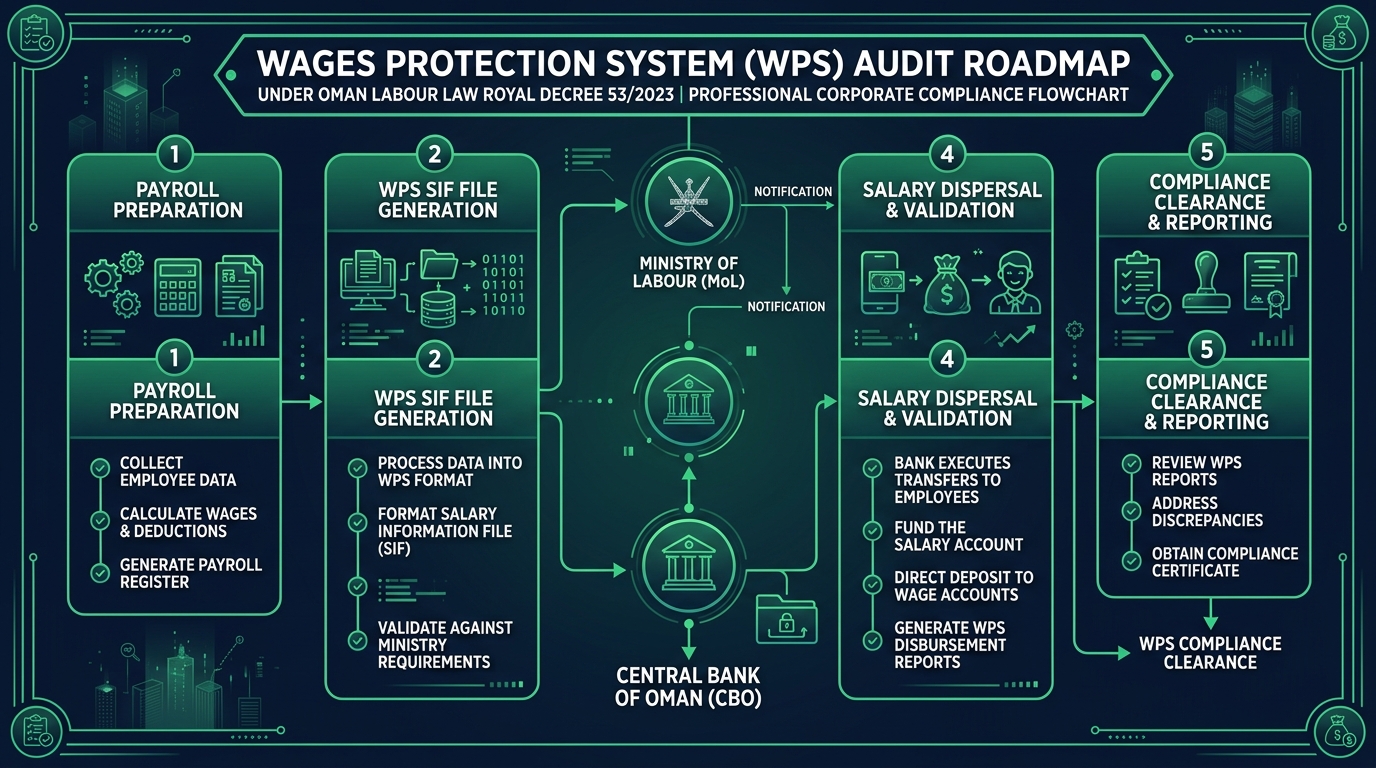
Implementing an effective workflow for Wages Protection System (WPS) compliance under Royal Decree No. 53/2023 (The Labour Law) involves a structured, five-stage lifecycle:
“`
[Phase 1: Operational Diagnostic] [Phase 2: Data & Document Assembly] [Phase 3: System Reconciliation] [Phase 4: Regulatory Submission] [Phase 5: Post-Filing Assurance]
“`
Phase 1: Operational Diagnostic & Gap Assessment
Conduct a comprehensive review of existing commercial records, contracts, tax registrations, and internal processes to identify discrepancies with current MOCIIP or Tax Authority directives.
Phase 2: Assembly of Statutory Documentation
Compile primary source documents, including the Commercial Registration (CR) computer printout, Chamber of Commerce membership certificate, audited financial statements, certified bank statements, and relevant ministerial licenses.
Phase 3: Financial Reconciliation & Verification
Reconcile operational sub-ledgers against the general ledger. For tax-related matters, verify that all input and output figures align across quarterly VAT returns, annual corporate income tax computations, and customs declarations on the Bayan portal.

Phase 4: Formal Portal Submission
Submit the required declarations, audit reports, or application dossiers through the relevant government digital portal (Oman Business Platform or Tax Authority Portal) utilizing verified PKI digital signatures.
Phase 5: Post-Filing Monitoring & Ongoing Compliance
Archive official submission receipts, follow up on ministerial clearances, and establish ongoing internal monitoring schedules to ensure uninterrupted license validity.
—
4. Commercial Impact: Financial Risks vs. Strategic Value
Understanding the tangible contrast between passive compliance and proactive advisory is critical for corporate decision-makers:
| Operational Dimension | Reactive / Non-Compliant Approach | Proactive Strategy with Muscat Audit | Strategic Business Advantage in Oman |
|---|---|---|---|
| Regulatory Standing | Risk of automated CR freezes and ministerial fines. | Unconditional compliance across MOCIIP and Tax Authority portals. | Uninterrupted business operations and instant license renewals. |
| Banking Relationships | Scrutiny during credit renewals; potential facility delays. | Transparent, audited financial packages satisfying CBO standards. | Preferred credit spreads and accelerated project financing approvals. |
| Tender Competitiveness | Incomplete documentation leading to bid disqualification. | Fully verified ICV scores, audited accounts, and tax clearances. | Highest commercial evaluation marks in PDO, OQ, and state tenders. |
| Tax Audit Exposure | High risk of disallowance on deductions and punitive surcharges. | Contemporaneous documentation supporting all deductible expenses. | Protected cash flow and predictable corporate tax liabilities. |
| Investor Confidence | Ambiguity regarding governance and beneficial ownership. | Clear governance frameworks complying with Omani corporate law. | Accelerated capital raising and smooth partner onboarding. |
—
5. Documentation, Filing Portals & Ministry Procedures
Successful execution requires meticulous preparation of official documentation:
– Commercial Documentation: Valid Commercial Registration (CR), Constitutive Contract (Articles of Association), and active Oman Chamber of Commerce and Industry (OCCI) certificate.
– Financial Records: General ledger extracts, trial balance, fixed asset registers, and audited annual balance sheets signed by a MOCIIP-accredited audit firm.
– Tax Identification: Active Tax Card issued by the Oman Tax Authority and verified 10-digit VAT identification number.
– Municipal & Lease Validation: Registered commercial tenancy agreement (Ejar) authenticated by the relevant municipality (e.g., Muscat Municipality).
All documentation must be presented in Arabic or accompanied by certified legal translations attested by an approved Omani translation bureau.
—
6. Internal Controls, Oversight & Audit Defense Protocols
Establishing robust internal controls is the most effective defense against regulatory penalties:
1. Periodic Internal Audits: Conduct quarterly internal audit reviews to verify that staff adhere to statutory operating guidelines and that transactions are properly recorded in the ERP system.
2. Segregation of Key Financial Roles: Ensure the individual initiating vendor payments does not hold sole authority for bank disbursement approvals, maintaining a minimum dual-signatory threshold.
3. Contemporaneous Audit Trails: Retain comprehensive electronic logs within your ERP platform recording user access, document edits, and invoice generation timestamps.
4. Independent Statutory Assurance: Engage licensed external auditors to conduct objective year-end substantive testing and issue formal audit opinions for shareholder and regulatory review.
—
7. Common Regulatory Bottlenecks & Practical Solutions
| Bottleneck / Operational Issue | Underlying Root Cause | Practical Remediation Strategy |
|---|---|---|
| Portal Submission Rejections | Uploaded documents lacked legal translation or official ministry attestations. | Validate all exhibits with an accredited corporate PRO team before digital filing. |
| Unreconciled Tax Discrepancies | Mismatch between customs import values on Bayan and quarterly VAT returns. | Implement monthly customs-to-ledger reconciliations prior to filing tax declarations. |
| WPS Payroll Holds | Salaries paid outside the electronic banking SIF pipeline or after the 10th of the month. | Standardize monthly payroll processing through licensed Omani commercial banks. |
| Commercial Registry Freezes | Failure to file updated beneficial ownership (UBO) or renew municipal licenses. | Establish automated compliance calendars tracking all statutory renewal dates. |
| Disallowed Corporate Deductions | Related-party expenses lacked transfer pricing documentation or commercial rationale. | Maintain contemporaneous benchmarking studies supporting intercompany transactions. |
—
6. Practical Commercial Case Study: Real-World Implementation in Oman
To illustrate the concrete application of these regulatory requirements, consider a representative commercial enterprise operating in the Sultanate of Oman:
Commercial Context & Operating Background
A foreign-backed engineering and contracting entity operating in the Ghala Industrial Area in Muscat sought to renew its Commercial Registration (CR), expand its credit facilities with an Omani commercial bank, and bid on a major infrastructure development tender in the Special Economic Zone at Duqm (SEZAD). However, an internal compliance review identified critical gaps:
1. Historical general ledger records lacked formal reconciliation with customs declarations filed through the Royal Oman Police Directorate General of Customs Bayan single-window portal.
2. Intercompany management fees paid to a regional holding company in the UAE lacked contemporaneous transfer pricing documentation, exposing the entity to full disallowance under Tax Authority Decision 180/2026.
3. Monthly wage disbursements to foreign technical staff experienced occasional administrative delays, triggering automated compliance alerts on the Ministry of Labour Wages Protection System (WPS).
Strategic Remediation & Execution by Muscat Audit
The leadership team engaged Muscat Auditing & Accounting Services to conduct an end-to-end statutory diagnostic and implement an accelerated remediation roadmap:
– Phase 1: General Ledger & Tax Reconciliation: Our chartered accountants conducted a forensic reconciliation between physical import entries, audited trial balances, and submitted quarterly VAT returns. Discrepancies were regularized through formal voluntary disclosures submitted via the Oman Tax Authority digital portal.
– Phase 2: Transfer Pricing & Economic Substance Documentation: We established an arm’s length transfer pricing Local File and Master File demonstrating the economic commercial substance of all intercompany services, completely shielding the deductions from arbitrary tax reassessments.
– Phase 3: WPS & Payroll Automation: We overhauled the company’s payroll pipeline, structuring standard Salary Information Files (SIF) integrated with Bank Muscat corporate internet banking, ensuring 100% on-time wage settlement prior to the 10th of every calendar month.
– Phase 4: Statutory Certification & Tender Clearance: We prepared audited financial statements under International Financial Reporting Standards (IFRS) and issued a certified In-Country Value (ICV) certificate verifying Omani workforce development and local procurement spend.
Verified Commercial Outcome & Business Impact
Within 30 business days, the client successfully achieved:
– Unconditional renewal of their Commercial Registration (CR) through the Oman Business Platform (Invest Easy) with zero administrative holds.
– Issuance of an official Tax Clearance Certificate from the Oman Tax Authority, facilitating immediate commercial bank credit facility renewals.
– Prequalification and successful award of the SEZAD project contract backed by an accredited ICV score, driving a 35% increase in annual enterprise revenues.
8. Frequently Asked Questions (FAQ)
Why is compliance with WPS Salary Transfer Oman Labour Law essential for businesses in Oman?
Adhering to these standards ensures full legal standing with MOCIIP, the Oman Tax Authority, and the Ministry of Labour, protecting the company from administrative fines, commercial registry holds, and tender disqualification.
What is the role of an accredited audit firm in this process?
Only auditing firms licensed by MOCIIP and registered with the Omani Association of Chartered Accountants possess the statutory authority to audit books, issue formal assurance reports, and represent clients before regulatory authorities.
How do non-compliance penalties affect commercial activities in Oman?
Penalties range from monetary fines (often between OMR 500 and OMR 10,000) to operational holds on the company’s Commercial Registration, preventing work permit issuance, visa renewals, and bank transactions.
Can foreign-owned companies in Oman complete these filings independently?
While online portals are accessible, foreign-owned entities strongly benefit from partnering with local chartered accountants who understand Omani statutory nuances, Arabic legal phrasing, and ministerial verification protocols.
How frequently must companies review and update their compliance filings?
Companies should review their compliance posture on a quarterly basis (coinciding with VAT filings and WPS wage reports) and execute comprehensive annual reviews during statutory financial audit preparation.
—
Experience seamless statutory audits, proactive tax defense, and strategic financial advice from Oman’s trusted corporate assurance firm.
Contact Muscat Auditing & Accounting Services Today | Direct Phone: Contact Muscat Audit | Office: Muscat, Sultanate of Oman.
—