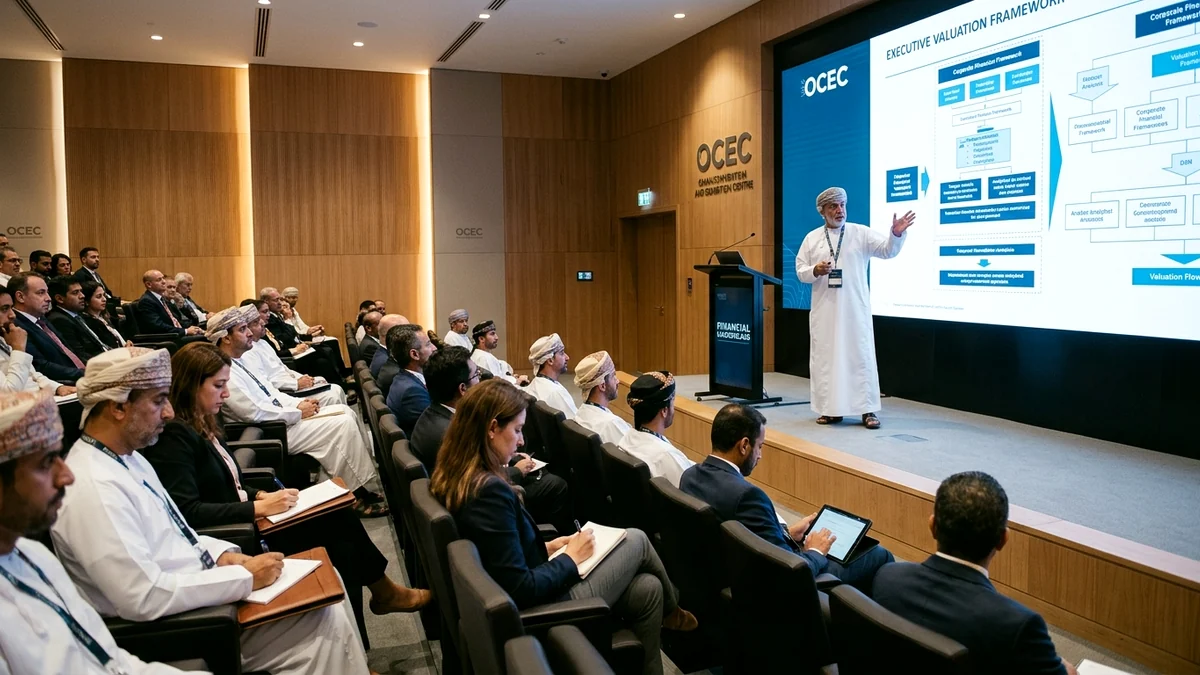
Corporate Finance Training & Executive Accounting Workshops in Oman: Upskilling Omani Finance Teams in IFRS, VAT, Internal Audit & Financial Modelling
Every year during the Q1 statutory audit season in Muscat, we observe the same pattern across dozens of Omani corporations: talented, hardworking in-house accounting teams spend weeks reworking their trial balances because of technical misunderstandings in IFRS 9 Expected Credit Loss (ECL) models, IFRS 16 right-of-use lease modifications, IFRS 15 construction revenue recognition, or Oman Tax Authority (OTA) withholding tax and reverse-charge VAT rules. The root cause is rarely lack of effort—it is the rapid velocity of regulatory and accounting change in the Sultanate.
With IFRS 18 replacing IAS 1, the Financial Services Authority (FSA) elevating governance expectations under Royal Decree 20/2024, and the OTA rolling out Phase-by-Phase Fawtara e-invoicing and deeper tax inspections, relying on outdated university textbooks or generic overseas webinars is no longer sufficient. As leading Chartered Accountants in Oman, Muscat Audit designs and delivers customized, practitioner-led Corporate Finance, IFRS, Tax & Internal Audit Training Programs built specifically around Omani statutes and your company’s live ERP environment.
1. Bridging the Technical Skills Gap in Omani Corporate Finance Departments
When Human Resources or Finance Directors in Oman commission external training, they often discover that academic trainers teach theory in a vacuum. An accountant may leave a three-day seminar knowing the conceptual definition of a “performance obligation” under IFRS 15, yet still struggle on Monday morning to post the exact journal entry for a variation order with 10% retention and 5% Omani VAT in SAP or Odoo.
Our Corporate Trainings & Advisory methodology reverses that paradigm. Every workshop is taught by active audit partners, tax directors, and corporate finance practitioners who audit and advise Omani companies daily. Before delivering a session, we review your company’s prior-year external audit Management Letter, recent OTA tax queries, and internal Chart of Accounts so every case study solves a real business problem inside your organization.
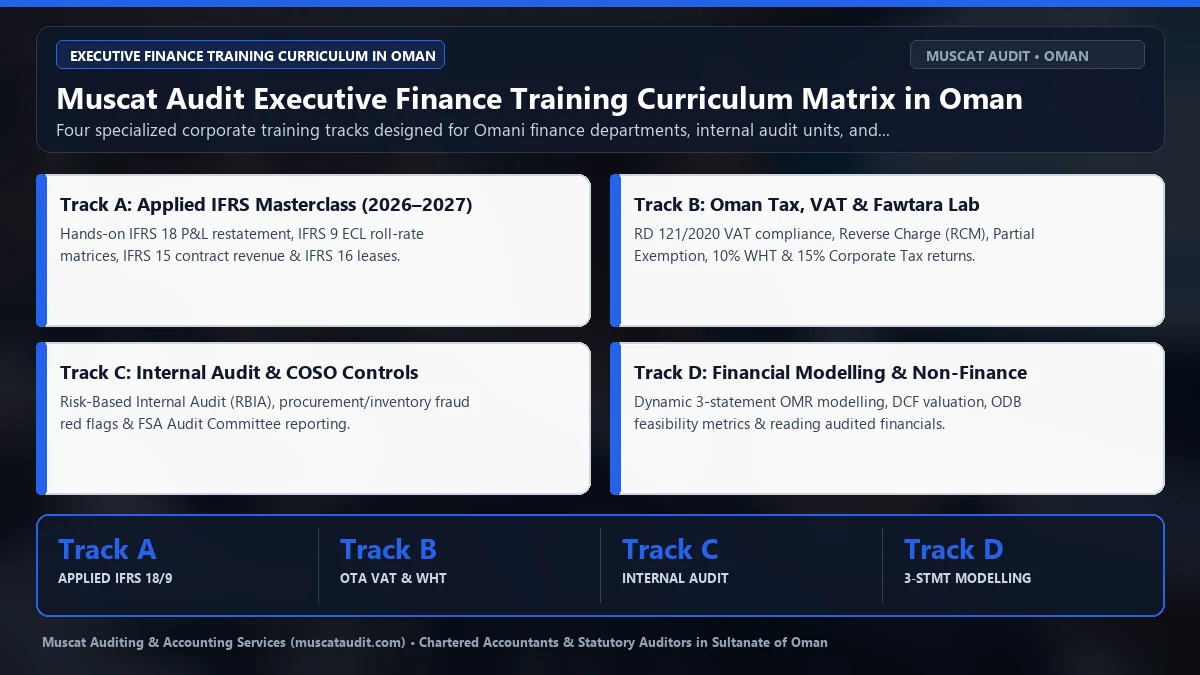
2. Executive Curriculum Matrix: IFRS, Oman Tax/VAT, Internal Audit & Financial Modelling
| Training Track | Target Audience in Oman | Core Technical Modules Covered | Practical Deliverable / Toolkit |
|---|---|---|---|
| Track A: Applied IFRS Masterclass (2026–2027) | CFOs, Financial Controllers, Chief Accountants, Reporting Teams | IFRS 18 P&L Redesign & MPMs, IFRS 9 ECL Matrices, IFRS 15 Contract Accounting, IFRS 16 Leases, IAS 19 Gratuity | Excel IFRS 9/16 working models & IFRS 18 Chart of Accounts mapping template |
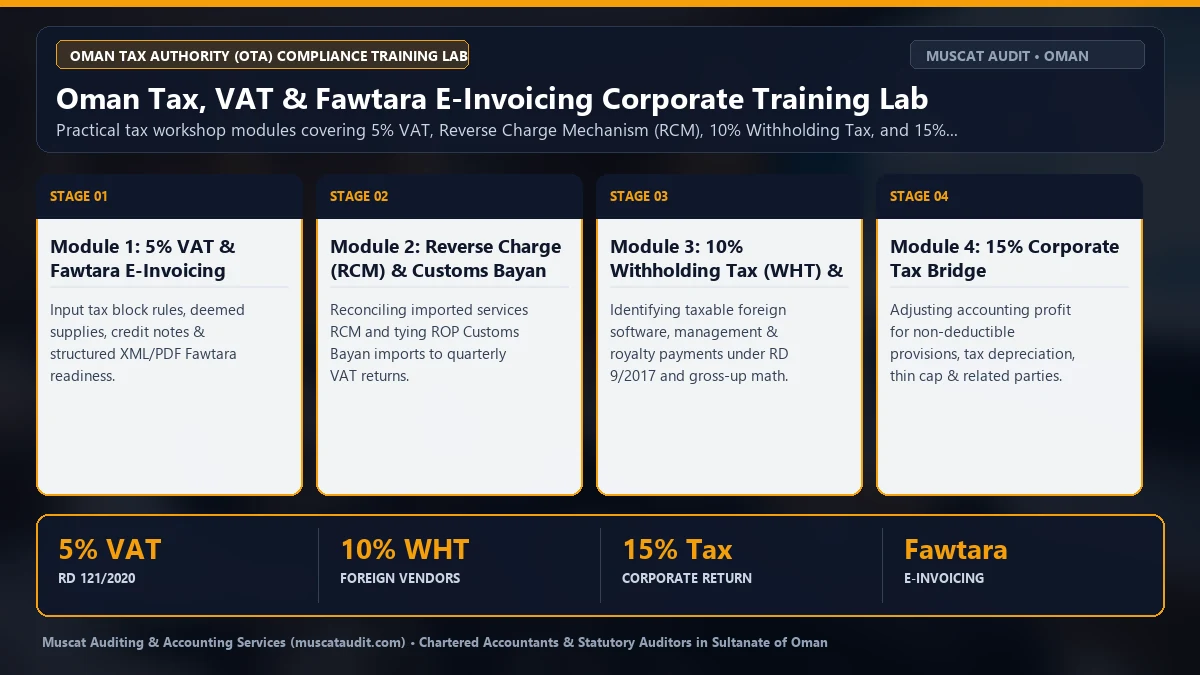
| Track B: Oman Tax, VAT & Fawtara E-Invoicing Lab | Tax Managers, AP/AR Accountants, Procurement & Billing Teams | RD 121/2020 VAT Rules, Reverse Charge Mechanism (RCM), Partial Exemption, WHT (RD 9/2017), 15% Corporate Tax & Fawtara | OTA Tax Audit Readiness Checklist & VAT-to-Turnover Reconciliation Workbook |
| Track C: Internal Audit, COSO Controls & Fraud Prevention | Internal Auditors, Risk Officers, Operations & Procurement Heads | Risk-Based Internal Audit (RBIA), Procurement & Inventory Fraud Red Flags, FSA Governance, Audit Committee Reporting | Risk Control Matrix (RCM) & Departmental SOP Audit Toolkit |
| Track D: Financial Modelling, Valuation & Finance for Non-Finance | CEOs, Board Members, Project Managers, Commercial Analysts | 3-Statement Dynamic Modelling, DCF & Capital Budgeting (NPV/IRR/DSCR), Reading Audited Financials, Working Capital Control | Dynamic 5-Year OMR Financial Model & Executive Ratio Dashboard |
3. Deep-Dive IFRS Bootcamps: Preparing Teams for IFRS 18, IFRS 9 ECL, IFRS 15 & IFRS 16
When preparing for annual External & Statutory Audit engagements, our technical trainers focus heavily on the four standards that cause 85% of audit delays in Oman:
- Hands-On IFRS 18 Workshop: Participants take a live Omani trial balance and reclassify every income and expense account into the new Operating, Investing, and Financing categories, while drafting compliant Management-Defined Performance Measure (MPM) note disclosures for 2026 comparative restatement.
- Building an Audit-Proof IFRS 9 ECL Provision Matrix: Instead of applying arbitrary flat bad-debt percentages (which both external auditors and the OTA reject), trainees build a historical loss-rate roll-rate matrix segmented by Omani customer tiers (government/ministries, oil & gas majors, corporate LLCs, and retail) adjusted for forward-looking macroeconomic indicators.
- IFRS 16 Lease Modification & Usufruct Accounting: Step-by-step Excel and ERP journal construction for SEZAD/Madayn industrial land usufruct leases, CPI rent escalations, and early lease terminations.
4. Oman Tax Authority (OTA) Compliance Academies: VAT Audits, WHT & Fawtara E-Invoicing
Tax compliance in Oman is not isolated to the tax department—it begins the moment a procurement officer issues a purchase order to a foreign software or engineering vendor, or a sales executive signs a promotional discount agreement. Our Tax & VAT Compliance Workshops train cross-functional finance, procurement, and commercial teams on:
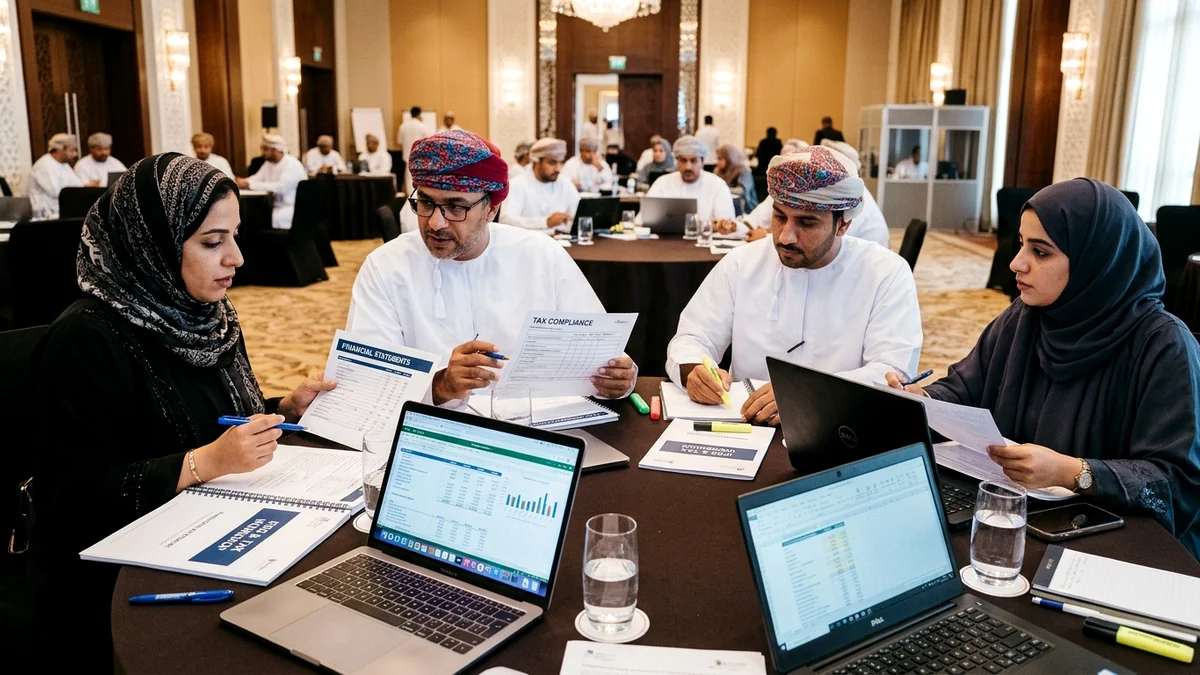
- Withholding Tax (WHT) Trap Prevention: Identifying foreign vendor payments subject to Oman’s 10% Withholding Tax (management fees, software/IT licensing, royalties, R&D, and specified cross-border services), reading Double Taxation Avoidance Agreements (DTAAs), and calculating gross-up clauses when foreign suppliers insist on net-of-tax contracts.
- VAT Input Tax & Reverse Charge Mechanics: Preventing blocked input tax claims on entertainment, non-business motor vehicles, and defective tax invoices, while preparing teams for the OTA’s mandatory Fawtara electronic invoicing structured data standards.
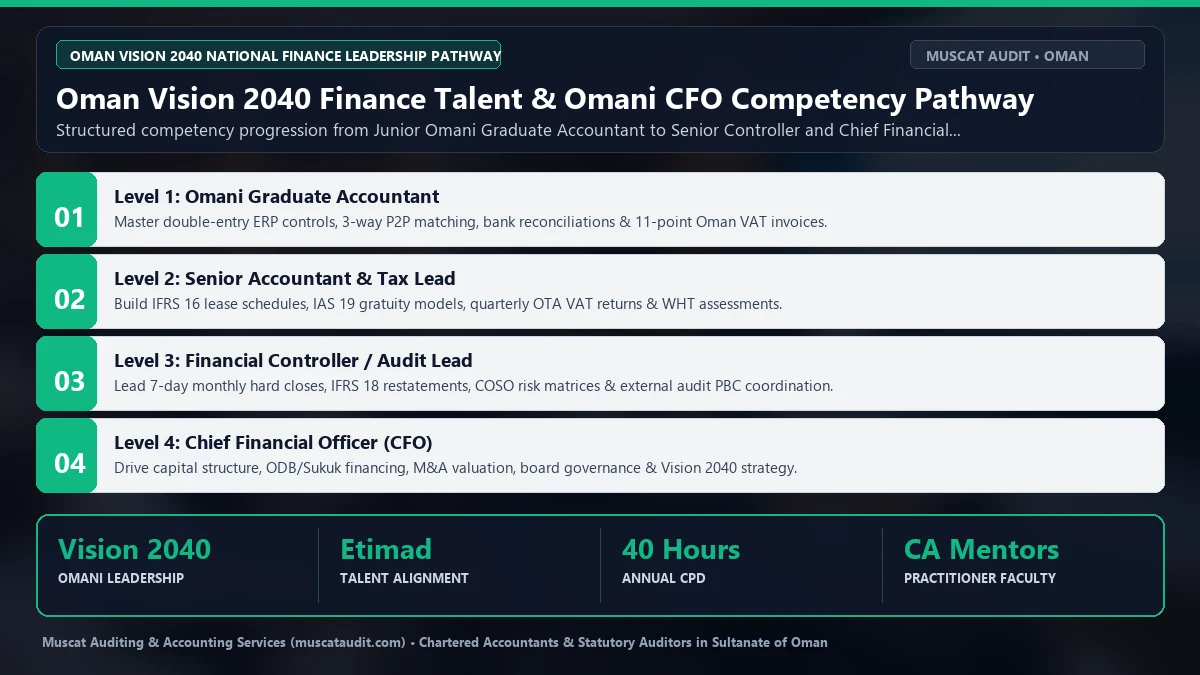
5. Empowering Omani National Finance Leaders (Vision 2040 & Etimad Alignment)
One of the core human-capital pillars of Oman Vision 2040 is elevating Omani nationals into high-value technical and executive leadership roles in the private sector. Through our Human Resources & Corporate Training division, we partner with SAOGs, SAOCs, family conglomerates, and government-related companies to deliver 6-to-12-month Omani Finance Controller & Future CFO Accelerators—combining classroom workshops with monthly on-the-job coaching during live monthly closes and audit committee preparations.
Case Study: Transforming Audit Readiness & Closing Speed for a 14-Accountant Muscat Industrial Group
To see how practitioner-led corporate training delivers measurable financial ROI, consider a diversified industrial and logistics group in Muscat employing 14 Omani and expatriate accountants across three subsidiaries. Prior to engaging Muscat Audit, the group required 22 business days after each month-end to produce a consolidated trial balance, and its annual statutory audit routinely dragged into late April with more than 35 audit adjusting journal entries—driven by inconsistent IFRS 16 lease schedules, manual spreadsheet errors in IFRS 9 Expected Credit Loss (ECL) provisioning, and misclassified Reverse Charge VAT on foreign software and engineering invoices.
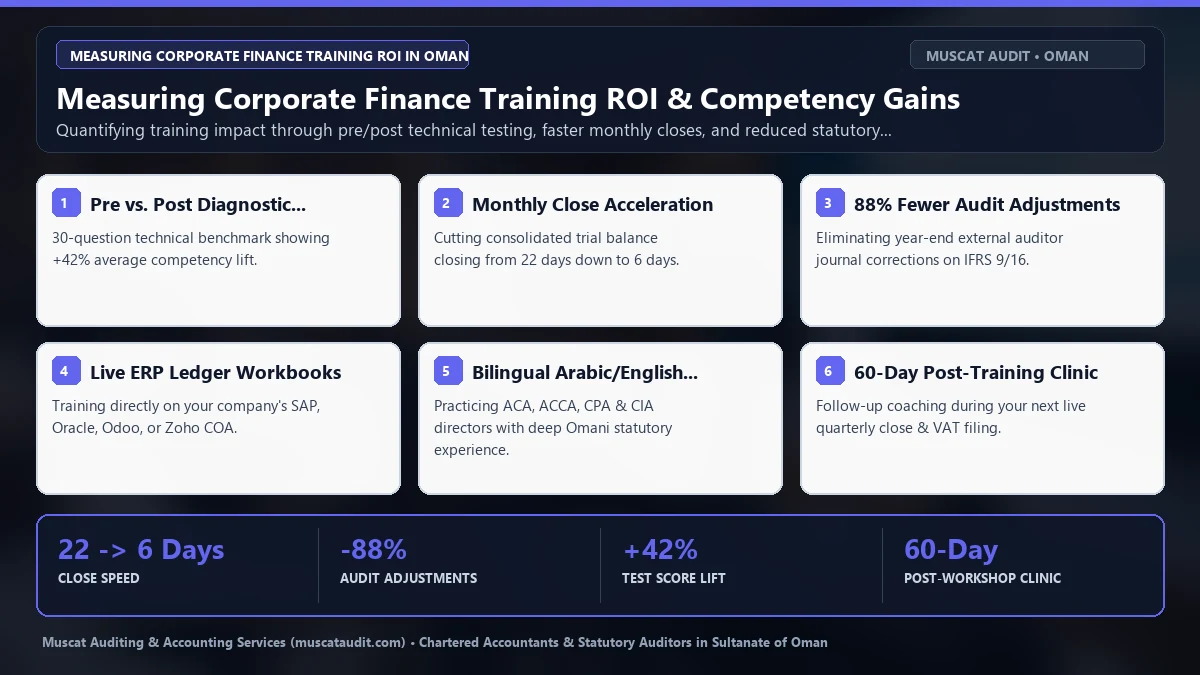
Our faculty designed a tailored 5-day intensive corporate academy combining our Applied IFRS Masterclass and Oman Tax & VAT Lab, using the group’s own anonymized SAP trial balance as the classroom workbook. Every accountant built a standardized IFRS 16 right-of-use schedule, an automated IFRS 9 aging roll-rate matrix, and a four-way OTA VAT-to-General-Ledger reconciliation template. We also conducted a half-day “Finance & Governance for Non-Finance Directors” briefing for the company’s procurement and project managers so tax invoices and contract variations were structured correctly at source. Within two quarters of completing the program, the group cut its monthly consolidated closing cycle from 22 days down to 6 business days, reduced year-end external audit adjustments by 88%, and successfully promoted two senior Omani accountants into Subsidiary Financial Controller roles.
How Our 4-Stage Corporate Training Delivery Methodology Works
- Stage 1 — Pre-Workshop Technical Diagnostic & Ledger Review: Every participant completes a confidential 30-question technical diagnostic across IFRS, Oman VAT/Corporate Tax, and internal controls, while our partners review your prior-year external audit Management Letter to pinpoint exact skill gaps.
- Stage 2 — Customized Workbook & Excel Model Construction: We build bespoke Excel templates and ERP journal guides tailored to your sector (whether contracting, manufacturing, retail, healthcare, or oil & gas services in Oman).
- Stage 3 — Interactive Practitioner-Led Delivery (In-Person or Hybrid): Delivered at your corporate headquarters in Muscat, Sohar, Duqm, or Salalah—or at an executive hotel venue—featuring live polling, group case competitions, and real-time Q&A with practicing Chartered Accountants.
- Stage 4 — Post-Training Assessment, Certification & 60-Day Clinic: Participants sit a post-training competency assessment to earn verifiable CPD certificates, followed by a 60-day virtual follow-up clinic during your next quarterly close to ensure newly learned templates are embedded in daily operations (see also our guide to IFRS 18 Financial Statements Presentation & 2026 Restatement in Oman).
6. Mandatory CPD / Governance Requirements vs. Corporate L&D Best Practices
Mandatory Statutory Requirements in Oman
- Continuous Professional Development (CPD) for Certified Professionals: Accountants and internal auditors holding ACCA, ACA, CPA, CMA, or CIA credentials in Oman must complete 40 hours of verifiable CPD annually (including ethics) to maintain good standing.
- FSA & CBO Governance Training Expectations: Regulated entities under the Financial Services Authority (FSA) and Central Bank of Oman (CBO) must ensure board members, audit committees, and AML/CFT compliance officers receive regular regulatory updates.
- Ministry of Labour National Training & Omanisation Plans: Employers in regulated sectors must maintain documented training and career progression plans for Omani employees.
Professional Best-Practice Recommendations
- Train on Your Own Live Chart of Accounts: Replace generic case studies with anonymized excerpts from your company’s actual ERP ledger and prior audit adjustments.
- Include Procurement & Commercial Teams in VAT/WHT Training: Tax errors originate in contracts and purchase orders long before invoices reach the finance desk.
- Conduct Pre-Audit Refresher Bootcamps in Q4: Run a focused 1-day IFRS & PBC Audit Readiness workshop every November so the December year-end close runs flawlessly.
- Measure Post-Training Competency Scores: Use pre-workshop diagnostic tests and 60-day post-workshop ledger reviews to verify knowledge retention.
7. Frequently Asked Questions on Corporate Finance Training in Oman
Why should Omani companies invest in customized in-house finance training rather than generic online accounting courses?
Generic international courses teach abstract accounting theory without addressing Omani statutory realities—such as how IFRS 15 interacts with Oman Tax Authority (OTA) VAT time-of-supply rules on retention money, how Royal Decree 20/2024 impacts MSX/FSA audit committee reporting, or how Oman Income Tax Law (RD 28/2009) treats IFRS 16 lease depreciation and IFRS 9 Expected Credit Loss (ECL) provisions in the tax computation. Bespoke corporate workshops built around your company’s actual Chart of Accounts and ERP system deliver immediate reduction in audit adjustments and tax risks.
How does corporate finance training support Omanisation and national talent development in finance departments?
Under Oman Vision 2040 and Ministry of Labour national workforce initiatives (including Etimad and sector-specific leadership tracks), Omani enterprises are actively promoting Omani graduates and mid-career accountants into Senior Accountant, Financial Controller, Internal Audit Manager, and CFO positions. Structured technical bootcamps mentored by practicing Chartered Accountants bridge the gap between university degrees and board-level financial leadership.
What are the most critical training topics for Omani corporate finance teams in 2026–2027?
The five highest-impact training modules in Oman today are: (1) IFRS 18 Presentation and Disclosure in Financial Statements (effective 2027, requiring 2026 comparative ledger restatement), (2) Oman VAT Audit Defense & Fawtara E-Invoicing Readiness, (3) Practical IFRS 9 ECL & IFRS 16 Lease Modelling in Excel, (4) Internal Audit, Fraud Detection & COSO Internal Controls for Non-Audit Managers, and (5) Finance for Non-Finance Executives and Board Directors.
Can Muscat Audit deliver bilingual (Arabic and English) corporate trainings for government entities, SOEs, and private groups in Oman?
Yes. Our training faculty includes bilingual Chartered Accountants (ACA, ACCA, CPA, SOCPA/GCC tax specialists) and Certified Internal Auditors (CIA) who deliver interactive workshops in Muscat, Sohar, Duqm, Salalah, or virtually—incorporating Omani Royal Decrees, OTA Arabic administrative circulars, and live case studies.
How do we measure the Return on Investment (ROI) of a corporate finance training program?
We benchmark every corporate training program using four concrete pre- and post-training metrics: (1) pre-test vs. post-test technical competency scores, (2) reduction in year-end external auditor adjusting journal entries, (3) shortening of the monthly trial-balance closing cycle (e.g., from 18 days down to 7 days), and (4) elimination of OTA VAT/WHT filing errors.
Book a Customized IFRS, Oman Tax/VAT, or Internal Audit Workshop for Your Team
Equip your finance department and leadership team with practical, Oman-specific technical mastery. Contact Muscat Audit’s Corporate Training faculty in Muscat to design an in-house or executive workshop tailored to your industry.