
IFRS 18 Presentation and Disclosure in Financial Statements: 2026 Comparative Restatement & 2027 Readiness Guide for Omani Enterprises
For more than twenty years, IAS 1 (Presentation of Financial Statements) gave corporate finance teams across the Sultanate of Oman wide latitude in how they formatted their Statement of Profit or Loss. One trading group in Muttrah might include share of profit from associates and fair-value gains inside “Operating Profit,” while a competing industrial conglomerate in Sohar excluded them. That flexibility ends with the arrival of IFRS 18 (Presentation and Disclosure in Financial Statements), which replaces IAS 1 in its entirety.
Although IFRS 18 becomes mandatory for annual reporting periods beginning on or after 1 January 2027, its requirement for full retrospective restatement means that 2026 is the live comparative reporting year for every calendar-year company in Oman. As a trusted provider of Auditing and Accounting Services in Oman, Muscat Audit is already helping CFOs, MSX-listed SAOGs, family holding companies, and mid-market LLCs redesign their ERP Charts of Accounts so their 2026 general ledgers capture Operating, Investing, and Financing items cleanly at the point of transaction entry.
1. Why IFRS 18 Is the Biggest Financial Reporting Overhaul in Two Decades
In Oman, full compliance with International Financial Reporting Standards (IFRS) is required by the Commercial Companies Law (Royal Decree 18/2019), the Financial Services Authority (FSA), and the Oman Tax Authority (OTA). While recent standards such as IFRS 15 (Revenue), IFRS 16 (Leases), and IFRS 9 (Financial Instruments) changed how specific transactions are measured, IFRS 18 transforms how every company presents its financial performance.
IFRS 18 rests on three core pillars that directly impact Omani financial statements and statutory audits:
- Mandatory Income Statement Categories & Subtotals: All income and expenses must be classified into five strict categories—Operating, Investing, Financing, Income Taxes, and Discontinued Operations—accompanied by two newly standardized subtotals: Operating Profit or Loss and Profit or Loss Before Financing and Income Taxes.
- Audited Disclosure of Management-Defined Performance Measures (MPMs): Non-GAAP metrics communicated publicly by management (such as “Adjusted EBITDA” or “Core Operating Income”) must be disclosed in a single audited note and reconciled to the nearest IFRS subtotal.
- Enhanced Aggregation, Disaggregation & Operating Expense Transparency: Companies can no longer bury large miscellaneous expenses in “Other Operating Expenses” and must provide specific disclosures on depreciation, amortization, employee benefits, impairments, and inventory write-downs when presenting expenses by function.
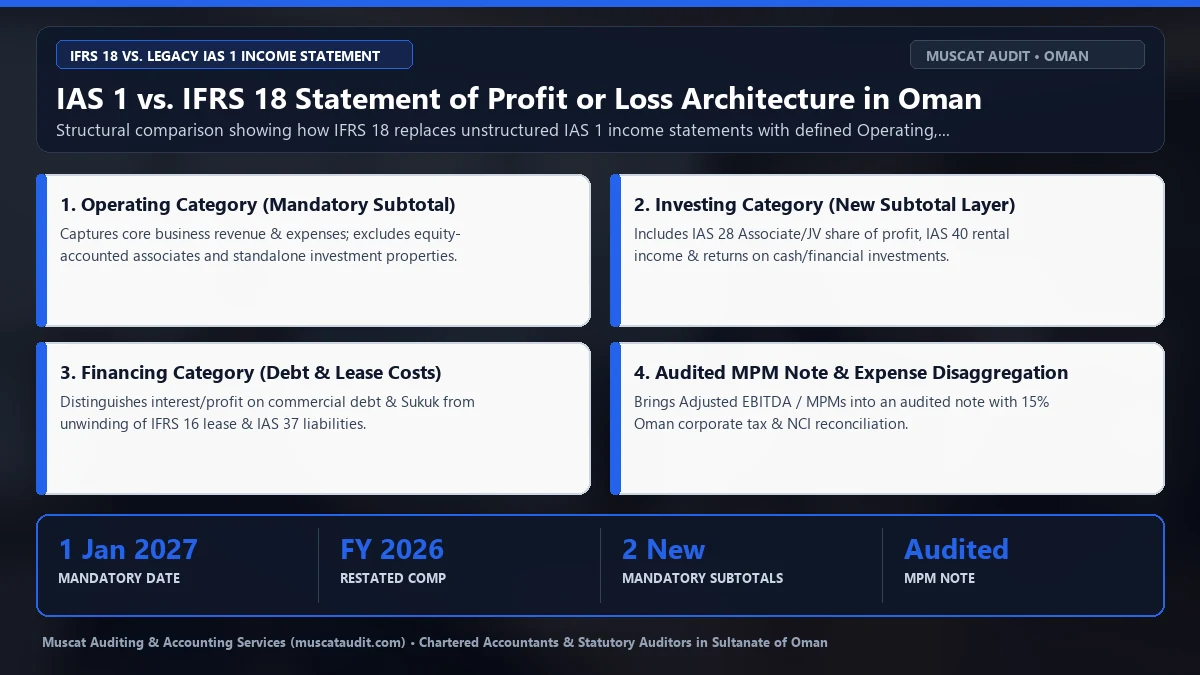
2. The New Five-Category Statement of Profit or Loss & Mandatory Subtotals
For a standard commercial, industrial, construction, or services enterprise in Oman (whose specified main business activity is neither banking/financing nor investing in financial assets), IFRS 18 requires income and expenses to be sorted into three primary operational/capital buckets before tax:
A. The Operating Category (Default Residual Bucket)
The Operating category captures all income and expenses from the company’s main business activities—as well as any income or expense not classified in the other categories. Crucially, even volatile or unusual operating items (such as warehouse fire losses in Sohar, restructuring severance under Oman Labour Law, or inventory obsolescence write-downs) remain inside Operating Profit unless they meet the strict criteria of another category.
B. The Investing Category
The Investing category captures returns from assets that generate a return individually and largely independently of the entity’s other resources. For a typical Omani conglomerate or LLC, this includes:
- Rental income and fair-value gains/losses from Investment Properties (IAS 40) held in Muscat or Salalah (unless real estate investment is the company’s main business activity);
- Share of profit or loss from Associates and Joint Ventures accounted for using the equity method (IAS 28)—which can no longer be included inside Operating Profit;
- Dividends and interest income earned on cash, fixed deposits, and debt/equity investments; and
- Incremental expenses directly attributable to acquiring or disposing of those investing assets.
C. The Financing Category
IFRS 18 draws a sharp distinction between liabilities that arise from transactions that involve only the raising of finance (such as commercial bank term loans, overdrafts, Islamic Murabaha/Sukuk facilities, and shareholder loans) and other liabilities (such as IFRS 16 lease liabilities, decommissioning provisions under IAS 37, and net defined-benefit end-of-service gratuity liabilities under IAS 19). Both categories’ interest expenses and interest unwinding are placed in the Financing category, right below the new subtotal Profit or Loss Before Financing and Income Taxes.
3. Worked OMR Example: IAS 1 vs. IFRS 18 Income Statement for a Muscat Group
To see how IFRS 18 alters reported Operating Profit and debt-covenant ratios, consider Al Batinah Industrial & Trading SAOC (an illustrative Muscat corporation with an IAS 40 commercial rental building in Al Khuwair and a 30% equity-method associate in Duqm):
| Line Item (OMR ‘000) | Legacy IAS 1 Classification | New IFRS 18 Category | 2026 Restated (OMR) |
|---|---|---|---|
| Revenue from Contracts with Customers (IFRS 15) | Revenue | Operating | 8,400,000 |
| Cost of Goods Sold & Operating Expenses (incl. Trade AP FX loss) | COGS / Admin / Finance | Operating | (6,950,000) |
| Mandatory Subtotal 1: Operating Profit | Previously included Associate & Rental | IFRS 18 Mandatory Subtotal | 1,450,000 |
| Share of Profit of Equity-Accounted Associate (IAS 28) | Often inside Operating | Investing | 210,000 |
| Net Rental Income from Al Khuwair Investment Property & Deposit Interest | Other Income | Investing | 95,000 |
| Mandatory Subtotal 2: Profit Before Financing and Income Taxes | Not Defined in IAS 1 | IFRS 18 Mandatory Subtotal | 1,755,000 |
| Interest Expense on Bank Muscat Term Loan & Murabaha Facility | Finance Costs | Financing (Raising Finance) | (240,000) |
| Interest Unwinding on IFRS 16 Lease Liabilities & IAS 19 Gratuity | Finance / Staff Costs | Financing (Other Liabilities) | (45,000) |
| Profit Before Income Tax | PBT | Subtotal | 1,470,000 |
| Oman Corporate Income Tax Expense (15% Statutory Rate) | Taxation | Income Taxes | (189,000) |
| Profit for the Year | Net Profit | Bottom Line | 1,281,000 |
Notice the strategic implication: while net profit remains OMR 1,281,000, moving the OMR 210,000 associate profit and OMR 95,000 property rental income out of Operating Profit and into Investing reduces reported Operating Profit by OMR 305,000. Any Omani corporate with bank loan covenants or executive bonus plans tied to “Operating Profit” or “Operating Margin” must proactively review its facility agreements with its IFRS & Financial Reporting advisors.
4. Bringing Management-Defined Performance Measures (MPMs) Inside the Audit
Many MSX-listed companies, IPO candidates, and large private groups in Oman highlight custom performance subtotals—such as “Adjusted Operating Profit,” “Core Earnings,” or “Normalized EBITDA excluding pre-opening costs”—in their Chairman’s Report, investor presentations, or bond prospectuses. Under IFRS 18, any subtotal of income and expenses used in public communications outside the financial statements to communicate management’s view of financial performance is classified as a Management-Defined Performance Measure (MPM) (note that standard Operating Profit before Depreciation, Amortization, and Impairments within the scope of IAS 36 [OPDAI] is now an IFRS-specified subtotal and therefore exempt from extra MPM reconciliation rules).

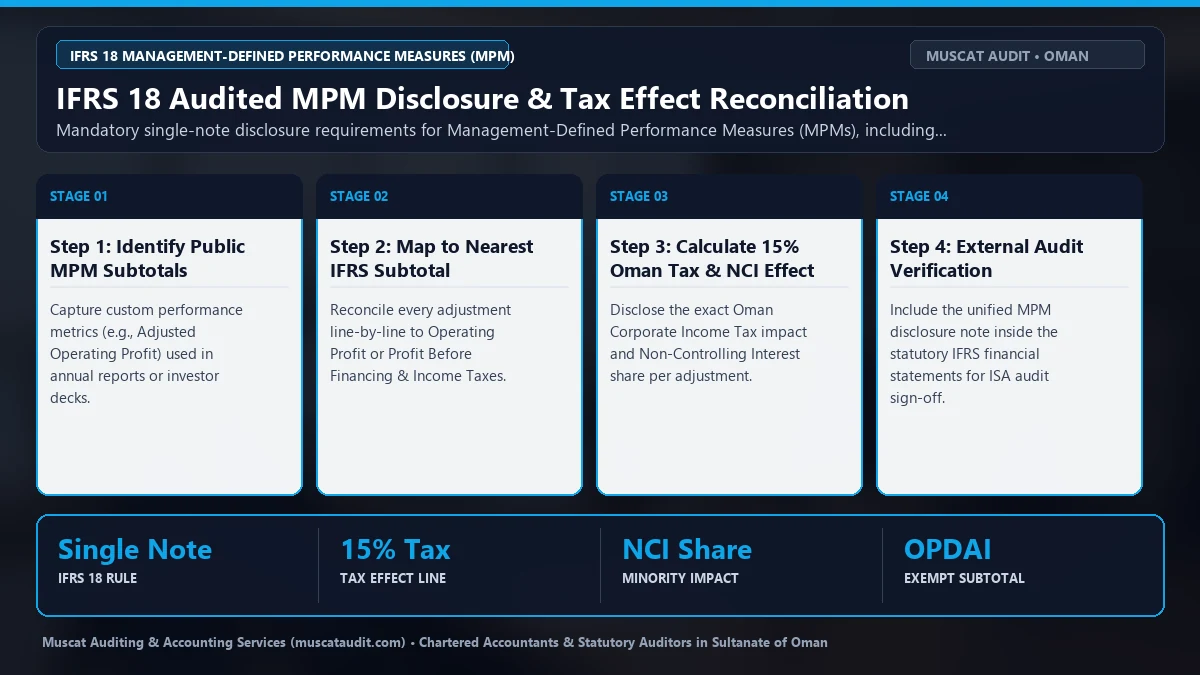
When an Omani company reports an MPM, IFRS 18 requires a dedicated, audited note in the financial statements containing:
- A clear statement that the MPM reflects management’s view of an aspect of financial performance and is not necessarily comparable with measures shared by other companies;
- An explanation of why the MPM provides useful information to users of the financial statements;
- A quantitative reconciliation between the MPM and the most directly comparable IFRS-defined subtotal; and
- The income tax effect (calculated in Oman at the applicable statutory tax rate or tax law rules in the jurisdiction) and the non-controlling interest (NCI) effect for each individual reconciling item!
5. IAS 7 Cash Flow Alignment, Foreign Exchange Rules & ERP Chart of Accounts
Alongside replacing IAS 1, the IASB made consequential amendments to IAS 7 (Statement of Cash Flows) that simplify and standardize cash flow reporting in Oman:
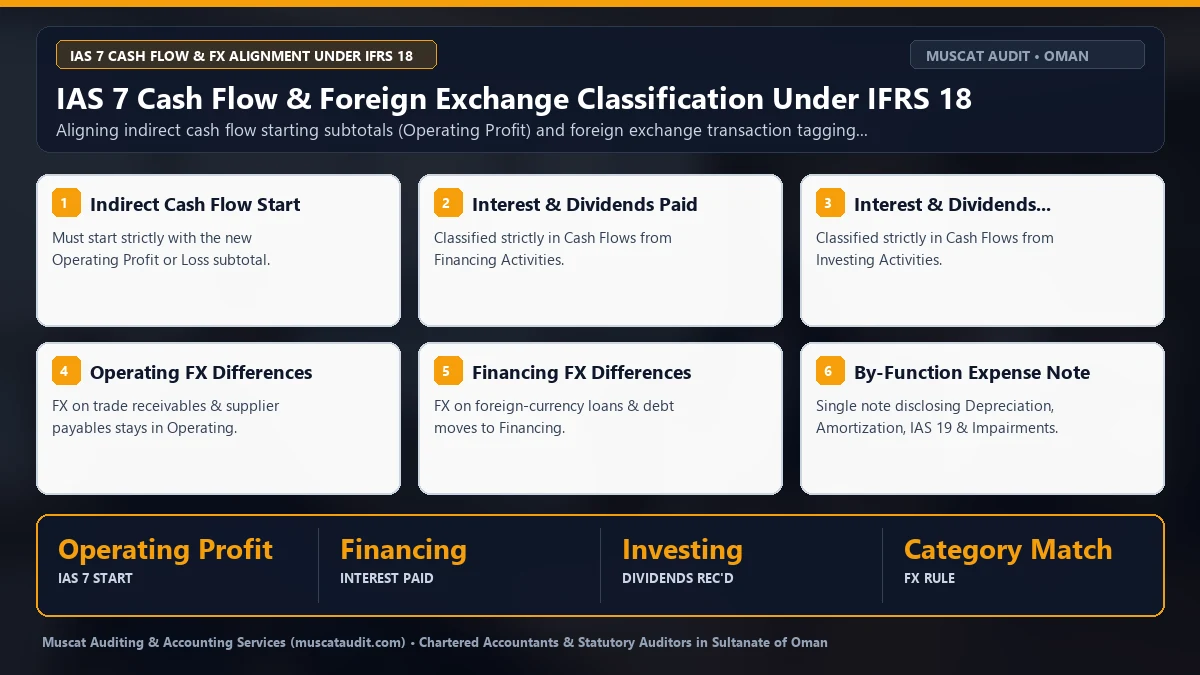
- Mandatory Starting Point for Indirect Cash Flows: Every entity using the indirect method must now begin its Statement of Cash Flows with the new Operating Profit or Loss subtotal—eliminating the previous patchwork where some Omani companies started with Profit Before Tax and others started with Net Profit After Tax.
- Elimination of Classification Options for Interest & Dividends: For non-financial corporates in Oman, interest paid and dividends paid must now be classified strictly inside Cash Flows from Financing Activities, while interest received and dividends received must be classified strictly inside Cash Flows from Investing Activities.
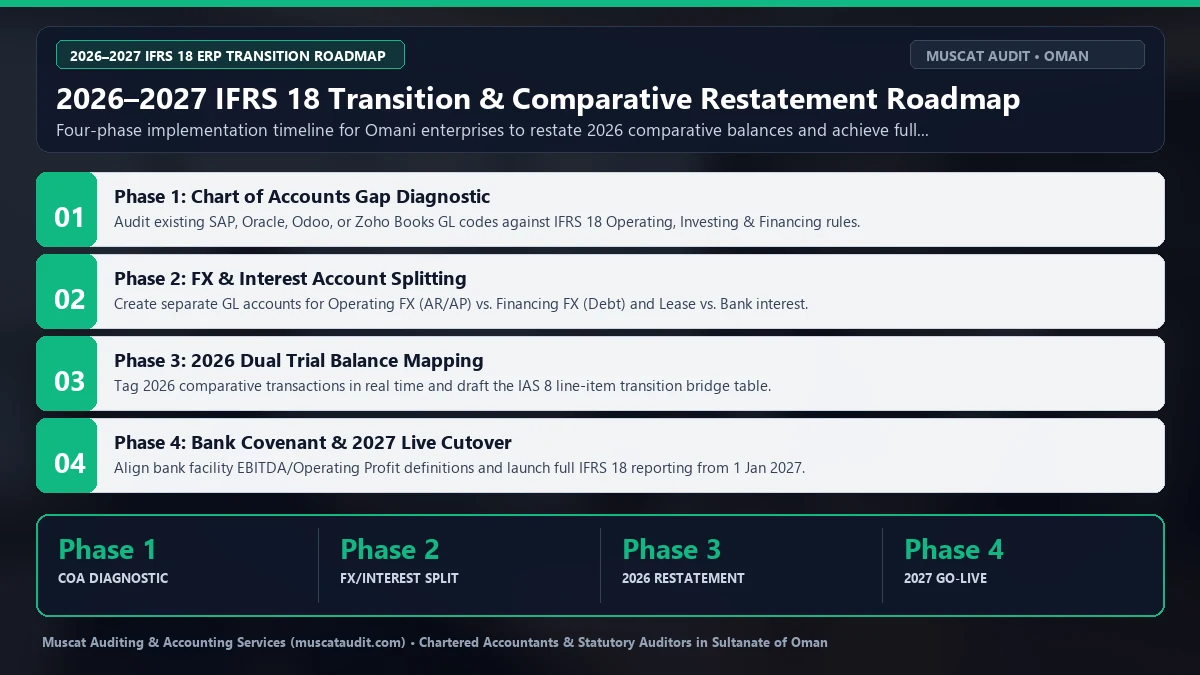
- Foreign Exchange Transaction Tagging in ERP Systems: Because foreign exchange gains and losses must follow the income statement category of the underlying item, your ERP & Accounting Software (SAP, Oracle NetSuite, Microsoft Dynamics 365, Odoo, or Zoho Books) can no longer post all FX revaluation entries into a single generic “FX Gain/Loss” account. You must configure separate GL codes for Operating FX (trade AR/AP), Investing FX, and Financing FX.
6. Mandatory IFRS 18 Rules vs. CFO Transition Recommendations
Mandatory Statutory Requirements in Oman
- Mandatory Effective Date & Retrospective Restatement: Mandatory for annual periods starting 1 January 2027 with full retrospective restatement of 2026 comparative figures and an IAS 8 reconciliation between old IAS 1 and new IFRS 18 line items.
- Mandatory Operating Profit Subtotal: Every Statement of Profit or Loss must present Operating Profit and Profit Before Financing and Income Taxes (except specific banks/insurers under main-business rules).
- By-Function Expense Disaggregation Note: Entities presenting operating expenses by function (COGS, Selling, Admin) must disclose in a single note the total and line-item breakdown of depreciation, amortization, employee benefits (IAS 19), IAS 36 impairments, and IAS 2 inventory write-downs.
- Single Audited Note for All MPMs: Any qualifying Management-Defined Performance Measure communicated publicly must be reconciled and audited inside the financial statement notes.
Professional Best-Practice Recommendations
- Run Dual IAS 1 / IFRS 18 Trial Balances in Q4 2026: Map your 2026 general ledger accounts to IFRS 18 categories before closing your 2026 statutory audit so your 2026 comparative column is already verified.
- Split FX & Interest GL Accounts Now: Create distinct Chart of Accounts codes for Operating FX vs. Financing FX and for Debt Interest vs. IFRS 16 Lease Interest.
- Review Bank Loan Covenant Definitions: Proactively engage your relationship managers at Omani banks to confirm whether EBITDA and Operating Profit covenant definitions freeze on legacy IAS 1 or update to IFRS 18.
- Upskill Your Finance Team: Enroll your financial controllers and senior accountants in specialized Corporate Finance & IFRS 18 Training in Oman.
7. Frequently Asked Questions on IFRS 18 in Oman
When does IFRS 18 become mandatory for companies in the Sultanate of Oman?
Issued by the International Accounting Standards Board (IASB) to replace IAS 1, IFRS 18 is mandatory for annual reporting periods beginning on or after 1 January 2027. However, because IFRS 18 requires full retrospective application under IAS 8, calendar-year Omani companies must capture and restate their 2026 comparative financial data under the new structure.
Does IFRS 18 change how net profit or corporate tax is calculated in Oman?
IFRS 18 does not change the recognition or measurement of individual assets, liabilities, income, or expenses—so your bottom-line net profit remains unchanged. However, it fundamentally changes how income and expenses are classified on the Statement of Profit or Loss (Operating, Investing, and Financing categories) and introduces mandatory new subtotals such as Operating Profit.
What are Management-Defined Performance Measures (MPMs) under IFRS 18?
Management-Defined Performance Measures (MPMs) are subtotals of income and expenses (such as Adjusted EBITDA or Normalized Operating Profit) used by management in public communications outside the financial statements. Under IFRS 18, MPMs must be disclosed in a single audited note to the financial statements, reconciled to the nearest IFRS-defined subtotal, and accompanied by tax and non-controlling interest effects.
How does IFRS 18 affect foreign exchange gains/losses and bank loan interest for Omani importers?
Under IAS 1, many Omani companies grouped all foreign exchange differences together in administrative or finance costs. Under IFRS 18, foreign exchange differences must be classified in the same category (Operating, Investing, or Financing) as the underlying transaction that gave rise to them—meaning FX differences on trade payables belong in Operating, while FX differences on USD debt belong in Financing.
Do Omani SMEs need to adopt full IFRS 18 or IFRS for SMEs?
All MSX-listed SAOGs, regulated financial institutions, SAOCs, and mainland LLCs preparing full IFRS financial statements for the Oman Tax Authority (OTA) and MoCIIP must transition from IAS 1 to IFRS 18. Entities permitted to apply the simplified IFRS for SMEs standard follow the IASB’s separate SME reporting framework unless full IFRS is required by their lenders or shareholders.
Get Your 2026 Comparative Ledgers Ready for IFRS 18
Do not wait until the 2027 audit cycle to reconstruct your 2026 comparative numbers manually. Partner with Muscat Audit’s IFRS & Financial Reporting specialists and Chartered Accountants in Muscat for a complete IFRS 18 gap assessment, Chart of Accounts redesign, and statutory audit readiness review.