
Financial Services Authority (FSA) & Royal Decree 20/2024: New Statutory Audit Oversight and Corporate Governance Rules in Oman
When His Majesty Sultan Haitham bin Tarik promulgated Royal Decree No. 20/2024 establishing the Financial Services Authority (FSA), most corporate executives in Muscat initially viewed the decree as a rebranding of the former Capital Market Authority (CMA). In reality, Article V of Royal Decree 20/2024 executed one of the most consequential regulatory shifts in modern Omani commercial history: it transferred the direct supervision, licensing, and quality inspection of the accounting and auditing profession from the Ministry of Commerce, Industry and Investment Promotion (MoCIIP) to the newly empowered Financial Services Authority (FSA).
For Chief Financial Officers, Audit Committee Chairs, family conglomerate boards, and SME owners across the Sultanate, this structural reform changes how statutory audits are scrutinized. Working with a recognized Top Audit Firm in Oman is no longer merely a box-ticking exercise for Commercial Registration (CR) renewal. Under the FSA’s active field-inspection regime, the credibility of your external auditor directly determines whether your annual financial statements pass muster with the Oman Tax Authority (OTA), domestic and international commercial banks, and institutional tender committees.
1. How Royal Decree 20/2024 Reshaped Audit Regulation in the Sultanate
Prior to March 2024, oversight of Oman’s external audit ecosystem was bifurcated. The former Capital Market Authority supervised auditors accredited to audit public joint-stock companies (SAOGs), insurance companies, and capital market institutions, while MoCIIP administered the general roster of accounting and auditing offices under the Accounting and Auditing Profession Law. By consolidating both mandates inside the Financial Services Authority, Oman aligned its regulatory architecture with international IOSCO and IFIAR (International Forum of Independent Audit Regulators) benchmarks—a key institutional goal of Oman Vision 2040.
Why did regulators consolidate oversight? Over the past five years, Oman has introduced a 5% Value Added Tax (Royal Decree 121/2020), modernized the Commercial Companies Law (Royal Decree 18/2019), overhauled the Labour and Social Protection frameworks (Royal Decrees 52/2023 and 53/2023), and expanded international debt and equity issuances on the Muscat Stock Exchange (MSX). Global institutional investors, credit rating agencies, and the Oman Tax Authority rely on audited financial statements as the primary truth layer of the economy. When an audit firm rubber-stamps incomplete ledgers without performing substantive procedures under International Standards on Auditing (ISA), systemic tax leakage and credit risk follow.
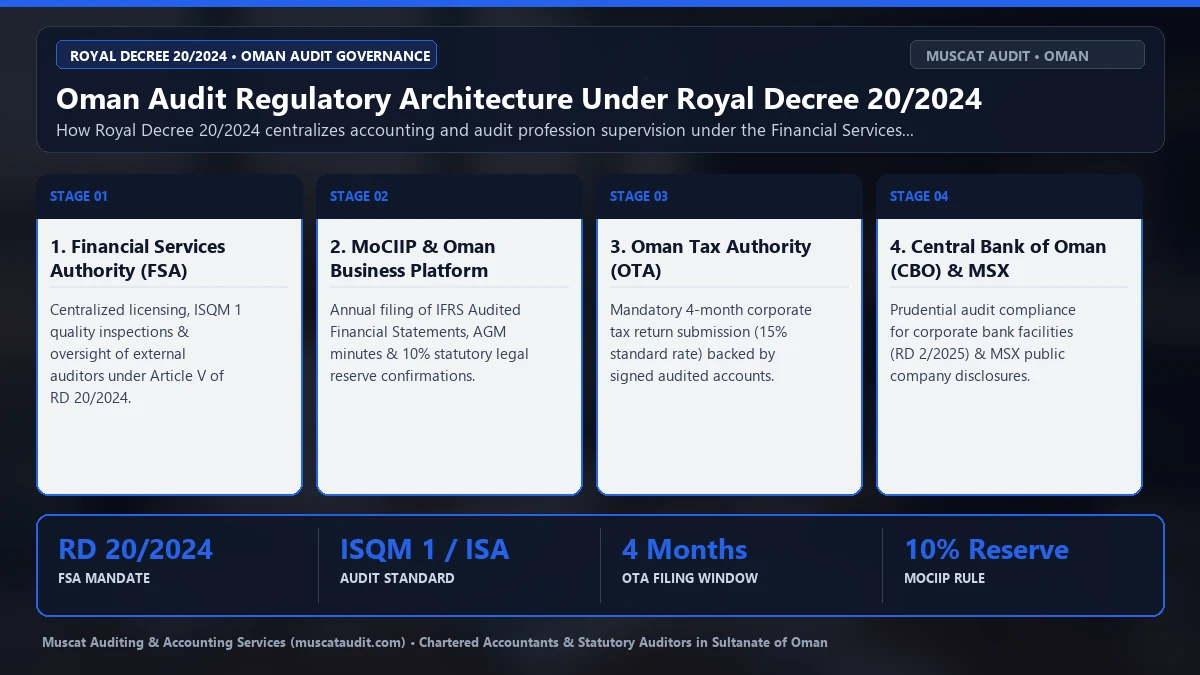
Since assuming jurisdiction, the FSA has stepped up field reviews of practicing audit offices across Muscat, Sohar, and Salalah—verifying partner-to-staff ratios, professional indemnity insurance, Omani nationalization targets within accounting teams, and strict compliance with the International Code of Ethics for Professional Accountants (IESBA). Several non-compliant practices have faced administrative warnings or license suspensions, sending an unmistakable message to corporate boards: verify your auditor’s regulatory standing before signing an engagement letter.
2. Jurisdiction Matrix: FSA vs. MoCIIP vs. Oman Tax Authority (OTA)
One of the most common questions our External & Statutory Audit partners hear from Managing Directors in Al Khuwair and Ruwi is: “If the FSA now regulates auditors, do we file our balance sheet with the FSA, MoCIIP, or the Tax Authority?” The answer depends on your corporate legal form and the specific statutory obligation being satisfied. Each authority governs a distinct pillar of corporate compliance:
| Regulatory Body | Primary Statutory Mandate | Key Governing Legislation | What Your Company Must Submit & Verify |
|---|---|---|---|
| Financial Services Authority (FSA) | Regulates capital markets, insurance, and the accounting & auditing profession; enforces Oman Code of Corporate Governance. | Royal Decree 20/2024; Capital Market & Insurance Laws; Executive Audit Regulations. | SAOGs & regulated entities file quarterly/annual disclosures via MSX/FSA portals; all companies must appoint an auditor licensed under FSA oversight. |
| Ministry of Commerce, Industry & Investment Promotion (MoCIIP) | Commercial Registration (CR) lifecycle, corporate governance of LLCs/SPCs/SAOCs, AGM filings, and UBO register. | Commercial Companies Law (Royal Decree 18/2019); Foreign Capital Investment Law (RD 50/2019). | Upload IFRS Audited Financial Statements, AGM Minutes, and 10% Legal Reserve confirmation on the Oman Business Platform (OBP). |
| Oman Tax Authority (OTA) | Administration of 15% Corporate Income Tax, 10% Withholding Tax, 5% VAT, and Fawtara e-invoicing. | Income Tax Law (RD 28/2009 & RD 9/2017); VAT Law (RD 121/2020); OTA Decision 180/2026. | File Annual Return of Income within 4 months of fiscal year-end (30 April) accompanied by signed IFRS Audited Financial Statements. |
| Central Bank of Oman (CBO) | Prudential supervision of commercial banks, Islamic banks/windows, finance & leasing companies, and PSPs. | New Banking Law (Royal Decree 2/2025); CBO Circulars BM/BI & Basel III/IFRS 9 guidelines. | Commercial borrowers with credit facilities above CBO thresholds must submit audited financial statements to their lending banks annually. |
As the matrix illustrates, your company’s statutory audit report is a single foundational document that feeds three or four separate regulatory pipelines simultaneously. If you need step-by-step guidance on uploading your signed accounts to the Ministry portal, review our companion briefing on MOCIIP Audited Financial Statements Filing & CR Renewal on the Oman Business Platform.
3. ISQM 1 Quality Management & Field Inspections of Audit Working Papers
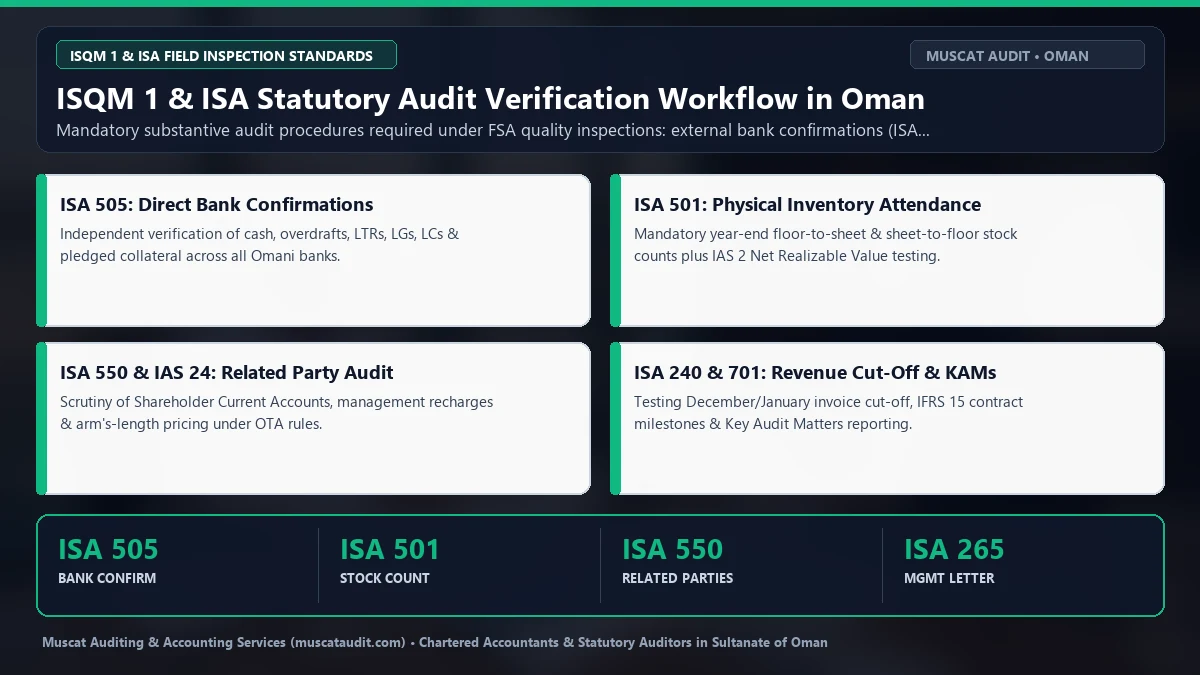
Under the FSA’s supervisory framework, every licensed audit practice in Oman must operate a documented System of Quality Management compliant with International Standard on Quality Management 1 (ISQM 1) and conduct every statutory audit in strict accordance with International Standards on Auditing (ISA). What does that mean in practice for an Omani business preparing for its year-end audit?

A. Direct External Confirmations (ISA 505)
Auditors can no longer rely solely on PDF bank statements downloaded by the client’s accountant. Under ISA 505, your external auditor must obtain direct independent confirmations from all Omani commercial and Islamic banks (such as Bank Muscat, Sohar International, National Bank of Oman, Bank Nizwa, and Ahlibank) covering cash balances, overdraft limits, letters of guarantee, letters of credit, and pledged collateral as of 31 December.
B. Mandatory Physical Inventory & Fixed Asset Attendance (ISA 501)
Where inventory or industrial spare parts represent a material balance on your balance sheet—common across Rusayl Industrial Estate manufacturers, Barka logistics hubs, and Muttrah trading houses—the auditor is required under ISA 501 to attend the year-end physical stock count in person, perform test counts from floor-to-sheet and sheet-to-floor, and inspect slow-moving or obsolete stock for Net Realizable Value (IAS 2) write-downs. Companies that appoint their auditor in March after the year has already closed risk receiving a Qualified Audit Opinion due to limitation of scope on opening/closing inventory.
C. Related-Party & Shareholder Current Account Scrutiny (ISA 550 & IAS 24)
In many Omani family-owned LLCs and closely held SAOCs, partners frequently route operational expenses or inter-company advances through a “Shareholders’ Current Account” or “Due from Related Parties” ledger. Both the FSA and the Oman Tax Authority (OTA) heavily scrutinize undocumented related-party balances. Under OTA corporate tax rules and Decision 180/2026, unsubstantiated management charges, non-arm’s-length interest, or personal shareholder withdrawals disguised as business expenses are disallowed and added back to taxable profit at 15%.
4. Practical Impact on MSX-Listed SAOGs, Closed SAOCs, and Mainland LLCs
Let us examine a practical Muscat case scenario to illustrate how FSA oversight interacts with commercial law and tax compliance. Consider an Omani industrial engineering group structured as a Closed Joint Stock Company (SAOC) in Ghala with paid-up capital of OMR 1,200,000 and annual revenue of OMR 6,800,000, alongside two wholly owned Limited Liability Company (LLC) subsidiaries.
- Auditor Appointment at the AGM: Under the Commercial Companies Law (Royal Decree 18/2019), the shareholders must formally appoint the external auditor at the Annual General Meeting (AGM) and fix the audit remuneration. Under the updated FSA oversight framework, the company secretary must verify that the audit firm holds an active license appropriate for the entity’s classification before registering the appointment on the Oman Business Platform.
- Audit Partner & Firm Rotation: To prevent familiarity threats under the IESBA Code of Ethics and Oman’s corporate governance rules, regulated entities and joint-stock companies must track consecutive audit tenure and rotate their engagement partner and audit firm within statutory limits.
- Separation of Non-Audit Services: An external audit firm performing your statutory audit under ISA cannot simultaneously act as management by preparing the primary books of account or making executive valuation decisions that it will subsequently audit (the “self-review threat”). Instead, businesses should segregate their Accounting & Bookkeeping Services or Internal Audit & Risk Advisory under strict independence walls, or engage an independent advisory team for pre-audit IFRS readiness.
5. Mandatory Legal Obligations vs. Governance Best Practices
When advising Boards of Directors and General Managers across Oman, we clearly distinguish between non-negotiable statutory mandates that carry legal or administrative penalties and professional governance recommendations that strengthen internal controls and creditworthiness:
Mandatory Statutory Requirements in Oman
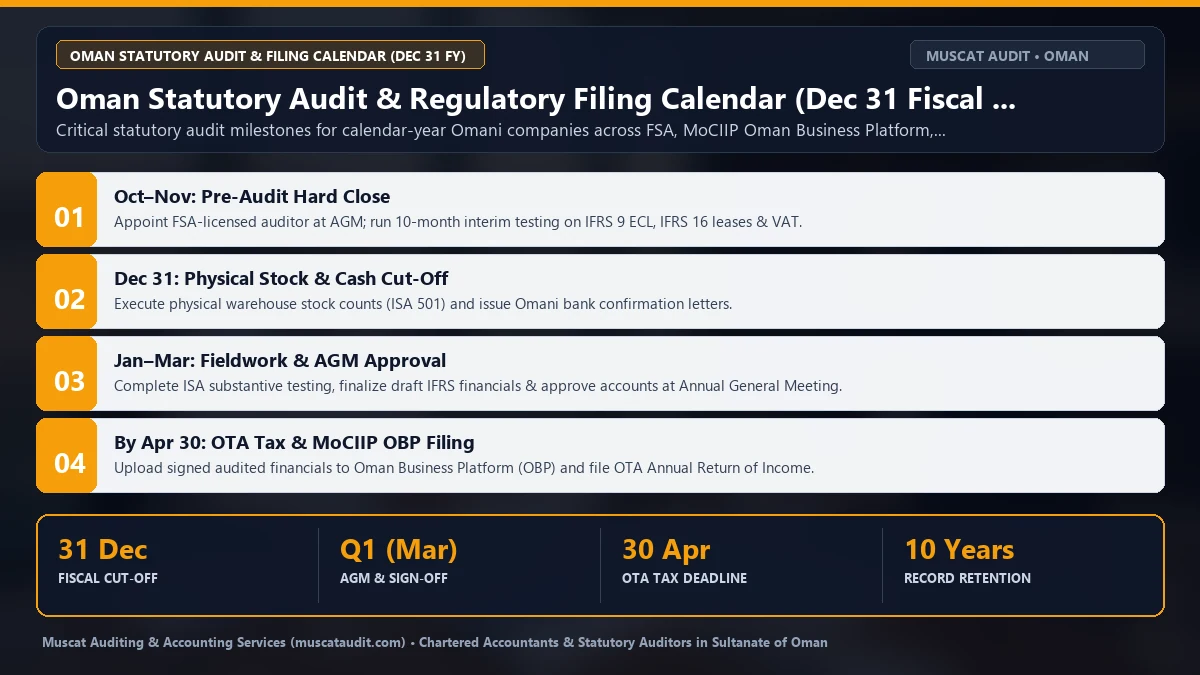
- Licensed External Auditor: Every SAOG, SAOC, LLC (meeting statutory thresholds), and Foreign Branch must appoint an external auditor licensed in the Sultanate of Oman under FSA/MoCIIP regulations (Commercial Companies Law RD 18/2019).
- IFRS Financial Statements in OMR: Formal financial statements must be prepared on an accrual basis in full compliance with International Financial Reporting Standards (IFRS) in Omani Rials (unless foreign currency reporting is officially authorized).
- 4-Month OTA Tax Filing Deadline: Audited financial statements must be submitted with the Annual Return of Income via the Oman Tax Authority portal within 4 months of financial year-end (30 April for calendar-year companies).
- 10% Statutory Legal Reserve: Companies must allocate 10% of net profit after tax to a non-distributable Legal Reserve until it reaches one-third (33.33%) of paid-up share capital (Articles 132 & 224, RD 18/2019).
Professional Best-Practice Recommendations
- Pre-Year-End Hard Close (October–November): Perform a 9-month or 10-month interim audit close before 31 December to resolve IFRS 9 ECL provisions, IFRS 16 lease schedules, and VAT reconciliations early.
- Independent Audit Committee Charter: Even for large family LLCs and closed SAOCs where not all MSX public listing rules apply, establishing a formal Audit & Risk Committee strengthens bank financing terms.
- Four-Way Tax Reconciliation Working Paper: Reconcile IFRS audited revenue against the four quarterly OTA VAT returns, customs Bayan import declarations, and WPS/SPF payroll filings prior to audit sign-off.
- ISQM 1 Engagement Letter Verification: Request confirmation of your auditor’s active FSA accreditation and professional indemnity coverage prior to AGM appointment.
6. Board & CFO Checklist for Appointing Your External Auditor
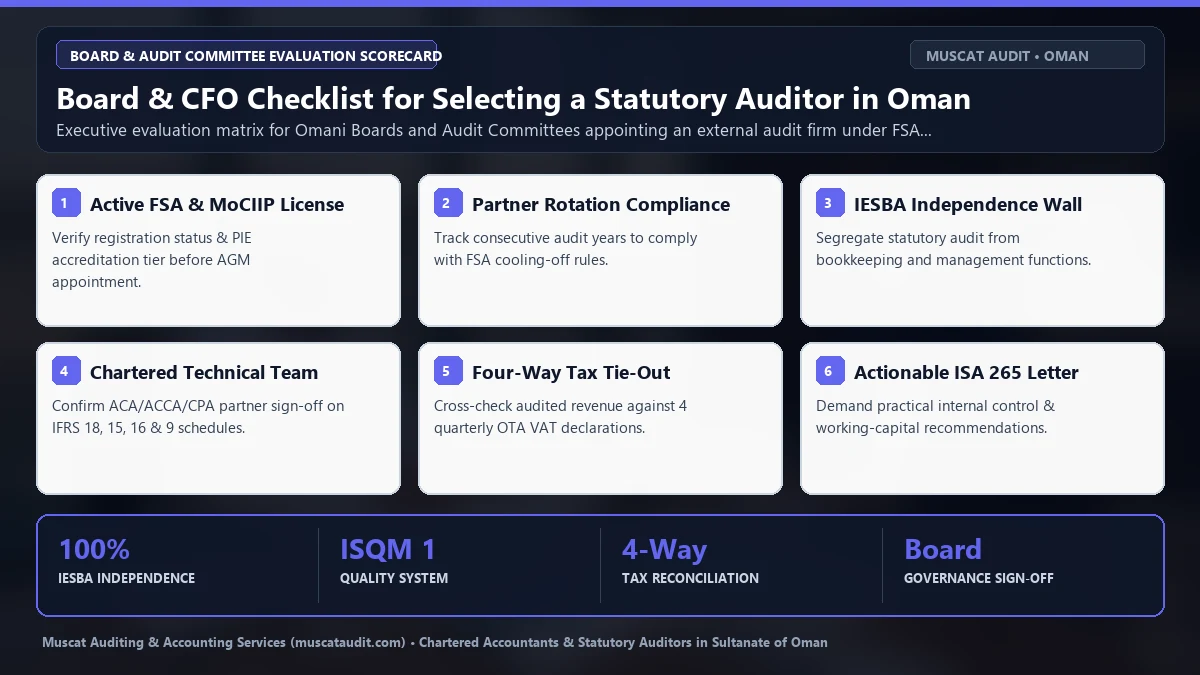
Before your shareholders convene their next Annual General Meeting or renew your existing audit mandate, evaluate your prospective audit partner against five rigorous criteria:
- Active FSA & MoCIIP Accreditation: Confirm that the firm is duly registered and authorized to sign statutory audit reports on the Oman Business Platform and accepted by all Omani commercial banks and the Oman Tax Authority.
- Depth of Technical IFRS & Tax Capabilities: Ensure the engagement team includes qualified Chartered Accountants (CA, ACCA, CPA) who understand complex standards—including IFRS 18 Financial Statement Presentation, IFRS 15 revenue recognition, and OTA corporate tax deductibility rules.
- Sector-Specific Experience in Oman: Auditing an EPC contractor in Duqm, a healthcare group in Muscat, or an oilfield services joint venture requires specialized industry audit programs rather than generic checklists.
- Transparent Audit Timeline & Management Letter Value: A high-quality statutory audit delivers more than a signed opinion; it provides an actionable Management Letter (ISA 265) highlighting internal control weaknesses, regulatory and compliance gaps, and working capital efficiencies.
- Strict Independence & Ethical Safeguards: Verify that there are no conflicts of interest or prohibited non-audit services that could compromise the validity of the Independent Auditor’s Report during an FSA or OTA inspection.
7. Frequently Asked Questions on FSA Audit Compliance
What did Royal Decree 20/2024 change for the accounting and auditing profession in Oman?
Under Article V of Royal Decree 20/2024, the Sultanate of Oman established the Financial Services Authority (FSA) to replace the former Capital Market Authority (CMA) and formally transferred the mandate for regulating, licensing, and inspecting the accounting and auditing profession from the Ministry of Commerce, Industry and Investment Promotion (MoCIIP) to the FSA.
Does my Omani LLC still file audited financial statements on the Oman Business Platform?
Yes. While the Financial Services Authority (FSA) now regulates the licensing, quality assurance, and professional standards of external auditors in Oman, commercial entities (LLCs, SPCs, and SAOCs) continue to deposit their annual audited financial statements and AGM minutes through the Oman Business Platform (OBP) administered by MoCIIP, as well as with the Oman Tax Authority (OTA).
Which entities require an FSA-accredited audit firm for Public Interest Entity (PIE) audits?
Public Joint Stock Companies (SAOGs) listed on the Muscat Stock Exchange (MSX), insurance and takaful operators, capital market institutions, investment funds, and specific regulated financial entities must appoint external audit firms specifically accredited on the FSA register for regulated entities.
What are the mandatory audit partner and audit firm rotation rules under Omani governance regulations?
For public joint stock companies (SAOGs) and regulated entities overseen by the FSA, Oman’s corporate governance framework restricts the continuous engagement of the same external audit firm to a maximum number of consecutive financial years (typically four consecutive years, followed by a mandatory two-year cooling-off period) to safeguard auditor independence.
How does an FSA audit quality inspection affect corporate clients in Muscat?
The FSA conducts field inspections of audit working papers under International Standards on Auditing (ISA) and ISQM 1. If a company appoints an non-compliant or unlicensed auditor whose registration is suspended, its statutory financial statements may be rejected by the Oman Tax Authority, commercial banks, and MoCIIP.
Partner with an Accredited Statutory Audit Firm in Muscat, Oman
Whether your organization is a listed corporate entity, a closely held SAOC, a high-growth SME, or a foreign branch operating in the Sultanate, Muscat Auditing & Accounting Services delivers ISA-compliant statutory audits, IFRS financial reporting assurance, and Oman Tax Authority compliance.